Dive Brief:
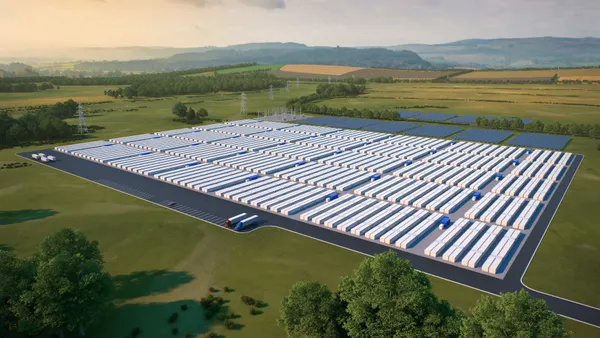
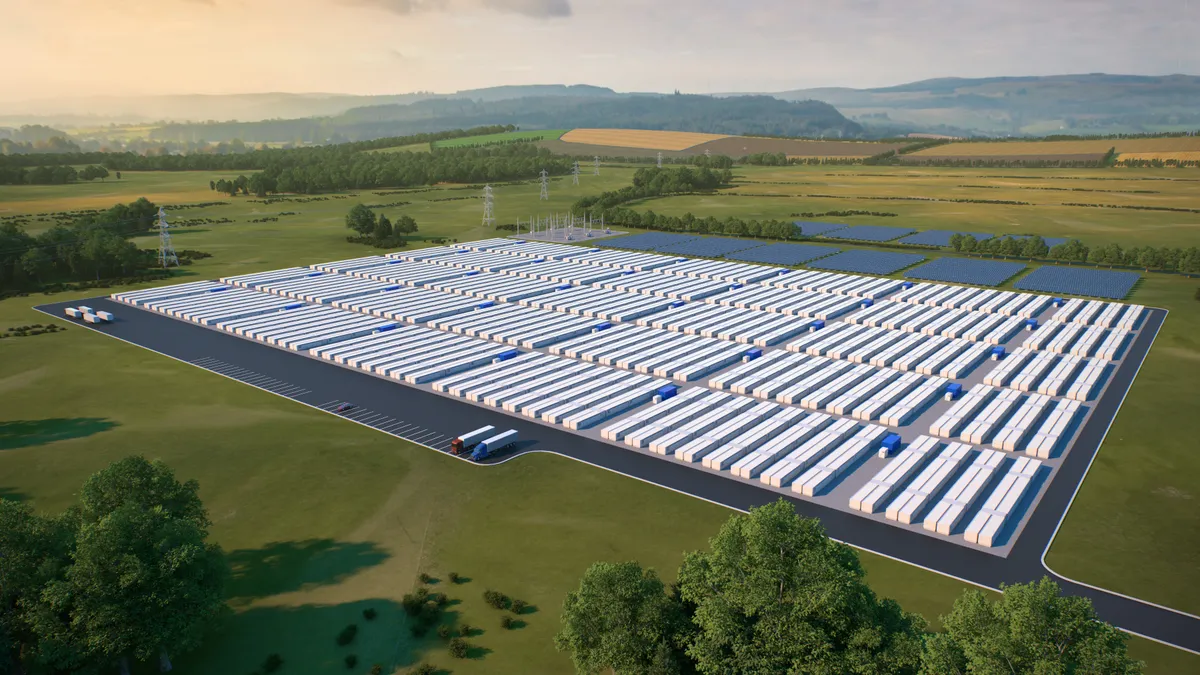
- Google and Xcel Energy said last week that they intend to build what Xcel calls “the largest battery project by gigawatt-hour energy capacity announced to date in the world” to support a data center in Minnesota powered by 1.6 GW of renewable energy.
- The 300 MW/30 GWh battery, built by Form Energy, will use iron-air chemistry to deliver multiday discharge during periods of high power demand, Xcel said. Form says its technology can deliver cost-effective discharge for up to 100 hours.
- Mateo Jaramillo, Form Energy’s CEO, said in an interview this week that his company expects to ship the first modules by the end of 2028 and pursue projects of similar scale as its West Virginia factory ramps up production later this decade. “This is really the scale of project that we expect to bid and participate in going forward,” he said.
Dive Insight:
The agreement outlines the deployment of 1,400 MW of wind, 200 MW of solar and Form’s 300-MW battery on Xcel’s Upper Midwest grid.
Kevin Coss, a utility spokesperson, said Xcel had not yet determined where it will deploy Form’s modules nor whether the entire 300-MW capacity will comprise a single installation “or multiple smaller installations.” Xcel does not anticipate installing “any part of the battery capacity included in this agreement” behind the meter at Google’s data center, which will be located in a rural area about 70 miles southeast of Minneapolis-St. Paul.
Xcel values long-duration energy storage for its ability to bridge periods of low wind and solar generation, “such as during the middle of winter when we can see several days of cloudy weather with very little wind,” Coss said. The utility plans to continue including the technology in future integrated resource plans, he added.
Google said it will pay all costs associated with the buildout through a new rate structure modeled after the Clean Transition Tariff it worked out with NV Energy in 2024 to support its Nevada partnership with Fervo Energy, an enhanced geothermal developer. Xcel said the companies will file the tariff with Minnesota regulators “in the coming weeks.”
The latest announcement appears to be part of Google’s strategy to acquire power for its data center operations at a time of grid constraints and fierce competition for capacity. Alphabet, Google’s parent company, paid $4.75 billion in December to acquire Intersect, a clean energy developer. Google and TPG Rise Climate inked a $20 billion with Intersect in late 2024 to develop “energy parks” supported by renewables and energy storage.
As part of its agreement with Xcel Energy, Google will also provide $50 million to support the utility’s Capacity*Connect program. Capacity*Connect is a novel proposal to site front-of-the-meter batteries at strategic locations to alleviate congestion and defer costly upgrades on Xcel’s distribution grid.
Minnesota regulators are now weighing the Capacity*Connect plan, the first commercial phase of which calls for 50 MW to 200 MW of batteries to be installed in 1-3 MW increments by 2028.
Ratepayer advocates in Minnesota — including the state attorney general — have raised concerns about the proposal, questioning why Xcel expects the Capacity*Connect program to cost significantly more than its Colorado subsidiary’s proposal for a distributed capacity program with similar objectives. An Xcel spokesperson pushed back in an email to Canary Media last month, noting the Minnesota proposal is more complex than the Colorado proposal and has a much longer time horizon.
Either way, Form Energy does not plan to participate in the Capacity*Connect program “as of now,” Jaramillo said.
In 2023, Minnesota regulators approved a 10 MW/1 GW Form battery at the site of the 1,879-MW Sherco coal-fired power plant that Xcel plans to retire in phases by 2030. Form also has a 1.5 MW/150 MWh project in development with Great River Energy, a Minnesota generation and transmission cooperative.
Form has been operating its commercial production facility on the site of a former West Virginia steel mill for about two years. The company has produced more than 100,000 electrodes, which resemble “very large brake pads,” along with “tens of thousands” of cells and other components, Jaramillo said.
“It turns out that’s how many you need to make to establish process control and make sure we can produce at scale,” he said.