
When the general public drives past a substation at peak demand, they probably don’t realize a whole region's worth of power might be moving through it, held in balance by the people who run it. Grid operators are some of the best problem-solvers I know, and with large loads coming online all across the country, they are being handed a new kind of problem. Unprecedented loads are showing up in months, on a grid that takes years to expand.
A familiar problem at a new scale
AI data centers, new factories, and the electrification of cars and buildings are driving the fastest demand growth in a generation. A single data center campus can ask for more power than a mid-sized city, and sometimes more than the entire state. The waiting line to connect new projects has grown so long that a customer who has already signed often won’t be served on time. Building new capacity is the fix, but it takes years, and the load won’t wait.
The grid itself is changing too. Conventional power plants use large turbines and generators whose rotating mass acts as a shock absorber against sudden swings in frequency. As those aging plants retire and more power comes through electronics instead of spinning machines, that cushion shrinks, and the grid needs faster-responding resources to stay steady.
Flexibility is becoming a grid resource
Regulators see it. In June, FERC told regional grid operators to revisit the rules for connecting large new loads, and to make room for customers that can raise and lower their demand on request. The message is directly aligned with the premise of what we build at Torus: loads that can flex, and resources that respond fast, are becoming an essential part of how the grid stays balanced. For a utility, a big customer's flexibility has to be accounted for in the plan.
There is real money to be saved in that flexibility. A new University of Utah study modeled the Western grid and found that running data centers more flexibly could save the system an estimated $62 million a year in operational costs through off-peak scheduling alone, and as much as $590 million with regional coordination and on-site energy infrastructure added. One of the researchers, Mohammad Amin Mirzaei, summed it up well: "Instead of shipping electricity across overloaded lines, you ship the computation."
Match the resource to the problem
Most large loads cannot do that, though. A factory or a hospital cannot move to another part of the country when the local grid is strained. For them, and for the utility serving them, flexibility has to come from scheduling, from controls, and from energy kept on-site. That is where fast storage earns its keep.
The right design depends on the shape of the problem, and speed matters as much as size. Batteries are a good fit for events that last minutes to hours. At Torus, we add rotational inertia to ours. The idea behind a flywheel energy storage system is centuries old: store energy in a spinning mass. Pair that old principle with modern power electronics and a flywheel can take in or send out power in milliseconds. Run together, the flywheel takes the fast, repeated hits and the battery handles the longer stretches. The result is a resource that holds voltage and frequency steady, at a substation or across enrolled customer sites, and answers a utility's call to ease off when the grid is stressed.
For a utility deciding where storage like this fits, three questions help:
- Where is the constraint, and what is it costing? A congested line, a shortage of capacity, and a power-quality problem each call for a different design. Start with the data.
- How fast, and for how long, does the resource need to respond? Power and energy are not the same thing. Size it for both the speed of the event and how long it lasts.
- How will it count? That depends on program enrollment, demand response, and how much firm capacity the system earns credit for.
Turn relationships into capacity
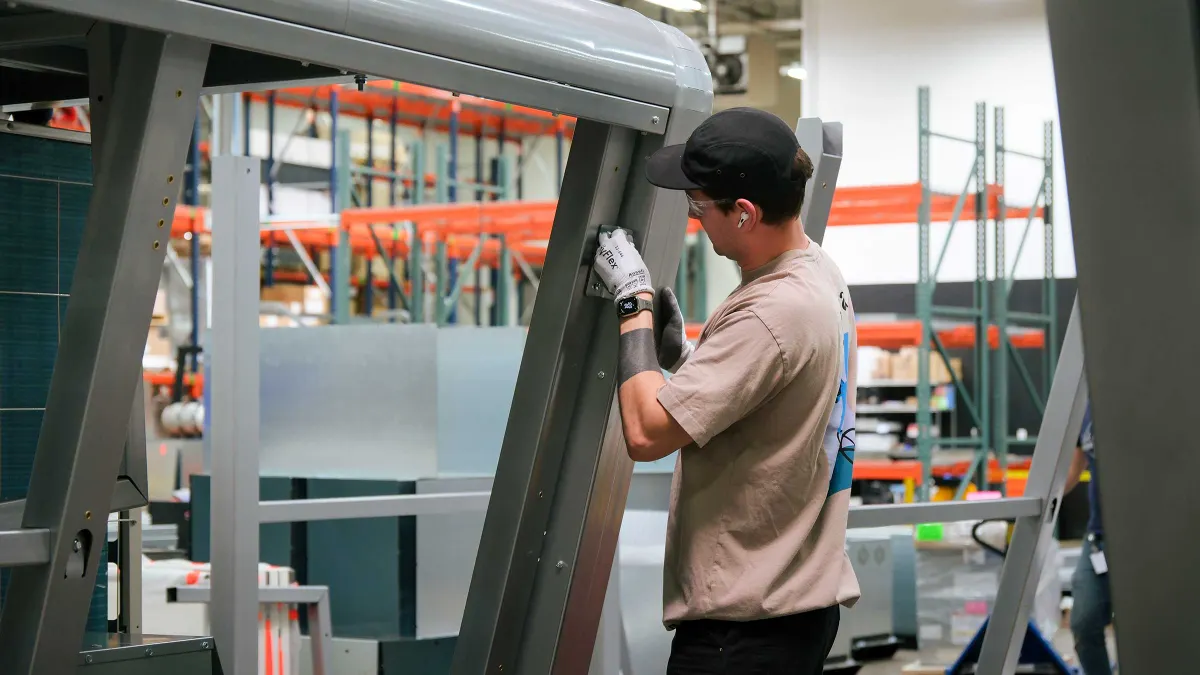
None of this replaces the long job of building out the grid. It buys time while that work goes on, and it puts capacity where the need is sharpest. Our own systems are built in Utah and go from a signed contract to running in 12 to 16 weeks, which gives a utility another option on a timeline that matches how fast the load is arriving.
Utilities have spent decades managing hard loads alongside their biggest customers. The chance now is to turn those relationships, and the programs already in place, into capacity the grid can call on, fast enough to keep up with what is coming.