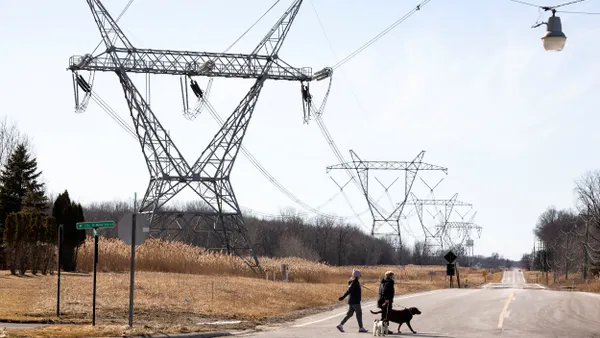

Utilities and grid operators are facing load growth projections that would have seemed implausible just five years ago. For example, as of last November, the Electric Reliability Corporation of Texas (ERCOT) reported that large loads seeking interconnection by 2030 would increase the peak demand served in ERCOT by 142 gigawatts, or nearly tripling its present-day demand.
Potential load growth isn’t just big in Texas. Nationally, the demand for grid power from data centers is expected to top 134 gigawatts by 2030, triple the amount needed in 2024. While it’s true that not all interconnection requests turn into actual projects, it’s undeniable that demand for electricity is growing quickly. This rapid load growth, much of it on unprecedentedly fast timelines, challenges utilities in many ways, including how they approach resource planning.
Rapid load growth highlights the necessity to move away from static and siloed scenario planning towards a more holistic planning approach that better captures benefit estimates, critical interdependencies, and unavoidable uncertainties. “Utilities are trying to determine what they’re going to power all the load growth with, and to do that, you need robust analysis that helps you determine the no-regrets investments you need to make to serve that load,” said Matthew Lind, director of resource planning and market assessments at 1898 & Co.
More specifically, Lind says unprecedented load growth underscores the need for resource planning that acknowledges the sheer scale of the necessary investments, considers the uncertainties of which projects get built and which don’t, and seriously grapples with cost allocation for projects that impact more than just a single investment segment (e.g. generation, transmission or distribution). For developers seeking to build new projects in this environment, critical questions must be answered:
- Beyond the initial interconnection study and network upgrade costs, how are you assessing the long-term risk of congestion and curtailment?
- How will constraints in seemingly unrelated infrastructure, like natural gas pipelines, affect your project's viability?
Planning for a grid in motion
Traditional resource planning and generation development have often looked at solving only supply and demand. Focusing planning exclusively on securing enough generation to meet demand is far too limited in a time of such rapid load growth. It also misses the costs and role of delivering energy to serve demand. “If you don’t bring in the delivery piece, you’re going to miss a lot of the costs,” Lind said. “You’ve got to look at the planning paradigm holistically, not just in the silo of solving for generation and demand.”
This is where integrated system planning becomes essential, as it moves beyond siloed analysis to model the interdependencies between generation, transmission, and distribution. Utility executives must convey strategic decision-making, answering questions like: Are your multi-billion-dollar investment decisions resilient enough to withstand a future where today's load forecasts do not fully materialize? How do your decisions hold up when the underlying market conditions may shift dramatically before the asset is even online?
Holistic planning requires considering factors well beyond a utility’s service territory, and even outside the electricity system itself. For example, the U.S. Energy Information Administration (EIA) expects 6.3 GW of new gas generation capacity to be added in 2026, with demand for gas to meet load growth remaining high through 2030. That level of gas-powered power generation inevitably puts pressure on already-constrained pipeline infrastructure. Modeling those interdependencies between gas and electric systems and across organized energy markets improves assessments about whether potential investments are necessary and prudent.
Building a baseline for an uncertain future
The former New York Yankee Yogi Berra famously said, “It’s tough to make predictions, especially about the future.” While that’s as true in resource planning as it is in baseball, there are ways to test potential investments against a variety of potential future scenarios.
That starts with building a baseline that can account for rising market interdependency. Whether connecting intermittent energy supplies or accommodating massive new data centers, a modern grid requires a starting point model that represents the interconnected market. This means covering all ISO, RTO, and non-RTO territory in the U.S. to establish how energy may be transacted over the next several decades. Using that foundation, resource planners and developers can then begin integrating a range of variables, like the trajectory of gas prices, technology costs, and demand that rises or falls short of expectations. With that foundation, possible investments can be evaluated against many futures rather than a handful of scenarios.
Resource planners are aware of the many uncertainties that challenge their work. While the question marks may build pressure for planners to continuously reassess, the reality is that many of the largest investments needed to serve demand — from new transmission to gas capacity — take over a decade to permit, finance, and build. When those assets finally come online, the market conditions may have shifted dramatically. It doesn’t matter how often planning is revisited once a project is underway. Planning with a solid baseline and myriad scenarios helps explain and justify investment decisions, no matter how much conditions change. “The more dollars associated with your decisions, the more robust your analysis should be,” Lind said.
Utilities are nearing a phase of serious regulatory scrutiny. Companies are projected to invest between $1.1 trillion and $1.4 trillion in grid infrastructure by 2030, about double the previous decade’s spending. That amount of spending, including its impact on utility rates, has not been fully tested in rate cases yet. But when that happens, regulators, commissions, and ratepayers will demand to know what assumptions planners used to propose investments and what alternatives were considered.
Rigorous planning is the one thing utilities and developers can control with certainty during an uncertain time. “The more you have a robust planning basis to tell your story, the easier it is to find a buyer or gain regulatory approval for your project,” Lind said.
Contact 1898 & Co. to discuss how a robust, integrated planning approach can help identify no-regrets infrastructure solutions and prepare your organization for the future.