Revenue per kilowatt hour for electricity — a proxy for retail rates — rose 9% on average this February compared to the same month last year — rising by 26.3% in Virginia, 21.9% in Ohio and 19.5% in Pennsylvania, according to a Thursday report from the U.S. Energy Information Administration.
“Total average revenues per kWh increased by 9.0% from last February, to 14.36 cents/kWh in February 2026,” EIA said. Residential retail prices of electricity went up 7.4% year-over-year.
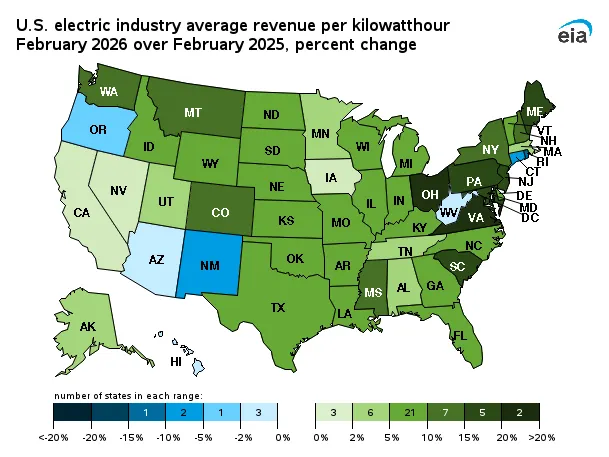
All four sectors — residential, commercial, industrial and transportation — saw increases in average revenues per kWh compared to last February. “The Transportation sector saw the highest increase, up 23.6%, then the Commercial sector, up 10.7%, followed by the Industrial sector, up 8.6%, and finally the Residential sector, up 7.4%,” EIA said.
More electricity was also sold year-over-year this February, the agency found, and total net generation went up 1.2%.
“Thirty-one states and the District of Columbia saw an increase in retail sales volume in February 2026 compared to last February. Rhode Island had the highest year over year percent increase in retail sales, up 31%,” EIA said. Nineteen states saw a decrease in sales, led by Montana, which was down 10.8%.
EIA also found that “the Northeast and Mid-Atlantic saw sizable shifts to other fossil fuels being used to generate electricity this February compared to the previous year.” Coal consumption fell nationwide by 11.3% that month, while natural gas consumption went up by 1.5%
Due to below-average temperatures in the East and above-average temperatures in the West, wholesale electricity and natural gas prices saw “a large range” in the East and a “tight spread” in the West in February, EIA said.
“In February 2026, Southern Company and Progress Florida experienced the largest monthly ranges in daily peak electricity demand of all the selected electricity systems in the country. This occurred as these two electricity systems experienced cold snaps in early February 2026 that resulted in significantly increased demand for electricity,” the agency said.