Dive Brief:
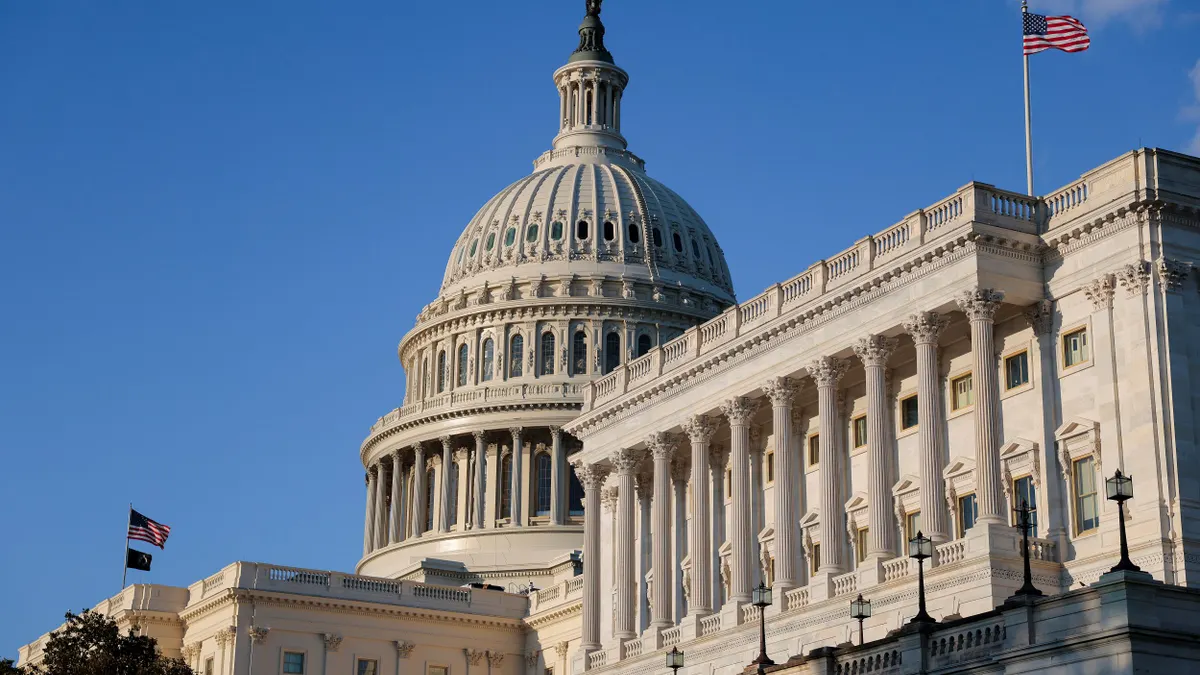
- A coalition of local, state and regional business and economic development groups descended on Washington, D.C., this week to push for federal permitting reform legislation ahead of midterm elections in November.
- In meetings with members of Congress and staff on Tuesday and Wednesday, the Chambers for Innovation and Clean Energy emphasized that fair and predictable permitting would unlock investment in the generation and transmission infrastructure needed to meet expected load growth and check rising power prices, Rob Bradham, CICE’s policy director, told Utility Dive in an interview.
- CICE and other groups are hoping to spark renewed momentum on permitting reform after the Standardizing Permitting and Expediting Economic Development Act, or SPEED Act, stalled in recent months, Bradham said. There’s room for a compromise measure as part of a continuing resolution or other must-pass legislation in 2026, he added.
Dive Insight:
The SPEED Act passed the U.S. House of Representatives in December with support from 11 Democrats and all but one Republican.
It lacked a companion bill in the U.S. Senate, however, and key upper chamber Democrats pulled out of negotiations after the Trump administration’s Dec. 22 order halting work on the five offshore wind projects under construction off the East Coast. One of the lawmakers, Hawai'i Democratic Sen. Brian Schatz, said the Trump administration would also need to lift what he called a “national solar ban” on public-lands projects for his party to engage on permitting reform.
On March 5, Democratic Sens. Martin Heinrich of New Mexico and Sheldon Whitehouse of Rhode Island said they would resume permitting reform negotiations following “recent developments … indicative of a positive direction from the Trump administration.”
“As we move forward, we expect that there will be no further interference with already-permitted wind projects and that the initial movement we’ve seen on solar project permitting will accelerate,” they said.
While there have been few substantive announcements on the negotiations since then, “permitting reform is something that has been bubbling underneath the surface, a constant topic of discussion here in D.C.,” Bradham said. “Sometimes these things come together in unexpected ways.”
In its public messaging and conversation with members of Congress, CICE is emphasizing the local and regional economic benefits of clean energy development, Bradham said. After more than a dozen consecutive quarters of year-on-year growth, clean energy investment slipped by 11% in the fourth quarter of 2025, according to the Rhodium Group.
“Smarter permitting means more jobs,” Bradham said.
Utility-scale energy projects can take many years to pass environmental review and secure the necessary federal air, water and land permits. The 3.5-GW SunZia wind and transmission project, which began exporting power to the Western grid earlier this month, took about 15 years to permit and spent several more in construction.
SunZia received its final permits and began construction during the Biden administration. The second Trump administration, in contrast, has broadly favored fossil and “baseload” energy projects over inverter-based renewables such as wind and solar.
In July, soon after Trump signed a bill rescinding or curtailing federal tax credits for intermittent renewables and then issued an executive order further constraining their development, the U.S. Department of the Interior said all wind and solar projects on federal land would require Secretary Doug Burgum’s approval. Federal permitting slowed dramatically in the months following the announcement, though some individual solar projects have continued to advance.
A federal judge in Massachusetts halted the policy on Tuesday. The Interior Department did not immediately say whether it would appeal the ruling.
CICE’s members want fairness and certainty in federal permitting, Bradham said. He likened permit approvals to a “promise” that project investors, developers and suppliers rely on for certitude. He said it’s reasonable for his members to ask that clean energy projects come in for the same treatment from permitting authorities as fossil energy projects.
“Tell me what the rules are and we’re happy to comply. That’s all we’re asking,” Bradham said.