Dive Brief:
- A newly expanded residential battery partnership between Guadalupe Valley Electric Cooperative and distributed battery storage company Base Power will provide the South Texas utility with 50 MW of capacity across its service territory, the companies said last week.
- The announcement builds on a 2-MW pilot project that demonstrated distributed batteries’ potential to enhance system flexibility and performance, GVEC General Manager and CEO Darren Schauer said on April 13.
- “The industry is moving toward distributed, aggregated resources that can be deployed quickly and at scale … this model [is becoming] a practical tool for reliability and system flexibility in Texas and beyond,” Tim Pianta, Base Power’s head of utility partnerships, said in an email.
Dive Insight:
GVEC aims to have 20 MW of distributed battery capacity online by the end of 2026 and subsequently add 15 MW to 20 MW per year through its partnership with Base Power, Schauer told Utility Dive in an interview.
GVEC participates directly in the Electric Reliability Council of Texas wholesale power market, a practice Schauer said is “relatively unusual” for distribution cooperatives that more often procure power through generation and transmission cooperatives.
Procuring 50 MW from Base Power would put the Austin, Texas-based company on par with the other providers GVEC purchases wholesale power from, Schauer said.
“Generally, we buy in 50-MW to 100-MW increments,” he said.
Schauer said GVEC serves about 100,000 customer meters across a 3,500 square-mile territory spanning suburban, exurban and rural communities east of San Antonio. Demand peaks between 500 MW to 600 MW in the summer but can spike to around 800 MW during winter cold snaps due to customers’ reliance on electric resistance heating to back up heat pumps, he said.
Cold snaps, as well as summer heat waves, can dramatically increase wholesale power prices in ERCOT’s energy-only market. During a prolonged winter storm in February 2021, market forces pushed clearing prices to $1,200/MWh before the Public Utilities Commission of Texas raised them further, to the legal maximum of $9,000/MWh, in a bid to bring more generation online.
Texas had 13.9 GW/22.9 GWh of grid-scale battery energy storage capacity at the end of 2025, most of which has come online since 2023, according to data analytics firm Modo Energy. Energy price volatility has fallen dramatically in response, with the average Texas BESS earning 84% less revenue in 2025 than 2023, Modo says.
But with population growth, data center development and new industrial loads supporting an ERCOT forecast of up to 300% load growth over the next six years and a U.S. Energy Information Administration projection for a 79% jump in wholesale electricity prices in 2027, Schauer said utilities like GVEC should prepare for renewed volatility in the years ahead.
“We think this is one piece of our ability to control our overall costs,” he said.
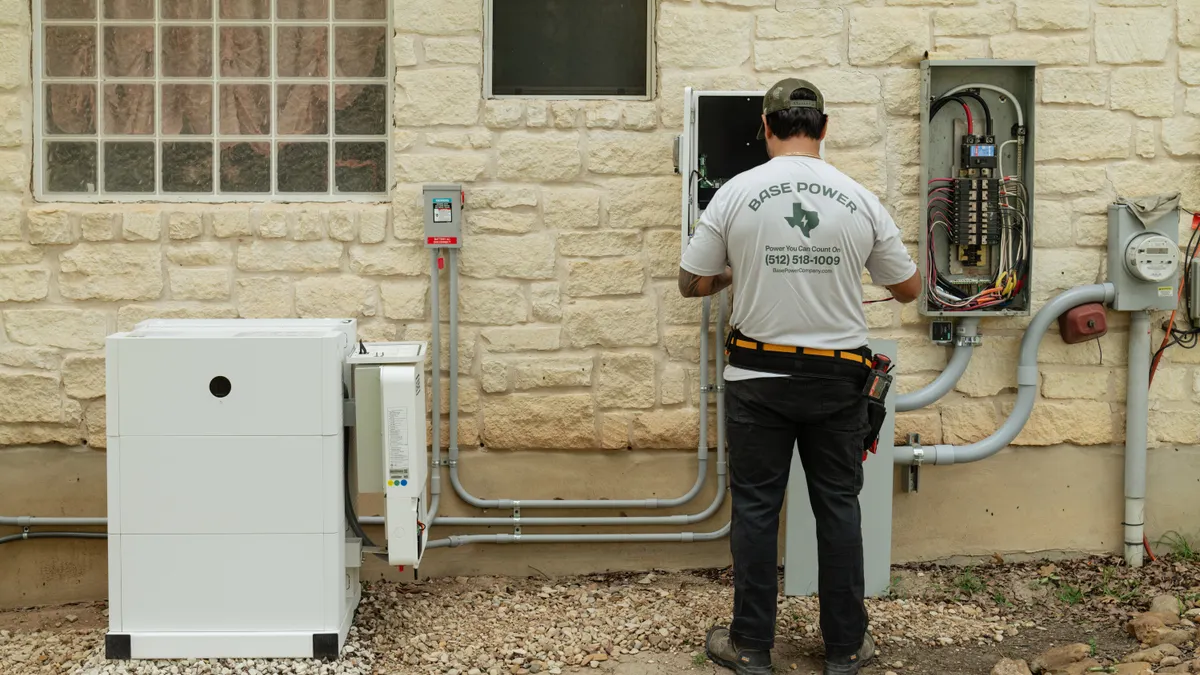
To boost uptake with homeowners, Base Power sharply discounts its 25-kWh batteries’ upfront cost. GVEC members pay less than 50% of the standard upfront price: $295 for a single-battery system or $445 for a dual-battery system, according to public marketing materials on its website.
Base Power says those figures are “95% cheaper than similar backup solutions.” The company also waives the standard $29/month membership fee for GVEC customers, according to its website.
Base Power maintains the batteries under a long-term contract and allows homeowners to draw on stored energy during grid outages. Each battery represents up to 12 hours of backup power for a typical GVEC customer who is “careful” about managing power consumption, Schauer said.
The company’s battery modules have more capacity than most competing residential systems. Tesla’s Powerwall 3 system is rated at 13.5 kWh, for example, while Enphase’s IQ 10 has about 10.1 kWh of capacity. Company executives say oversized batteries give it more flexibility to buy and sell power in wholesale markets, which reduces customers’ power costs in turn.
GVEC and Base Power say batteries installed through the partnership will participate in ERCOT’s Aggregated Distributed Energy Resource pilot program, which allows distributed batteries and other resources to earn revenue through direct participation in the grid operator’s wholesale energy and ancillary services markets. The Public Utilities Commission of Texas transferred management of the ADER program to ERCOT last year after struggling to scale participation to the initial 80-MW goal set in 2022.
Schauer said GVEC evaluated the potential transmission cost savings of “utility-scale” distribution-connected batteries and “determined that assets located behind an end-use customer’s meter provide additional value for the cooperative in the form of reduced transmission costs.” As a generation asset registered with ERCOT, a utility-scale battery “is not able to reduce the utility’s transmission values, while devices behind the meter can,” he added.
“I view this, along with other distributed [energy resources], as an ongoing part of our business and the industry itself,” Schauer said. “The more distributed tech on the grid, the better off we’re all going to be.”