Dive Brief:
- American Efficient; its owner, Modern Energy Group; and affiliated companies must pay about $1.1 billion for “one of the largest and most brazen frauds” in the Federal Energy Regulatory Commission’s history, the agency said Wednesday.
- American Efficient violated the market rules of the PJM Interconnection and the Midcontinent Independent System Operator by selling them energy efficiency resources that it didn’t control or that wouldn’t reduce load beyond what would have happened anyway, FERC said.
- The company also manipulated the PJM markets by fraudulently presenting itself as a legitimate capacity seller, making misleading statements that its program lowered customer prices and by failing to tell PJM that MISO and ISO-New England had disqualified the company from their capacity markets, FERC said.
Dive Insight:
FERC ordered American Efficient, Modern Energy and the affiliates to pay a $722 million fine and return about $410 million in “unjust profits,” plus interest, to the grid operators — $407.7 million to PJM and $2.1 million to MISO.
“American Efficient’s years-long fraud profoundly disrupted the organized capacity markets and ultimately increased costs for ordinary Americans,” FERC Chairman Laura Swett said in a concurring statement. “To make matters worse, American Efficient’s scheme also subverted critical market mechanisms designed to promote reliability during grid stress conditions.”
American Efficient contends it followed PJM’s rules.
“At no point did American Efficient violate the law or seek to mislead anyone,” the company said in a statement to Utility Dive. PJM reviewed and approved American Efficient's participation in its capacity market based on detailed, transparent submissions over 30 times in a 10-year period, the company said.
“FERC's allegations are baseless and unprecedented, and we are confident a federal court will agree,” American Efficient said.
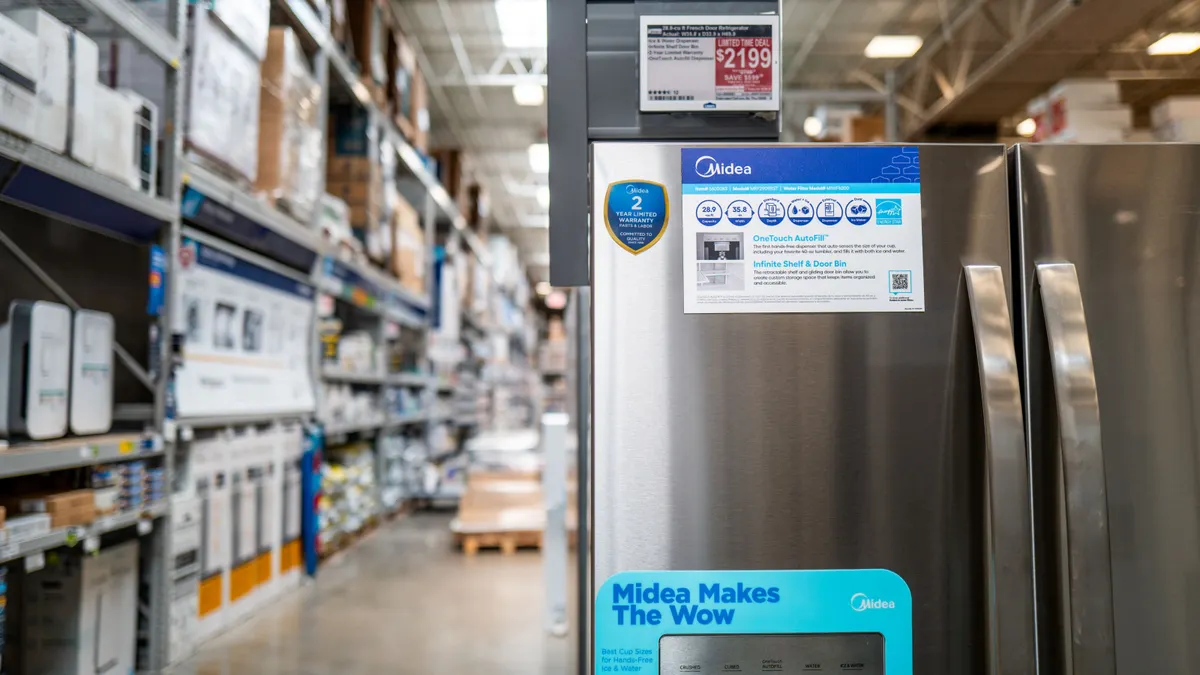
American Efficient considers itself an “upstream” participant in the energy efficiency industry, according to FERC. Instead of installing efficiency products or contracting with customers who do, it buys sales data from retailers like Home Depot, Lowe’s and Walmart and then figures out how much electricity would be saved if end-use customers install the products, according to FERC. It then bids the energy savings into the capacity markets as if it caused them, the agency said.
“This is a scam for the history books,” FERC said. “[American Efficient] engaged in naked rent-seeking — hijacking a regulatory mechanism intended to promote energy efficiency and converting it into an ATM for American Efficient’s worthless paper-shuffling scheme.”
The company offered and cleared more than 20 GW over 11 years and received about $500 million in capacity payments from PJM and $15.5 million from MISO, according to FERC.
American Efficient’s affiliates began participating in PJM’s capacity market in 2014 and in MISO’s capacity market in 2017. MISO expelled American Efficient from its capacity market in 2021 for failing to show it owned or had the rights to the efficiency resources, according to FERC.
An American Efficient policy director who resigned from the company in October 2021 told FERC’s enforcement office that the company’s business model was “at best unethical” and amounted to “a wealth transfer between ratepayers” and the company, according to the agency.
Through its parent company, Modern Energy Group, American Efficient has received funding since 2021 from an unnamed investment bank in exchange for capacity payments, according to FERC.
American Efficient, based in Durham, North Carolina, operates in 23 states, according to the company’s website. “We operate projects in collaboration with major manufacturers, distributors, and retailers to facilitate the adoption of energy efficient products and aggregate, measure, verify and deliver their energy savings for wholesale energy markets,” the company says on its website.
FERC’s findings are largely in line with a “show cause” order it issued in December 2024 giving American Efficient a chance to respond to the allegations contained in a report from the agency’s enforcement office.
A month later, American Efficient responded by suing FERC in the U.S. District Court for the Middle District of North Carolina, arguing that the agency’s enforcement action violated the company's constitutional right to a jury trial and that FERC’s status as an independent agency violates the U.S. Constitution.
The court in November rejected American Efficient’s request for a preliminary injunction to halt FERC’s enforcement action.
Editor’s note: this story was updated with a comment from American Efficient.