Dive Brief:
- Outside of the winter season, capacity prices plunged across the Midcontinent Independent System Operator in its just-held Planning Resource Auction as new power supplies outpaced demand growth, MISO said in a report released Tuesday.
- Capacity prices fell sharply in the summer season — from $666.50/MW-day in all regions to $424.30/MW-day in MISO’s North and Central regions, $384.10/MW-day in Arkansas and Mississippi and $412.10/MW-day in Louisiana and Texas.
- Annualized capacity prices across MISO’s 10 zones fell to a range of $116/MW-day to $126/MW-day for its 2026-27 Planning Year from a range of $212/MW-day to $217/MW-day a year ago, according to the grid operator.
Dive Insight:
Capacity offered in MISO’s summer auction increased 3.4% to 141 GW from 136.3 GW a year ago. The increase was driven by 5.6 GW of new accredited capacity — with more than half coming from solar, followed by gas and battery storage. Increased accreditation added 1.3 GW and additional imports added 1 GW. Those increases were offset by 1.4 GW in capacity retirements and 1.7 GW in reduced accreditation.
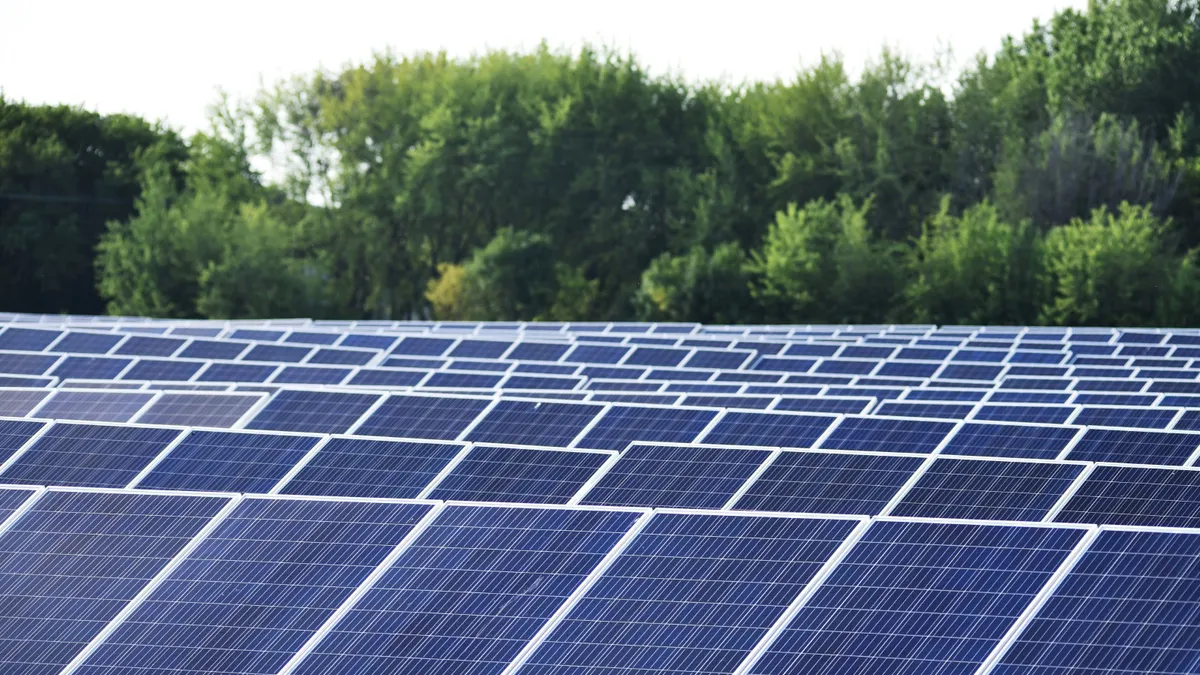
About 12.2 GW of accredited solar capacity cleared the auction, up 59% from 7.6 GW a year ago, according to the report. About 5.5 GW of wind cleared, down 8% from 6 GW last year.
About 4.3 GW of behind-the-meter generation and 9 GW of demand response resources cleared for the summer season, about the same as in 2025.
“Capacity offered into this year’s auction grew by as much as 4% in each season compared to last year,” Aubrey Johnson, MISO vice president of system planning and competitive transmission, said in a press release. “That increase reflects the collaborative efforts of MISO, our states and our members to bring new resources online quickly to meet growing demand. While we are making real progress, we still have more to do to address reliability risks as load growth accelerates.”
The summer auction cleared with a reserve margin 3.5 percentage points above MISO’s 7.9% reliability reserve target, the grid operator said.
MISO operates the grid and wholesale power markets across 15 states from Louisiana to Minnesota and in the Canadian province of Manitoba.
Most load-serving entities in MISO supply their own capacity or secure it before the auction, the grid operator noted. LSEs without enough capacity to meet their resource adequacy requirements will pay the auction clearing prices for their capacity shortfall.
Fast-track interconnection could ease reliability risk: NERC
The auction results come about a week after the North American Electric Reliability Corp. released an analysis of MISO’s reliability outlook if the grid operator adds capacity through its Expedited Resource Addition Study process — a temporary fast-track interconnection review that aims to bring generation online quickly to alleviate resource adequacy risks.
In a report released in January, NERC deemed MISO to be at “high risk” for power outages in 2028. State utility regulators in MISO’s footprint pushed back against NERC’s assessment, saying in part that the grid operator failed to consider the ERAS program.
Assuming that 25 GW of “unforced capacity” — a measure of how much capacity is expected to be able to meet demand — come online through the ERAS program as planned, risk in the MISO region would be “normal” from 2028 through 2030, instead of “high,” according to NERC.
However, NERC warned that like all generating projects the ERAS projects face a range of risks, including supply chain constraints, the need for transmission upgrades and limits on natural gas pipeline capacity.