The CEO of one of the world’s biggest suppliers of electrical equipment sees the AI-driven global construction boom continuing for years — and driving a shift from traditional low-voltage systems to 800-volt direct-current architecture for data centers.
In August 2025, Eaton Corp. paid $86 million for Resilient Power Systems, a solid-state transformer developer.
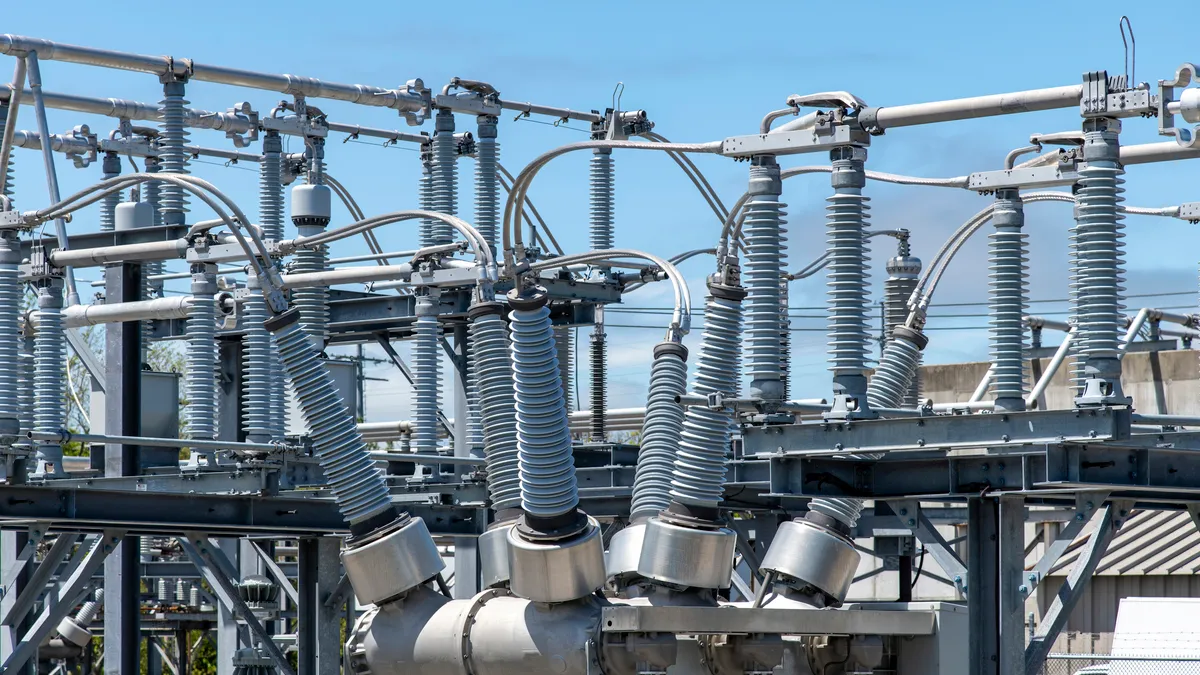
Using magnets and semiconductors rather than specialized steel alloys and vast amounts of copper wiring, solid-state transformers, or SSTs, are more compact and efficient than traditional low- and medium-voltage transformers. Data centers built on the 800-volt direct-current architecture that Eaton expects will soon become the industry standard could reduce non-IT capital expenditures by up to 18%, according to a recent McKinsey analysis.
Earlier this year, the Electric Power Research Institute, New York Power Authority and North Carolina State University tested a 1-MW SST under “real-world” conditions and cut power losses in half compared to a traditional transformer configuration.
Paulo Ruiz, CEO of Eaton, told investors on Tuesday that the company’s 15-kV, 2-MW SST became, “to our knowledge,” the first multi-megawatt unit to pass all tests under a new UL Solutions standard for the technology.
However, it may be some time before Eaton SSTs are widely deployed, he cautioned.
“The good thing for us to keep in mind is that this direction of travel, in terms of migrating from AC to DC, is real because of the large power savings that the customers see in this new technology,” he said. “But the timing of that transition is not under our control.”
He added that SSTs are only one of several “key building blocks” needed, along with DC breaker, power quality and advanced cooling technologies.
“The AC architectures are not bad, and we are fine either way,” Ruiz said. “We win in either path.”
Ruiz said he sees no letup in the global demand for power equipment from data centers and utilities.
Eaton, which is headquartered in Ireland but is one of the largest suppliers in the U.S. market, makes and markets low- and medium-voltage electrical products such as single- and three-phase power quality systems, utility-grade power distribution equipment, circuit protection and power reliability equipment. It reported a record $8.9 billion in third-quarter sales, up 28% year over year.
“We track the [worldwide] projects that are announced, and now they amount to 366 GW,” Ruiz said, of data centers. “Contrast that with the installed capacity of 50 GW. It's an enormous build-out. In my opinion, this will last for many years to come.”
Eaton predicts end market growth of about 11% in 2027. In 2025, data centers and distributed IT accounted for 21% of sales, while utilities accounted for 11%.
A little less than half the total of third-quarter sales came from Eaton’s Electrical Americas segment. That unit benefits from broad-based demand from data centers and other electrification “mega-projects,” helping to widen profit margins, Ruiz said.
The Electrical Americas segment saw its backlog rise to $16 billion – up 33% year over year – while orders increased 39% on a rolling 12-month basis.
Ruiz emphasized that data centers were not Eaton’s only high-growth customer segment. Utility investment and other large-load industrial customers are propelling business, too, he said.
“Demand continues to run ahead of what we can convert,” Ruiz said. “This is a business that continues to benefit from powerful secular trends, utility investment, grid modernization, industrial reshoring, AI-driven data center expansion and broader electrification.”
Doubling down on data centers
In the past two years, Eaton has acquired multiple companies with data center exposure.
The most recent was a roughly $920 million deal for COL Group, an Italian manufacturer of medium-voltage electrical distribution equipment, grid automation technologies and modular power systems that Eaton said would boost its sales to data center and utility customers in Europe.
In March, Eaton paid about $9.6 billion to acquire Boyd Thermal, “a U.S.-based global leader in thermal components, systems, and ruggedized solutions for data center, aerospace and other end-markets,” the company said in a securities filing this week.
The Boyd pickup will help Eaton develop integrated power and cooling architectures for data center customers and “deliver differentiated grid-to-chip solutions while increasing our exposure to some of the fastest-growing segments of the data center market,” Ruiz said.