Dive Brief:
- An enhanced geothermal project between 100 MW and 500 MW can be brought online within three to six years of project initiation, and with sufficient drill rigs and crews that timeline could be brought under three years, according to a report released Monday by the Center for Public Enterprise.
- “This represents a 70% to 75% reduction from the seven-to-ten-year timeline frequently cited for conventional geothermal development on federal land,” the report said, and “is fast enough to appear in near-term IRP planning windows.”
- Conventional geothermal development requires locating a permeable reservoir that already contains fluid, posing siting and permitting challenges. Enhanced geothermal, however, uses drilling and hydraulic fracturing to create a reservoir to deposit fluid into.
Dive Insight:
Geothermal development timelines within five years assume that developers are able to secure access to permits and transmission “in a reasonable timeframe,” the report said, but the authors noted that Department of the Interior “implemented emergency permitting procedures under the Trump administration’s national energy emergency declaration that would further compress post-leasing review windows,” although the procedures are subject to litigation.
The Trump administration has shown support for geothermal, with the Department of Energy last month announcing a $171.5 million funding opportunity to “support next-generation geothermal field-scale tests for both electricity generation and exploration drilling to support characterization and potential confirmation of promising geothermal prospects.”
“DOE analysis shows the potential for at least 300 gigawatts of reliable, flexible geothermal power on the U.S. grid by 2050,” DOE said in a release. The U.S. currently has around 4 GW of geothermal capacity.
The Center for Public Enterprise’s report also notes that geothermal is a relatively firm source of renewable energy, with a geothermal plant operating at a capacity factor above 80 percent “typically [receiving] a qualifying capacity credit of 80–85 percent, comparable to conventional thermal generation.”
“Unlike variable renewables, whose capacity credits are calculated through probabilistic [effective load carrying capability] modeling and decline sharply as penetration increases, geothermal qualifying capacity is based on historical production during peak hours and remains stable over time,” the report said.
The report brought in analysis from the California Public Utilities Commission which found that 1 MW of geothermal “reduced the need for [3 to 5] MW of solar-plus-storage in least-cost portfolio optimization, a finding that informed its subsequent adoption of a preferred portfolio including 1.7 GW of new geothermal.”
Enhanced geothermal “is not yet the cheapest resource on a levelized cost basis — but its cost trajectory, combined with its firm capacity value, makes the economic case increasingly strong,” the report said. “[Fervo Energy’s] drilling data underpin this trajectory. Well costs fell 49% across the first four Cape Station wells. [The National Laboratory of the Rockies] updated its drilling cost assumptions downward by [24% to 26%] from GeoVision estimates based on recent field data.”
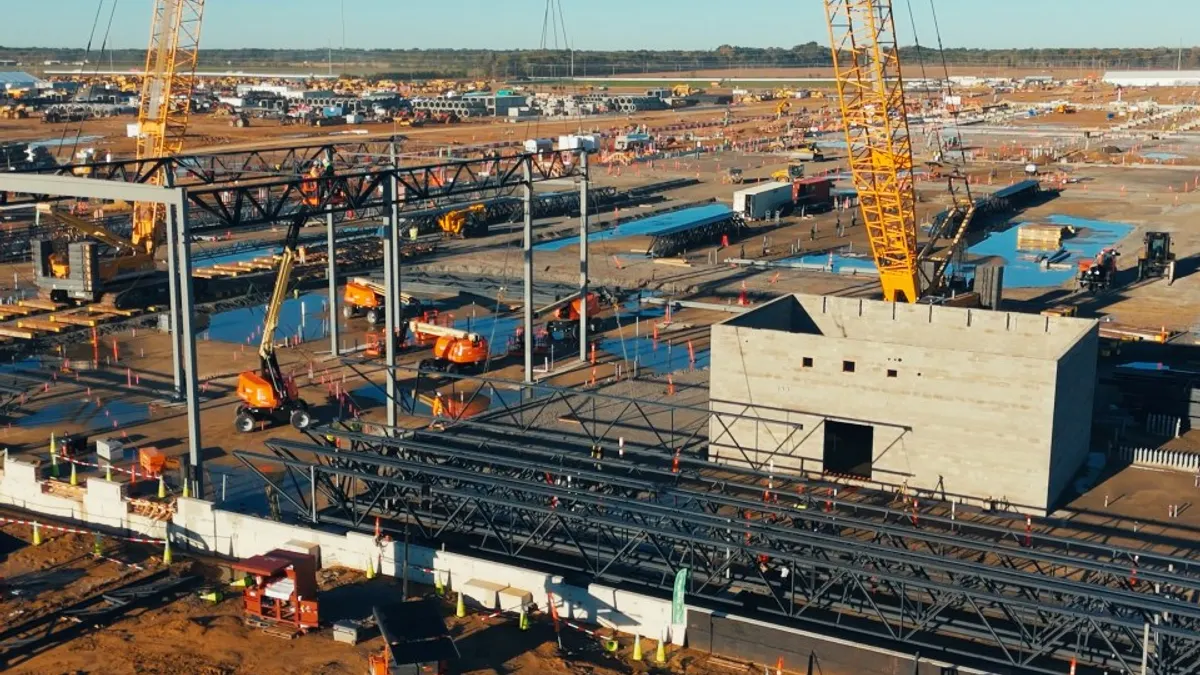
Fervo Energy announced Thursday that it has secured $421 million in non-recourse debt financing for the first phase of its 500-MW Cape Station geothermal plant in Beaver County, Utah. Cape Station is expected to start delivering first power to the grid this year and reach approximately 100 MW of operating capacity by early 2027.
The Center for Public Enterprise’s report said that the “critical enabler” allowing enhanced geothermal projects to commercialize quickly is “technology transfer from the shale revolution.” At Fervo’s Cape Station project, “more than 90 percent of on-site labor hours come from oil and gas workers,” the report said.
“Those workers are employing the same processes that are used to drill the 10,000+ unconventional wells produced annually in the U.S.,” said the report. “The industry is scaling with much more industrial expertise than would be suggested from a single commercial plant, providing confidence in a rapid, repeatable development process.”