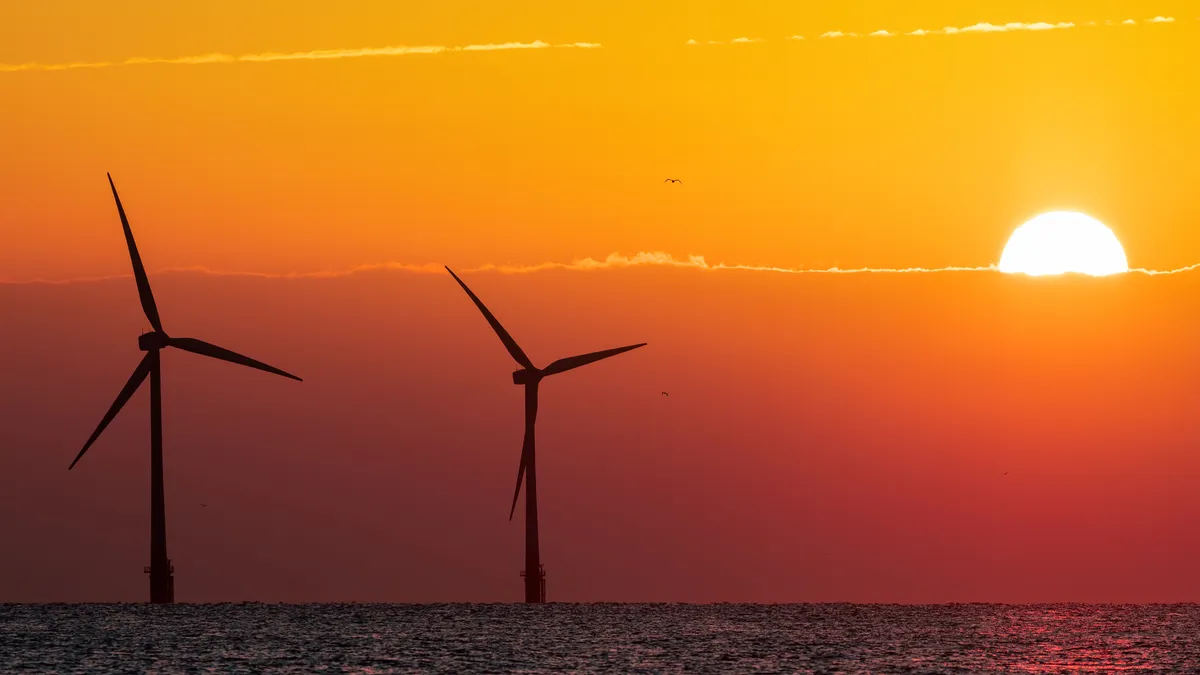
Nine Northeast states and the District of Columbia are exploring development of an offshore transmission network along the Atlantic Coast to reduce electricity costs and improve reliability. On Monday, the Northeast States Collaborative on Interregional Transmission published a trio of reports around technical standards and policy recommendations to advance a high-voltage direct current network.
The reports are an important step in ensuring states, grid operators and the electric industry “are working from a shared framework to help accelerate offshore wind deployment and unlock broad consumer benefits,” Weezie Nuara, Massachusetts deputy secretary for federal and regional energy affairs, said in a statement.
Along with Massachusetts, the collaboration incliudes Connecticut, Delaware, Maine, Maryland, New Jersey, New York, Rhode Island, Vermont and D.C. The reports were developed by the Planning Offshore Interregional Network Standardization Consortium, a research effort that launched in 2025.
The states collaborative is made up of regulatory commissions, agencies and governor’s offices. The POINTS Consortium is a group of technical experts and state leaders.
The three reports cover recommendations for standardizing offshore transmission network design; HVDC procurement and contracting strategies; and approaches to develop standardized HVDC transmission and modernized reliability standards. The POINTS consortium developed the reports with support from the U.S. Department of Energy and other organizations. Brattle Group, which consulted on the reports, called their release “a key milestone in advancing interregional transmission pathways that can maximize the benefits of offshore wind deployment.”
Report recommendations include addressing procurement issues through a Northeast offshore transmission order book that would demonstrate long-term market demand and provide greater certainty to equipment and cable manufacturers.
“Supply chain constraints extend beyond the OEMs themselves and [contribute] to extended project timelines and elevated costs,” according to the report. “For example, the limited availability of specialized cable-laying vessels represents an additional constraint for submarine cable projects.”
The reports also called for establishment of a technical working group to evaluate HVDC integration challenges and opportunities in the region, and the creation of a task force led by the North American Electric Reliability Corp. to focus on HVDC technologies and reliability frameworks.
“At a time when the federal government is doing all it can to sow chaos and disrupt our energy supply, New Jersey is committed to pursuing new generation,” New Jersey Board of Public Utilities President Christine Guhl-Sadovy said in a statement. POINTS consortium members are “committed to doing the hard technical and policy work now so that New Jersey — and the region — is ready to move without delay when conditions change."
The Trump administration has been opposed to wind development, but on Monday the U.S. Court of Appeals for the 1st Circuit granted a U.S. Department of Interior request to drop its defense of a ban on wind projects. Attorneys general from 17 states and Washington, D.C. challenged an executive order President Trump signed last year, attempting to block wind power development in the U.S.
“Donald Trump is surrendering to our legal challenges against his bogus, unlawful ban on wind energy,” Sierra Club Senior Advisor Nancy Pyne said in a statement. “While everyday Americans face soaring bills and unstable prices, renewable energy offers an affordable, common sense solution.”