Dive Brief:
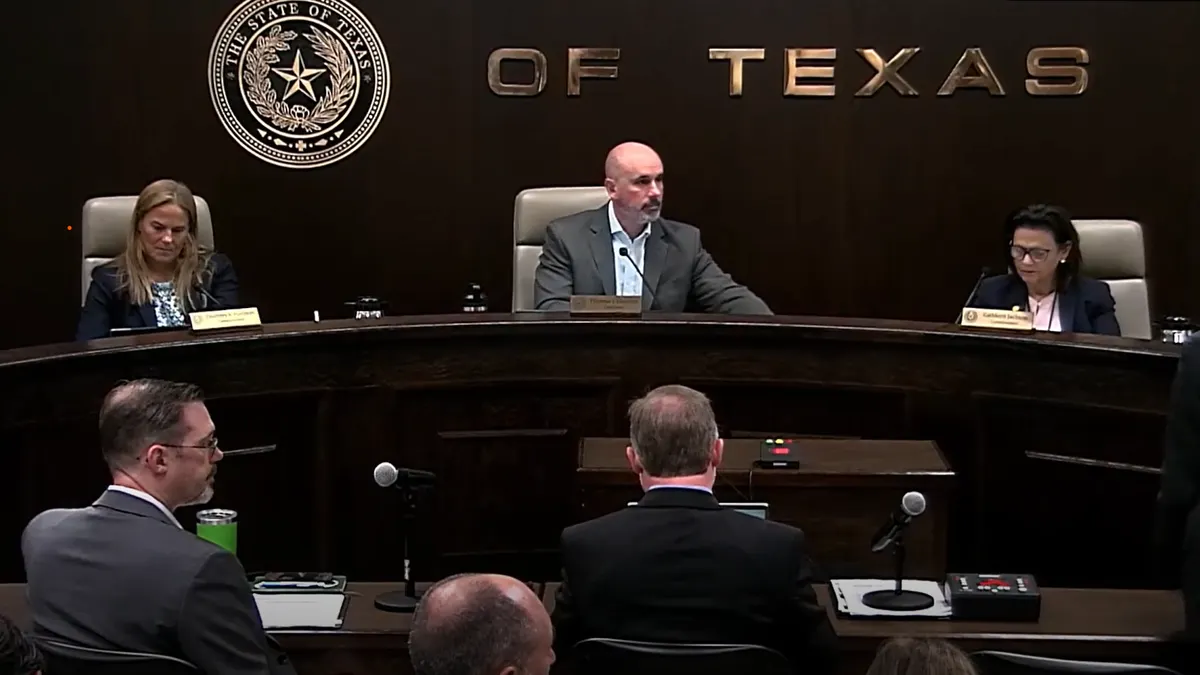
- The Pennsylvania Public Utility Commission last week released a final order establishing a “first-of-its-kind” model tariff framework for large-load customers, including data centers, the PUC said.
- Notably, the order — which is nonbinding — recommends utilities charge large-load customers for any system upgrades that “would not have been needed ‘but for’ the interconnection” of that customer, “irrespective of whether other customers will benefit” from the infrastructure. It also instructs utilities to allow large-load customers to self-construct certain upgrades.
- The Environmental Defense Fund, which submitted comments on an earlier proposal, noted that while many states are weighing similar rules to assign costs to large-load customers, Pennsylvania may be the first to push for them to pay up front through “Contributions in Aid of Construction” payments.
Dive Insight:
Large load tariffs have proliferated as the artificial intelligence boom fuels a surge in interconnection requests, raising concerns about the impact to the grid and electricity costs.
In 2025, state regulators approved 29 large load tariffs, compared to 14 between 2018 and 2024, according to the Smart Electric Power Alliance. As of March, there were more than 75 such tariffs pending or in place across 36 states, according a Database of Emerging Large Load Tariffs maintained by SEPA and the North Carolina Clean Energy Technology Center.
Pennsylvania’s model tariff, which is intended to apply to any customer exceeding 50 MW individually or 100 MW in aggregate, aims to “guide” Pennsylvania’s electric distribution companies as they evaluate potential large load customers, the PUC said.
In addition to cost protections, the tariff model includes provisions on collateral and financial security, including deposits, intended to mitigate the risk of stranded assets; expectations for utilities to complete interconnection studies within six months; guidance related to load ramping schedules, minimum contract terms and customer exit provisions; and recommendations for maintaining public-facing information regarding large load interconnection requests and study status.
“Pennsylvania is confronting a level of electric load growth that has not been seen in generations, driven largely by data centers and advanced manufacturing,” PUC Chairman Steve DeFrank said in a statement. “Rather than waiting for these challenges to overwhelm the system, this Commission chose to lead. This Final Order establishes a thoughtful framework that supports economic development, strengthens transparency and planning, and protects existing ratepayers from bearing the financial risks associated with unprecedented new demand.”
The EDF praised the PUC in a statement for establishing a “strong foundation for fair cost allocation,” while emphasizing that regulators and utilities must follow through by applying the voluntary guidelines.
For example, implementing “but-for” cost allocation “will not always be simple,” the organization warned.
“Determining which customer(s) triggered a transmission upgrade can be technically complex and difficult to track,” it said. “Many of the relevant discussions occur deep within PJM subcommittee meetings that most consumer advocates lack the resources to monitor closely.”
The EDF also expressed disappointment that the order did not “make significant progress” on “non-firm” or “interruptible” service, which allows utilities to curtail electricity to large load customers during periods of grid stress.
“Expanding interruptible service is one of policymakers’ most effective tools for limiting near-term grid costs tied to data center growth,” the EDF said. “Rather than creating a new framework tailored to large loads, the Commission opted to rely largely on utilities’ existing interruptible service tariffs, which will often not be a good fit for large loads.”
Lucas Fykes, senior director of energy policy and regulatory counsel at the Data Center Coalition, told Utility Dive in an email that the DCC is in the process of reviewing the order with members.
"We appreciate the Commission's effort to establish a framework that is structured, transparent, and grounded in core cost-causation principles, while also recognizing the importance of continued investment and economic growth in Pennsylvania," Fykes said. "The final order importantly maintains an end-use-neutral framework, applies prospectively to new large load interconnections and incremental load growth, and recognizes the importance of evaluating contract terms, collateral, and other risk-management tools as part of an integrated package."
Update: This story has been updated with comments from the Data Center Coalition.