
For most of the U.S. power system’s history, rate design has served a single purpose: allocating costs among customers, based on when and where they used electricity. Today, however, utilities aren’t just turning to rate design to recover costs after they are incurred, but to reduce those costs in the first place. Time-of-use rates, peak pricing and other dynamic pricing structures are emerging that translate grid constraints into actionable price signals in order to shape when and where consumers use the grid.
This shift reflects the rapid evolution of the U.S. power system. Demand is on the rise. Renewables comprise the majority of new generation capacity, bringing low-cost, albeit intermittent supply. New smart devices like EVs and heat pumps have the potential to exacerbate stress on the grid, but can also be orchestrated to shift their demand away from system peaks. Against this backdrop, rate design has become a critical tool to coordinate and align new patterns of supply and demand, thereby delivering lower-cost outcomes for the grid as it evolves.
There’s just one problem: many utilities can’t support innovative rates because they still rely on legacy billing systems and rate engines. Most of this legacy tech was designed for non-interval meter data, simple rates and a slower pace of change.
Advanced metering infrastructure (AMI) has taken utilities one step closer to rate design innovation by making granular usage data available. As of 2024, U.S. utilities had installed more than 140 million advanced meters, reaching ~80% of the U.S. electric customer base.¹
Figure 1: Installed meters in the United States (millions)

However, despite widespread AMI deployment, only ~10% of U.S. electric customer accounts are enrolled in some form of time-varying rate (TVR), because smart meters alone can’t enable advanced price signals.²
Today, the rate design innovation bottleneck has shifted away from metering constraints to IT implementation. Utilities are experiencing this bottleneck in increasingly costly ways. For example, PG&E has said its legacy billing system “was not designed for modern bill components and calculations” and described an implementation “backlog” of 26 new or revised rates.³ Xcel Minnesota likewise indicated that configuring its billing system for a residential TOU rate would take a year and cost over $1 million.⁴ Examples like this abound, at significant cost to ratepayers and society. When utility billing technology cannot operationalize regulatory and market ambition quickly and affordably, policy goals become harder to reach.
That is why it’s critical that today’s utilities possess modern billing and rate design capabilities. Their value lies in enabling utilities to introduce, test, revise and scale complex rate designs affordably quickly and in response to changing system conditions, customer behavior and costs.
Fortunately, tech platforms have risen to the challenge. Kraken’s Customer software is one example of modern utility billing technology available in the marketplace today. It is used by utilities and retail energy suppliers around the world to bill over 90 million customer accounts.
Consider this use case: In September 2022, in response to Russia’s invasion of the Ukraine and the resulting energy crisis, the UK government announced its Energy Price Guarantee. The Guarantee was an affordability measure that automatically applied a discount to all households with a domestic gas and/or electricity contract, expected to save the average household about £1,000 per year relative to what they would have otherwise paid. Notably, the UK government gave energy retailers until October 1, 2022 to implement the Guarantee – a rapid deadline reflecting volatile market conditions. The Guarantee was not designed as a simple bill credit; instead, it required retailers to actually adjust the effective unit rates they charged their customers. For Kraken’s four clients in the UK, that meant updating rate design calculations and repricing eligible tariffs in only three weeks.
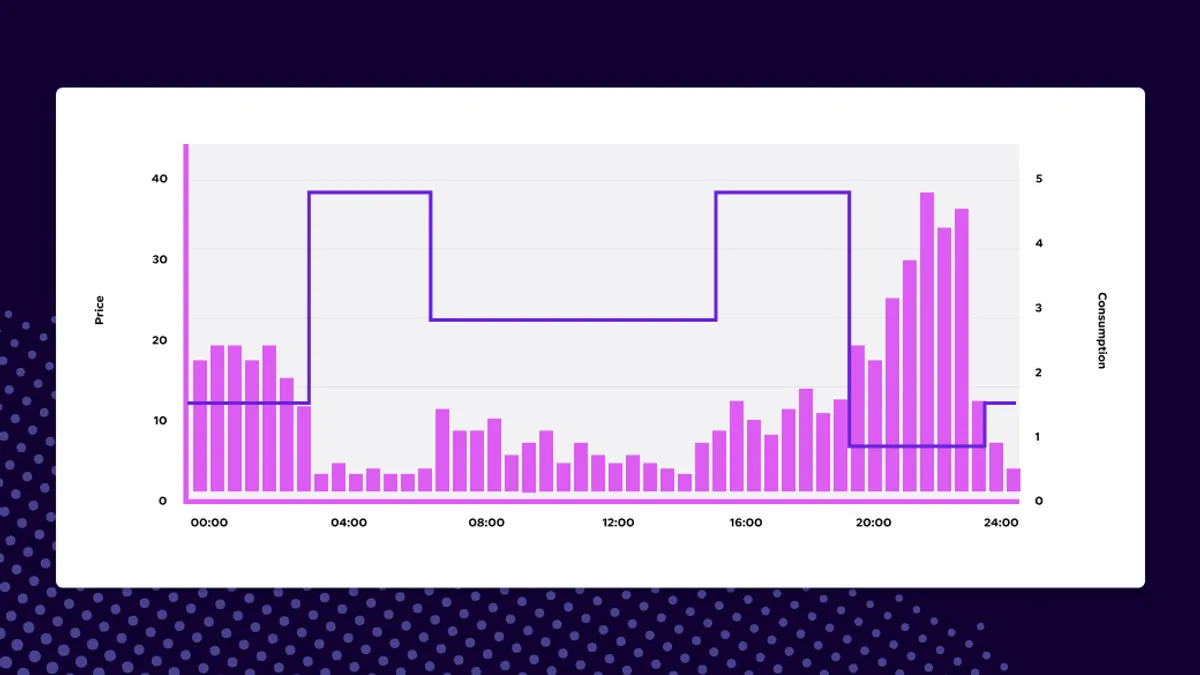
Beyond implementing innovative rates for affordability purposes, Kraken also enables rate design innovation that unlocks more value from customer DERs. One example is Octopus Energy’s Intelligent Octopus Go tariff, which features a half-hourly on-peak and off-peak pricing structure. Under the tariff design, Octopus can extend the off-peak pricing to additional hours if grid conditions make it such that power is especially cheap. Put simply, the tariff does not just charge customers a pre-determined fixed rate at granular half-hour increments; instead, it dynamically applies more favorable rates when system conditions support it. Kraken has implemented this innovative rate design for Octopus Energy and is delivering results at scale – today, more than 350,000 customers (an estimated 50% of all eligible customers) are enrolled on the Intelligent Octopus Go tariff.
Figure 2: Example daily electricity pricing and consumption on the Intelligent Octopus Go rate (light blue indicates consumption at off-peak pricing)

Currently utilities are leaving much of the value of their prior AMI investments unrealized. The ability to rapidly design and implement price signals that facilitate new patterns of supply and demand that lower grid costs are well within reach. Modern billing technology is the key to rate design innovation and all the benefits that follow.
1 Energy Information Agency, "Electric Power Annual: Table 10.5", released October 16, 2025, available at: https://www.eia.gov/electricity/annual/
2 EIA, "Form 861: Dynamic Pricing" for 2015 through 2024, available at: https://www.eia.gov/electricity/data/eia861/. See also, EIA, "Form 861: Sales to ultimate customers" for 2015 through 2024, available at: https://www.eia.gov/electricity/data/eia861/
3 Pacific Gas & Electric, “Billing Modernization Initiative: Second Errata to Prepared Testimony”, August 15, 2015, Docket 24-10-014, pages 4-4 and 4-18:19.
4 Minnesota PUC Staff, “Staff Briefing Papers re: Xcel Residential TOU Rate Design”, March 6, 2025, Docket M-23-524, page 24.