
Storm response has improved. Utilities are better prepared, with more coordinated crew deployment, expanded vegetation management programs and increased situational awareness from advanced monitoring systems.
Yet the outcome hasn’t changed enough.
Power outages still cost the U.S. economy an estimated $67 billion each year. Weather drives roughly 80% of major outage events and about 90% of those disruptions occur on the distribution system.
The issue isn’t preparation. It is how the grid is designed to perform under stress.
Rethink resilience as distribution design
Storm performance is still driven by what is built into the grid edge—and most of that infrastructure was designed for a less demanding operating environment. Often secondary to other capital priorities, the grid edge now contains a high concentration of aged assets that are routinely exposed to environmental stressors.
When a storm arrives, customer outages cascade. Crews are dispatched into severe conditions and service is restored over hours or days. The grid is largely returned to its prior state and the next event repeats the costly react-and-repair cycle.
Shifting those outcomes doesn’t have to mean rethinking the entire system. It can begin by updating a smaller set of design decisions that determine how the grid detects faults, contains their impact and enables restoration. By integrating proven distribution automation technologies in targeted locations, utilities can change how the system responds during and after a storm without redesigning the system itself.
Three design approaches for your grid edge
Prevent avoidable lateral outages with fault discrimination
Overhead lateral circuits generate some of the highest fault volumes on the system. Most faults are transient, but conventional fuse protection provides no fault discrimination capability. A temporary and permanent fault produces the same outcome: fuse operation, sustained outage and crew dispatch.
During major weather events, the cumulative effect across hundreds or thousands of lateral circuits consumes restoration time and crew capacity.
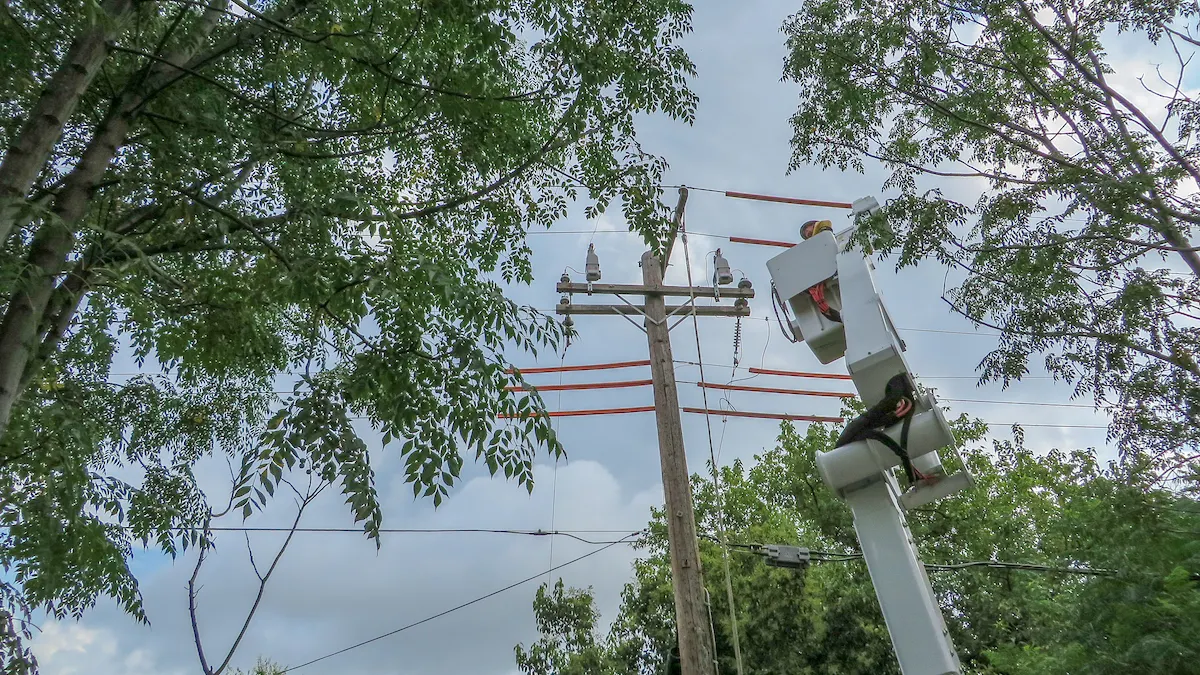
When lateral protection strategies include lateral automation, the system responds differently. Cutout-mounted reclosers can automatically clear temporary faults to restore power and avoid sustained outages. They isolate permanent faults to the affected lateral.
- More customers remain energized.
- The broader system is protected.
- Crews can focus on critical repairs, improving restoration pace during major events.
Grid sensors deployed alongside these devices add visibility, helping utilities identify high-fault-rate circuits and target investment where interruptions occur most.
Reduce underground outage duration with automated isolation and power restoration
Undergrounding reduces storm exposure, but fault restoration on underground residential circuits presents a distinct operational challenge. Fault location requires manual switching and testing to identify the damaged segment, a methodical process that consumes restoration time when constraints are most acute.
Automated underground restoration systems for residential distribution loop circuits shorten that timeline. After detection, faults are isolated and power is restored from an alternate source in less than a minute. Customers remain connected and crews can focus on repairs in more controlled conditions.
Integration with transformer monitoring and analytics platforms provides continuous visibility, helping utilities get ahead of additional infrastructure failures.
Localize restoration actions with distributed intelligence
During major storm events, centralized control rooms must manage a surge of simultaneous alerts. Prioritization and sequencing become harder for operators. Communications can also degrade, which further limits centralized control.
Distributed intelligence at the grid edge enables autonomous action. Devices can assess system conditions, coordinate with neighboring devices, isolate faults and initiate service restoration without dependence on central system commands. This capability remains even under degraded communications during severe weather.
A resilient approach is achievable
Taken together, these three approaches help utilities move away from the expensive react-and-repair cycle. By treating resilience as a design principle and targeting grid-edge automation investments where outages cluster and restoration times are long, utilities can steadily improve storm outcomes without a wholesale redesign.
Implemented before the next storm, the upgrades change how the system behaves during and after an event. The grid is better positioned to respond, adapt and recover quickly from disruptions to better protect communities and crews. That’s the difference between responding to storms and designing the grid to come through them.
Authored by Kumar Chandran, Senior Director – Market Strategy and Business Development at S&C Electric Company.