
As electricity grids face increasing pressure from growing demand, aging infrastructure and intermittent renewable generation, the ability to deliver reliable power on demand is no longer optional. It’s fundamental to economic growth.
There’s a growing consensus that energy storage technologies are becoming a cornerstone of modern electricity systems and when most people think of energy storage, they think of batteries in a TV remote or in an electric car. Scaling energy storage to grid level is a paradigm shift.
What if energy storage meant storing compressed air in rock caverns thousands of feet underground, using widely deployed components from the energy and oil and gas industry and the same workforce that powered decades of energy security around the world?
This isn’t hypothetical. It’s happening today.
Underground storage. Above ground benefits.
For decades, underground caverns have been used to store energy products such as propane and butane. In fact, nearly 200 caverns are used around the world to balance hydrocarbon supply and demand. They’ve largely gone unnoticed because they’re hidden in plain sight, quietly supporting energy systems from below the surface. Advanced Compressed Air Energy Storage, or A-CAES, follows the same principle, underground storage that provides above-ground benefits.
A-CAES stores energy in rock caverns, delivering reliability where the grid needs it most. A single 500 MW, eight hour A-CAES facility can store enough electricity to power a city the size of Boston for eight hours on less than 100 acres of land. Since the energy storage facility is built into rock, there are no critical minerals required and the caverns don’t degrade, unlike your typical battery.
Why geology matters
A-CAES facilities are built in hard rock geology that is commonly found around the world. Suitable formations include igneous and metamorphic rock, which are naturally impermeable and self-supporting, making them ideal for A-CAES. This is the same rock that many kitchen countertops are made from. On average roughly a third of landmass is suitable for A-CAES caverns.
Because this geology is so widely available once you’re 2,000 feet below ground, projects can be flexibly located near areas where the grid needs them – built in areas with high electricity demand and accessible transmission, without the land and water intensity or transmission build-out required by other popular storage technologies.
Hydrostor evaluates potential project sites by conducting rigorous geological evaluation including downhole characterizations and lab tests which define the rock strength, impermeability, and insolubility. Approximately 25-30 percent of total project cost is on the subsurface build, which is derisked through multiple verification boreholes. Explore rock samples from our projects to see firsthand the geological formations that support A-CAES development.
How A-CAES works
At its core, A-CAES functions as a giant air battery. When discharged, the cavern is flooded with water. To charge, compressed air is injected into the cavern, displacing water upward into a surface reservoir. It is 100 percent charged when the cavern is filled with air. To discharge, water flows back into the cavern, pushing the compressed air to the surface to generate electricity. The cavern operates at a fixed pressure band with the weight of the water column acting as a massive underground piston.
Despite their scale, these systems operate at relatively modest pressure, around 75 bar. For comparison, scuba diving tanks operate between 200-300 bar. Each project requires a one-time fill of water (approximately 150 cubic meters per MWh) that is comparable to filling ~50 Olympic swimming pools (10m depth) for a 500 MW, 8-hour system. This means A-CAES uses up to ten times less water and twenty times less land than equivalent sized pumped hydro power (dam height of 120m).
Built locally and built to last
There are three main steps to build an A-CAES cavern:
- Drill Shaft #1: Using controlled detonations from the surface to cavern depth (0ft to 2,000ft), the initial shaft down to the cavern is made. This becomes the air shaft, which will carry compressed air during plant operations. The final shaft is four feet in diameter.
- Excavate Cavern: Mining equipment is lowered through the air shaft, where it is then reassembled underground and used to excavate the cavern. Excavated rock is removed via Shaft #1.
- Bore Shaft #2: The second shaft is made using a raise bore process (mechanical method used to excavate vertical shafts without explosives) all the way from the cavern depth at 2000 feet back to the surface. This becomes the water shaft, which is lined and cemented and extends into a sump below the cavern floor to maintain a water seal. The final water shaft is eight feet in diameter.
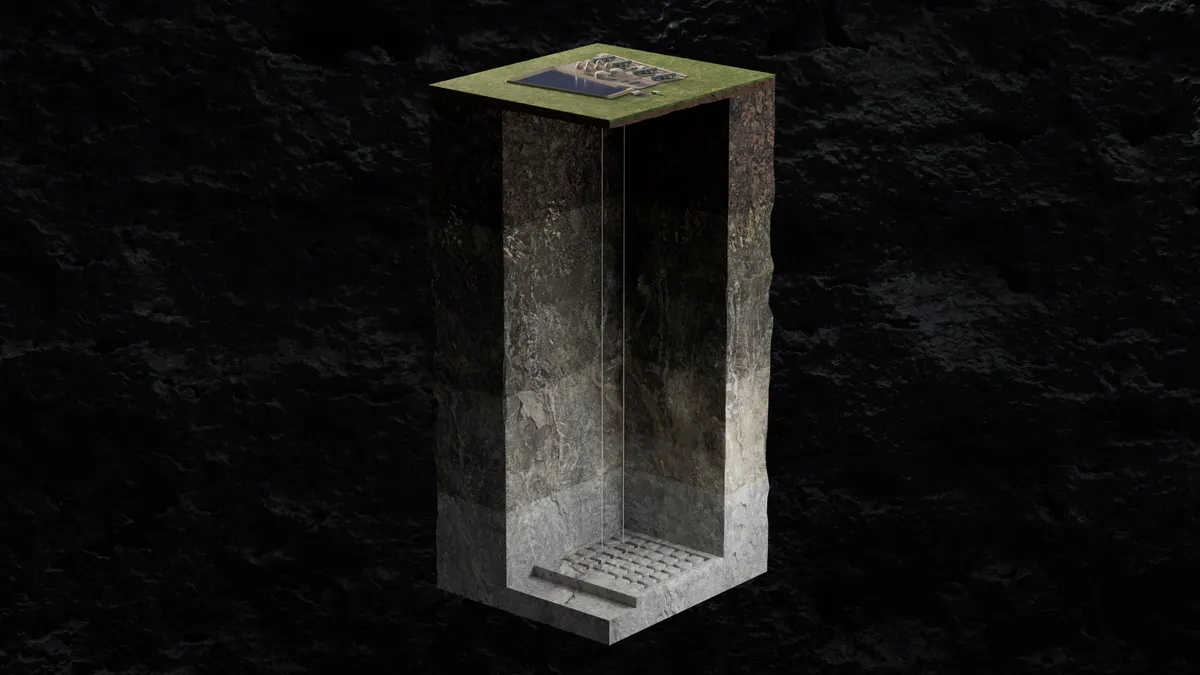
Each project draws on decades of engineering and construction expertise and relies on hundreds of skilled workers from the mining and oil & gas industries. Caverns are excavated in a room and pillar layout, which is extensively used in underground mining for its flexibility and high safety factors, ensuring cavern integrity over a 50+ year operating life.

Rendering of an A-CAES cavern excavated deep into bedrock using a room and pillar layout
The energy beneath our feet
As the grid evolves, the most powerful solutions may not always be visible. Sometimes, they lie beneath the surface, built on proven supply chains, workforces and infrastructure designed to last for generations.
Explore how underground caverns are engineered to support the future of energy storage in What Lies Beneath.