Vladimir Abdelnour is an energy researcher and Nathan Johnson is professor and director of the Laboratory for Energy And Power Solutions at Arizona State University. LEAPS works at the intersection of technology, business models, and policy to accelerate energy innovations to implementation and scale.

The fastest and most cost-effective way to ensure resource adequacy and create headroom for new growth is to better use the resources we already have. In Arizona, pool pumps can make a big difference.
Demand response programs have shown the ability to shift energy use and delay or avoid the need to build new assets to meet peak system demand. They can defer billions of dollars in centralized generation upgrades by leveraging customer-procured generation, storage, and load control. In aggregate, these assets can be coordinated and controlled as virtual power plants to defer or displace the build-out of large-scale generation.

U.S load growth has accelerated due to large-scale demands, including from data centers, and many distributed small-scale demands, such as electric vehicles. The Energy Information Administration estimates that the U.S. will need an additional 200 GW of useful capacity by 2030, but only half of this capacity is planned to go online. We simply can’t build fast enough.
Policy mechanisms and investments have largely prioritized transmission, storage, and centralized generation, but that progress has slowed due to supply chain shortages and permitting. It’s time policymakers and utilities placed greater emphasis on scaling demand response programs as a faster, cost-effective way to meet load growth and resource adequacy requirements.
Emerging tariff structures create new opportunities
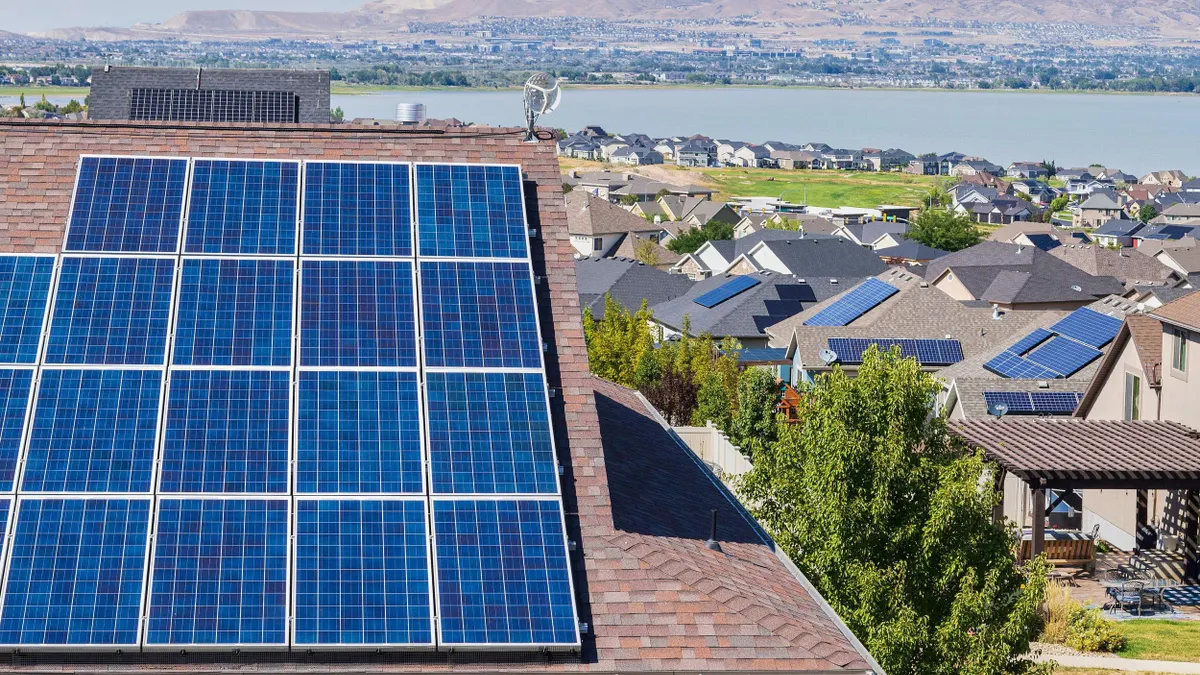
In the sunny Southwest, some utilities have introduced 'super off-peak' hours that offer significantly reduced electricity prices during peak solar generation. In Arizona, Salt River Project introduced the E-28 residential rate plan in November 2025, which designates super off-peak hours from 8 a.m. to 3 p.m. The plan encourages customers to shift power to midday periods, when solar energy is abundant, by offering electricity rates are over 50% lower than in other rate plans, promoting both cost savings and environmental benefits. Arizona Public Service offers a similar plan.
This push for lower daytime pricing across the United States is a result of negative wholesale electricity pricing, which occurs when supply exceeds demand, forcing generators to bid below zero to remain online or capture production tax credits. This phenomenon is prominent in regions such as Texas, parts of Kansas and Oklahoma, and California, where transmission limits and high penetrations of wind and solar drive frequent negative prices. This is an opportunity to soak up cheap energy by shifting demand.
The demand response potential of pool pumps
Pool pumps offer a gigawatt-scale opportunity for demand response in Arizona alone. Generally run at nighttime, pool pumps could be automated with demand response programs or programmed manually to run during the day. Spending 30 seconds to update the pump’s operating schedule could save a homeowner over $100 per year.
How much difference could pool pumps make to peak demand? The size of this shift is meaningful in the aggregate: Arizona has approximately 505,000 residential pools. By cross-referencing census data with utility territories, we determined approximate distribution by utility: APS has 186,850 pools; SRP has 207,050 pools; Tucson Electric Power has 67,000 pools, and the rest are dispersed among smaller utilities across the state.
Looking at SRP and APS, which have tariff structures with lower daytime rates, shifting pool pump operation can amount to 3,280 MWh per day in those territories, assuming single-speed pool pumps are 1-1.5 horsepower and operate for an average of four hours. Shifting pool pump operation from nighttime to midday super-off-peak hours can shift up to 820 MW in demand — that’s an entire power plant, just from pool pumps.
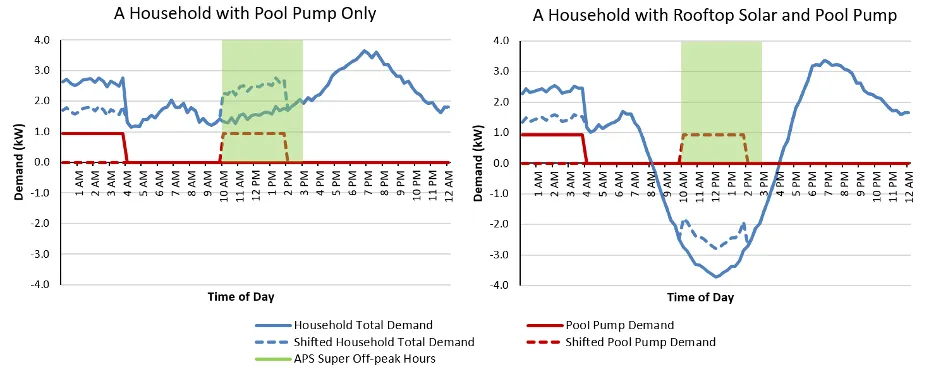
Figure 1 shows examples of this using data for two single-family households with APS super off-peak rates from 10 a.m. to 3 p.m. One home has solar installed and one home does not. Shifting pool pump operation to the daytime also reduces solar PV backfeed to the utility when generation exceeds household loads.
Aggregate financial savings are significant. For APS customers, shifting pool pump operation to APS super off-peak hours could save customers $25 million annually, or about $134 per pool owner. For SRP customers, potential savings are even greater: Shifting pool pump operation to SRP super off-peak hours could save customers $58 million annually, or around $283 per pool owner. That’s a combined savings of $83 million per year to ratepayers — policymakers need to help enable and incentivize those savings.
Gigawatt-scale load shifting opportunities can grow through policy and proven business models. The VPP market in the U.S. is no longer in its pilot phase — it’s maturing fast, with more than 500 VPPs in North America alone.
Shaving peak demand through demand response and VPPs buys time to offset the slowdown in grid build-out due to equipment procurement delays. This is particularly important considering that large loads — such as hyperscale data centers and advanced-manufacturing labs — are slated to add 4.5 GW of new demand in APS alone by 2030.
Brattle Group’s latest demand-growth outlook warns that these facilities are being sited faster than new generation or transmission can be financed, permitted, and built, a timeline that now stretches three to five years for “fast-track” projects. Scaling flexible-load portfolios is the quickest and often least-cost option to maintain resource adequacy in the short term. FERC Order 2222 provides a mandate and an opportunity. Every gigawatt we reduce from peak demand can delay or avoid the need for peaker plants and multibillion-dollar wire upgrades.
Pool pumps are a near-term example to avoid capital cost through bring-your-own-device programs.
APS indicates that BYOD could avoid capacity costs by $80/kW-year; Arizona Solar Energy Industries Association values the avoided capacity even higher, at $200/kW-year. Although SRP is not a regulated utility, it operates on the same regional grid and likely faces similar capacity costs for the purposes of this illustration.
Regardless of the specific value of avoided capacity costs, the aggregate amount is significant when applied to the 820 MW of pool pumps across APS and SRP territories. This equates to between $66 million and $164 million per year in avoided capacity costs with benefits that can be directly passed on to ratepayers. These are costs that would otherwise be spent on fast-start gas turbines, battery storage, or transmission uprates. By reducing peak demand, we simultaneously improve reserve margins during a decade when supply chain constraints make "new steel in the ground" increasingly difficult to deliver.
Regulators and utilities must modernize and move toward automated load management. By defaulting the state’s half-million pool pumps to run during midday solar peaks, we can treat them as a demand response resource. This "set-and-forget" shift can defer up to $164 million in infrastructure costs annually, providing a low-hanging solution to the capacity gap.