Dive Brief:
- The U.S. Department of Energy on Thursday committed up to $850 million to construct two new coal-fired power plants, modernize more than a dozen other facilities, and bolster coal export capabilities from the West Coast.
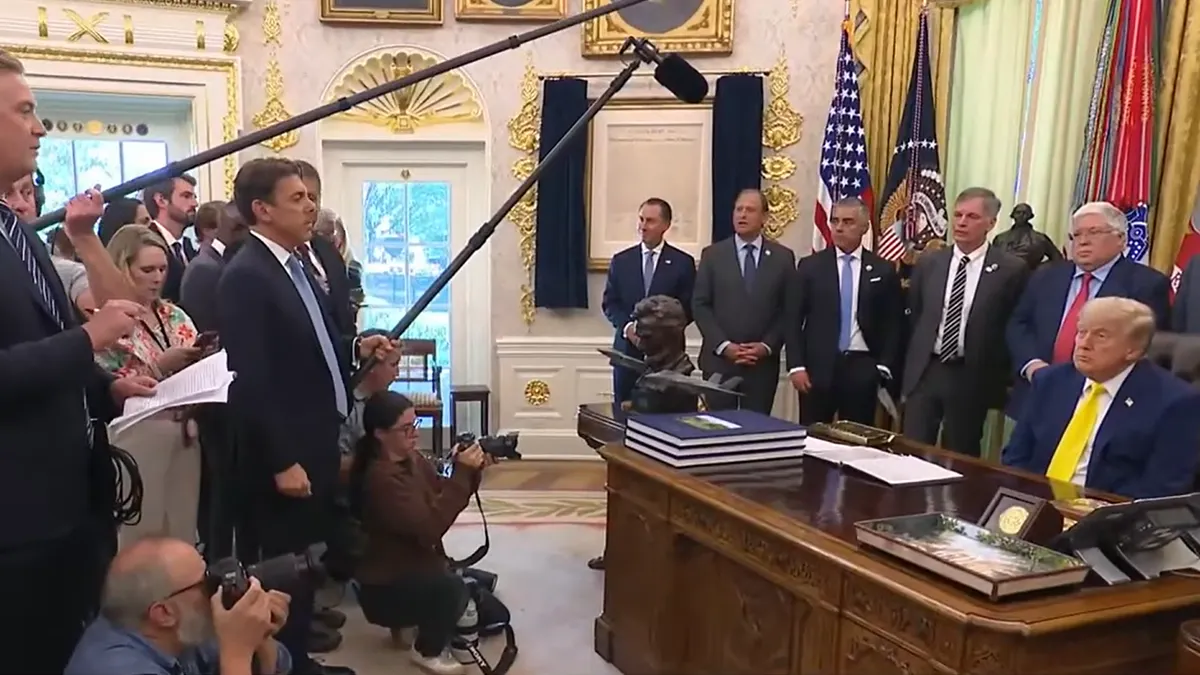
- The funds will support 17 total projects, including new coal-fired plants in Anchorage, Alaska, and Mt. Storm, West Virginia, which will have a combined capacity of 2.85 GW. “It’s all very clean,” President Donald Trump told reporters at the White House.
- Consumer and environmental advocates criticized Trump’s support for the ailing coal sector. It is “swamp politics at its worst, and there is nothing even remotely conservative about it,” David Jenkins, president of Conservatives for Responsible Stewardship, said in a statement.
Dive Insight:
The Trump administration approved 76 coal-related permits in more than a year of efforts to revive the flagging fuel and execute an agenda of “energy dominance.” His latest attempt includes tapping Defense Production Act funding to expand the industry.
“Last year we prevented 17 GW of coal-powered electricity from going offline. That’s enough power for about 13 million homes, and at a very low price. It’s the lowest price,” Trump said of coal resources.
But critics say the opposite is true. “This move, along with the President blocking the retirement of old coal plants that are too costly to operate, is making most Americans poorer,” Jenkins said. “This is a total misuse of the Defense Production Act, a giant giftwrapped payout to subsidize and prop up a flailing industry that can no longer compete in the free market.”
The coal funding is “another example of Trump ignoring the affordability crisis,” Tyson Slocum, director of Public Citizen’s energy program, said in a statement. “Abusing emergency authorities to justify subsidies for coal is a waste of taxpayer dollars and a clear giveaway to an absurdly outdated, expensive and dirty fossil fuel.”
DOE said it plans to use up to $425 million in Defense Production Act Title III funds to support a dozen coal-plant projects and $75 million for the West Gateway Terminal Project, to operate a rail-served marine export terminal. The coal projects include:
- $19 million for Arizona Electric Power Cooperative to modernize and extend the operating life the Apache Generating Station near Cochise, Arizona;
- $33 million for Duke Energy Kentucky to boost generating capacity at its East Bend Station in Boone County, Kentucky;
- $22.5 million for Oklahoma Gas and Electric’s Sooner DCS Modernization Project near Red Rock, Oklahoma, to modernize the facility’s distributed control system to maintain reliability and improve efficiency; and,
- $46.3 million for Tennessee Valley Authority to revitalize its Cumberland Fossil Plant in Stewart County, Tennessee, to meet regional demands for dispatchable power.
The West Gateway Terminal Project “will support continued growth in U.S. coal exports, improve supply chain resilience, and strengthen energy partnerships with allies throughout the Indo-Pacific region,” DOE Under Secretary of Energy Kyle Haustveit said in a statement.
In a separate announcement, DOE said four projects will receive up to $350 million under the agency’s “Restoring Reliability: Coal Recommissioning and Modernization” initiative, to add or preserve roughly 3.6 GW of coal-fired capacity.
Along with almost 3 GW of new capacity split between Alaska and West Virginia, DOE announced funding for a project in Guayama, Puerto Rico, to retrofit and modernize an existing 510-MW coal-fired plant, and another project in Cumberland, Maryland, to recommission a 205-MW facility that ceased operations in 2024.
The Anchorage plant will have 1.25 GW of new coal capacity and the West Virginia Energy Campus project will offer 1.6 GW, according to a fact sheet from DOE. They would be the first new U.S. plants to come online since 2013, Trump said.
Also Thursday, U.S. Secretary of Energy Chris Wright issued an emergency order directing the Orlando Utilities Commission to ensure that Unit 1 at the coal-fired Stanton Energy Center near Orlando, Florida, remains available to operate. The unit was slated to enter a premature extended cold shutdown this month. The order is effective through Sept. 1.
“Americans are upset about high electricity prices,” Wright said at the White House event. “Blame closing existing, reliable, secure plants, and replacing them with subsidized, unreliable plants — a gauranteed way to drive electricity prices up.”
But critics say coal plants are expensive to operate and the administration’s efforts are driving U.S. power bills higher. In March, the Sierra Club published analysis showing the Trump administration’s emergency orders to keep six retiring fossil-fueled power plants online have cost ratepayers more than $230 million.
More emergency orders have been issued since the Sierra Club analysis. Coal supporters, however, say the resources are essential and Trump’s investments will help maintain power grid reliability.
“Coal is a critical part of America’s energy security,” America’s Power President and CEO Michelle Bloodworth said in a statement. The group represents the U.S. coal sector.
“The United States has approximately 400 years of domestic coal reserves, making it one of the most fuel-secure energy sources available,” Bloodworth said.