Dive Brief:
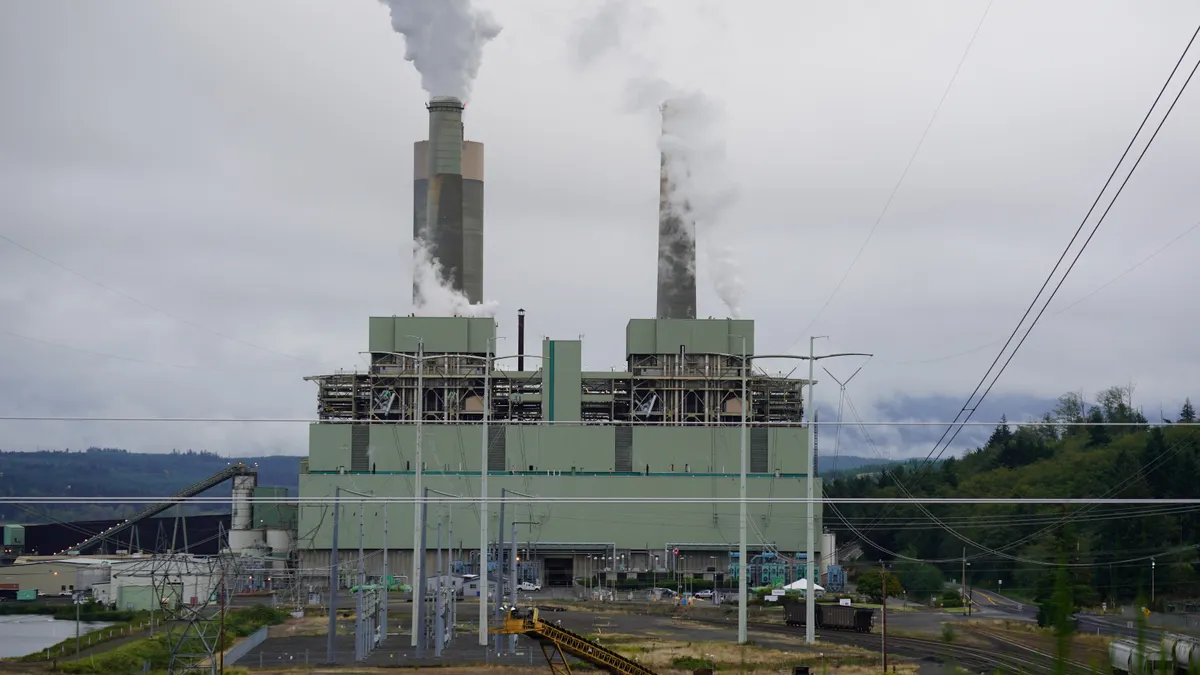
- The U.S. Department of Energy on Tuesday ordered TransAlta, a Canadian independent power producer based in Calgary, to continue running its 730-MW, coal-fired Centralia Unit 2 in Washington past its planned retirement at the end of this month.
- The order signed by DOE Secretary Chris Wright said the region faces emergency conditions from increasing demand and accelerated power plant retirements that “could lead to the potential loss of power to homes, businesses, and facilities critical to the national defense in the areas that may be affected by curtailments or power outages, presenting a risk to public health and safety.” It said the emergency could last years.
- The DOE could issue similar orders for at least five other coal-fired power plants set to retire at the end of this year, according to Earthjustice. “The shutdown of our last coal plant [in Washington] is two weeks away, and now the Trump administration has manufactured a fake emergency ordering TransAlta to keep burning coal against everyone's wishes," Patti Goldman, an Earthjustice attorney, said in a statement.
Dive Insight:
The DOE has issued a series of similar orders under the Federal Power Act section 202(c) to keep two power plants in Michigan and Pennsylvania from retiring as planned.
Lawsuits are pending in federal court to overturn those orders, which affect Consumer Energy’s majority-owned coal-fired 1,420-MW J.H. Campbell power plant in West Olive, Michigan, and Constellation Energy’s two 380-MW gas- and oil-fired units at its Eddystone power plant near Philadelphia. In part, the suits say DOE failed to show there are emergencies affecting the power systems in the Upper Midwest or the Mid-Atlantic region.
The reliability impacts of retiring the Campbell and Eddystone units was vetted by the Midcontinent Independent System Operator and the PJM Interconnection, respectively, before the grid operators approved the shutdowns.
Under the 90-day emergency order, Wright ordered the Centralia unit to remain running until March 16, 2026. It should operate at the direction of either the Bonneville Power Administration — in its role as a balancing authority — or the California Independent System Operator — in its role as reliability coordinator for the region, Wright said.
The plan to retire the Centralia power plant — Washington’s last coal-fired power plant — is enshrined in a state law based on SB 5769. TransAlta retired its 670-MW Centralia Unit 1 in 2020.
TransAlta has been selling electricity from the power plant through long-term contracts and on a merchant basis, according to the company’s financial filings.
It is unclear who will pay TransAlta to keep the Centralia plant running. Consumers Energy and Constellation will be paid through charges imposed by MISO and PJM on loads on their systems. The Northwest lacks a regional transmission organization and TransAlta lacks retail customers.
The DOE emergency orders for the Campbell and Eddystone plants were directed to MISO and PJM, not the power plant owners.
Wright directed TransAlta to propose tariff revisions or waivers with the Federal Energy Regulatory Commission “as needed.” Rate recovery is available through the federal regulation governing energy emergencies, Wright said.
The DOE order could also affect TransAlta’s recently announced plan to switch the Centralia unit to gas.
TransAlta on Dec. 9 said it agreed to sell Puget Sound Energy electricity, capacity and ancillary services over 15 years starting in late 2028 after the 700-MW fuel conversion was complete. The $600-million conversion would reduce carbon emissions from the power plant by 50%, according to TransAlta. The company said it expected to make a final investment decision after receiving all required approvals in early 2027 from the Washington Utilities and Transportation Commission.
TransAlta is evaluating the DOE’s order and will provide information on it when it becomes available, the company said Wednesday.
Last year, Centralia Unit 2 produced 2.8 million MWh, making it the ninth largest power producer in Washington that year, according to the U.S. Energy Information Administration. The unit accounted for 2.7% of the 102.4 million MWh in Washington’s net utility and IPP generation last year, the EIA said.
The DOE could issue more emergency orders for other coal-fired power plants slated to retire at the end of the month. They include:
- the 427-MW Craig 1 unit in Colorado, jointly owned by PacifiCorp, Platte River Power Authority, Salt River Project, Tri-State Generation and Transmission Association and Public Service Co. of Colorado;
- the 335-MW Comanche 2 unit, owned by PSCo;
- the 772-MW R.M. Schahfer power plant in Indiana, owned by Northern Indiana Public Service Co.;
- the 90-MW F. B. Culley 2 in Indiana, owned by CenterPoint Energy; and,
- the 590-MW Big Cajun II Unit 3 in Louisiana, partly owned by Entergy.
Also, there are gas- and oil-fired power plants set to retire this month, and coal plants scheduled to convert to different fuels, in Florida, Illinois, Minnesota, South Carolina, Tennessee, Virginia and Wyoming, according to Earthjustice.