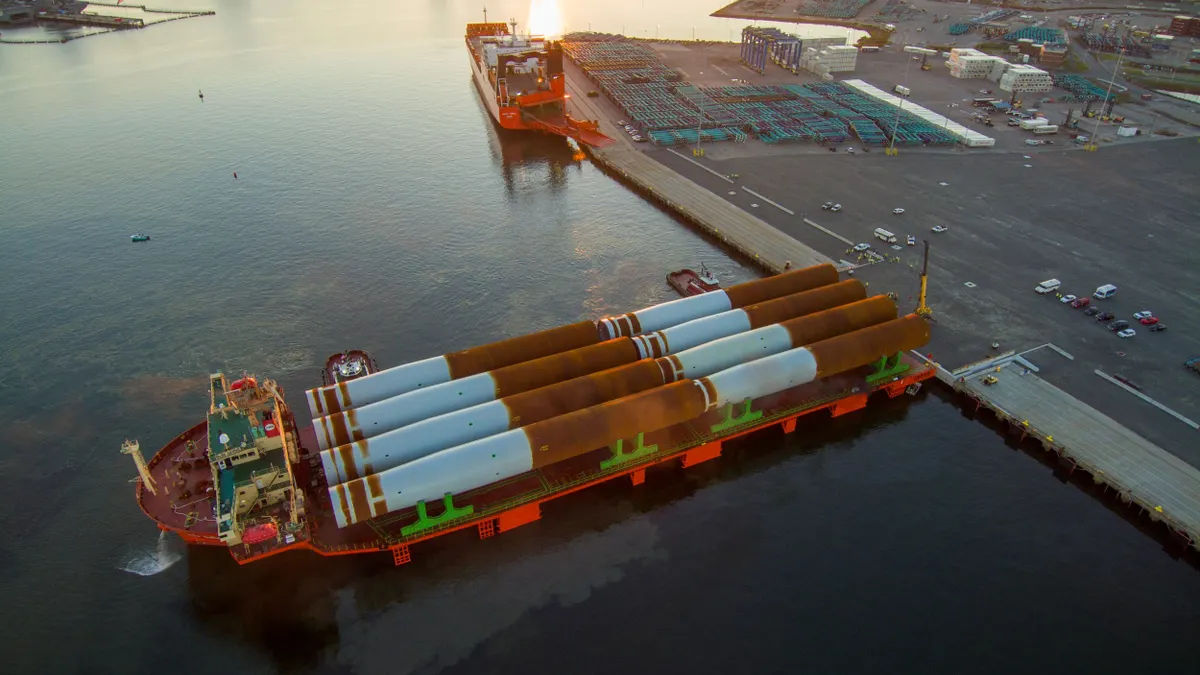
Dominion Energy says completing the 2.6-GW Coastal Virginia Offshore Wind project — the largest wind farm in the United States — by its target date of June 2027 is a top priority in the near term.
The project under construction off Virginia’s southeastern coast began producing power in March and is about 75% complete, according to an investor presentation on the company’s 2026 first-quarter earnings. Nine of its 176 turbines were installed as of the end of April, with the last four turbines taking about two days each to install.
Dominion cast the uncertainty created by President Trump’s stop-work order on CVOW and four other offshore wind farms under construction off the Atlantic seaboard as manageable. The project’s estimated capital budget actually declined slightly early this year, to $11.4 billion, as the stop-work order lifted and the U.S. Supreme Court quashed Trump’s sweeping tariffs.
Robert Blue, Dominion’s president, chairman and CEO, said in a call with analysts Friday that CVOW would generate approximately $5 billion in fuel savings for customers over the first 10 years of operations. Dominion’s fuel and other energy-related costs jumped 67%, according to the company’s quarterly report to the Securities and Exchange Commission.
Dominion pegged CVOW’s levelized energy cost at $84/MWh, within the $80-$90/MWh range spelled out in its initial state regulatory filing in 2021.
“With no change to either LCOE or customer bill impacts, CVOW remains one of the most affordable sources of energy for our customers,” Blue said.
A focus on transmission, distribution as data center pipeline grows
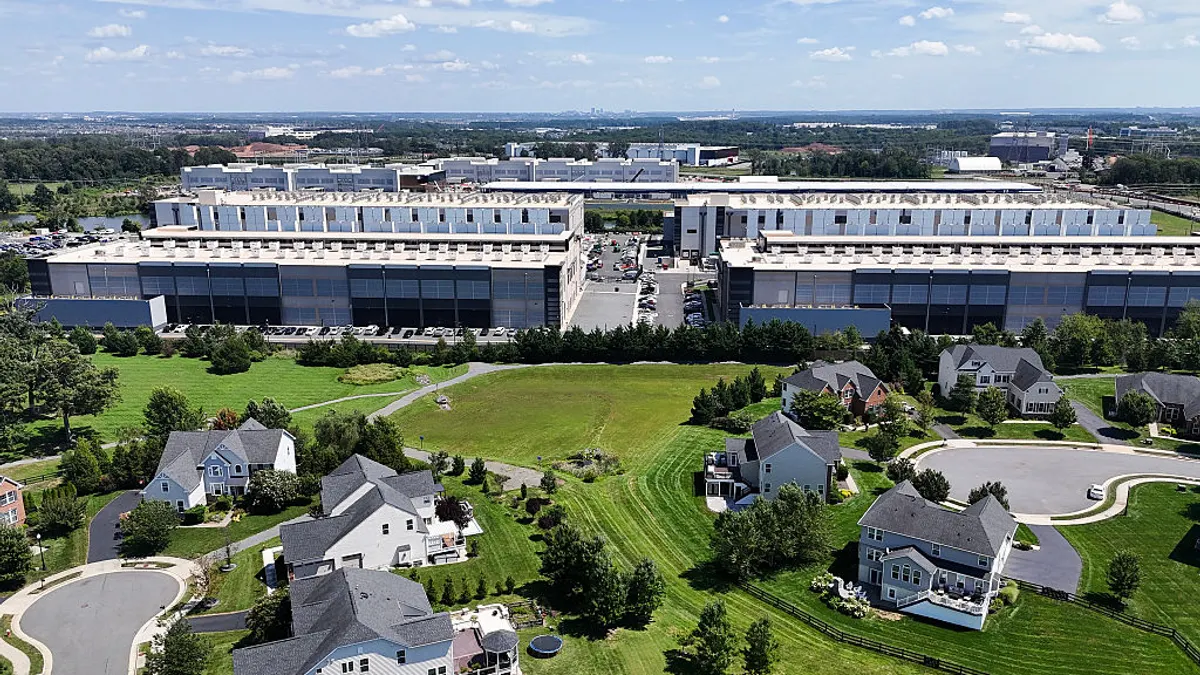
Dominion Energy’s pipeline of contracted data center capacity has risen approximately 5% since December and now stands at about 51 GW, the company said today. In Virginia, its largest utility market, Dominion sold 4% more electricity year over year in the first quarter of 2026.
The rise in sales was driven by robust commercial growth of 8.4% – mostly from data centers, according to an investor presentation. Sales to residential and industrial customers grew by 1.3% and 0.9%, respectively.
With robust load growth and a growing large-load pipeline driving significant regulated investment needs, Dominion expects annual earnings growth of 5% to 7% through 2030 “with a bias starting in 2028 toward the upper half of the range,” Chief Financial Officer Steven Ridge said Thursday.
Dominion, whose subsidiaries include regulated electric utilities serving parts of Virginia and the Carolinas, left its five-year capital spending projection unchanged from its previous investor update at about $65 billion.
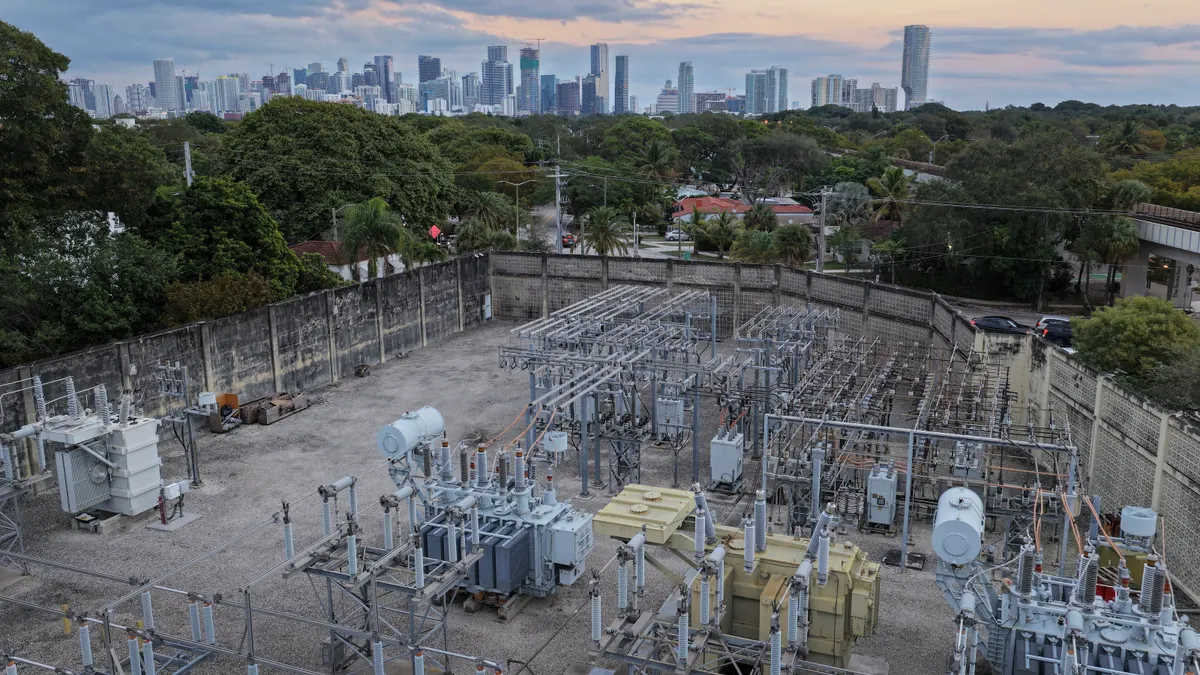
Nearly half of the planned investment will support transmission and distribution infrastructure, the company said in December. In February, the PJM Interconnection’s board approved $11.8 billion in transmission projects, $4.8 billion of which will occur in Dominion’s Virginia territory.
Gas generation will account for nearly one-fifth of the total planned spending, with solar and energy storage combining for another 13%, the company said in December.
Though Dominion’s five-year spending estimate remained unchanged, Ridge said it could find “incremental opportunities to deploy regulated capital” in the early 2030s and beyond. The company expects its expanding data center pipeline to act as a tailwind for some time to come, he said.
“We continue to see accelerating and durable demand from our differentiated high-quality, low-risk data center customers,” Ridge said.
Nodding to the affordability concerns that have come to dominate public debate around data center development and utility investment generally, Ridge said Dominion was confident large-load customers “will fund the infrastructure required for their growth, protecting existing customers from cost shifts and mitigating stranded cost risk.”
Ridge also flagged a new Virginia law expanding the state’s long-range energy storage procurement targets. The law, one of several clean energy bills signed into law by Democratic Gov. Abigail Spanberger this spring, requires Dominion to petition for a combined 20 GW of short- and long-duration energy storage projects by 2040 — up from 3 GW by 2035, Ridge said.
“We’ll reflect this new multi year opportunity as well as other regulated investment opportunities in our capital update early next year,” he said.