El Niño has developed in the Pacific Ocean, with warming water potentially upending U.S. weather patterns and complicating electric utility forecasting, say meteorologists at AccuWeather following NOAA’s June 11 declaration.
The return of El Niño could offer some relief to utilities preparing for another active Atlantic hurricane season, but it may increase operational risks elsewhere on the grid, experts said. The previous El Niño episode persisted from 2023 into 2024.
The climate pattern is developing unusually early and is strengthening quickly, allowing it to exert greater influence on weather conditions across the United States. The outlook comes as utilities continue to invest in grid resilience and storm response capabilities.
A split summer scenario, where regions across the U.S. experience contrasting weather patterns, is expected to increase pressure on regional power systems, with AccuWeather forecasting heavier rainfall in parts of California and the Southwest alongside hotter, drier conditions across the Northwest, Northern Plains and Upper Midwest.
In Florida, forecasters expect periodic stretches of above-normal temperatures and below-average rainfall that could add to load management challenges. Meteorologists said the shifting conditions may drive flooding and debris flows, along with drought and wildfire threats, with the potential for regional outages and broader grid disruptions through late fall.
AccuWeather is predicting 11 to 16 named storms in the Atlantic, which would be below recent La Niña-influenced seasons, but fewer storms do not mean lower reliability risk. AccuWeather Lead Hurricane Expert Alex DaSilva said storms forming close to the coastline during El Niño years can pose heightened risks due to shorter preparation time.
“It only takes one storm,” DaSilva said, noting that even a quieter season can still yield significant infrastructure damage.
The Edison Electric Institute, which represents investor-owned utilities, is prompting its members to coordinate with industry and government partners on preparedness and mitigation efforts to maintain reliability and support rapid restoration. The El Niño pattern “can affect storm activity and add uncertainty to seasonal outlooks,” EEI Senior Vice President of Industry Operations Jennifer DeCesaro told Utility Dive in an email.
The trade group highlighted mutual assistance efforts that allow companies to pre-position crews, equipment and supplies ahead of major storms, a key strategy given that severe weather accounted for roughly 80% of power outages between 2000 and 2023.
Looking beyond this year, AccuWeather sees elevated drought risk persisting across portions of the Plains from Texas to North Dakota even after El Niño peaks, raising longer-term concerns for resource adequacy and system planning.
“El Niño patterns tend to be persistent, meaning places that end up drier than average can stay that way for an extended period of time, possibly for months or even years,” said AccuWeather Expert Meteorologist Paul Pastelok.
AccuWeather also estimates a 40% chance the climate pattern strengthens into a rare “Super El Niño,” which could extend weather impacts into 2027.
As weather risks grow more complex, utilities are expanding investments in distributed energy resources. An Electric Power Research Institute report identified microgrids, energy storage and automation tools as ways to support localized islanding for faster restoration, though the technologies also face weather-related limitations.
“Microgrids are not immune to extreme weather; therefore, climate-informed planning must account both for how microgrids enhance resilience and how extreme weather may degrade performance or alter generation and storage availability,” said Erik Smith, technical leader of climate data analysis at EPRI, in a written statement.
Utilities are also allocating increasing funds for targeted prevention, including Florida Power & Light’s nearly $15.1 billion, 10‑year Storm Protection Plan. The shift is toward vegetation management, stronger poles and selective undergrounding as overhead lines and substations remain key failure points in severe weather, where localized damage can quickly cascade into broader outages.
“The goal is not to harden everything, but to invest where outage risk and community impacts are highest,” said Hayley Lai, grids and utilities analyst at BloombergNEF, in an interview.
Lai added that storm-related costs, often recovered over time through rates or surcharges, can result in customers paying for restoration long after an event. Public funding or regulatory action may offset some costs, but typically not fully, and underinvestment can result in repeated outages and more expensive recovery efforts.
Ryan Ward, a weather and commodities analyst at BloombergNEF, said recent storms underscore that variability. He pointed to a new study that found Hurricane Helene left nearly 6 million customers without power across 10 states, while Hurricane Zeta affected more than 3,700 miles of transmission lines — more than Hurricane Ian, which caused 2,455 miles of transmission impacts despite being a Category 4 storm.
“In short, a weak season overall does not imply no risk, especially if a storm landfalls in a vulnerable location,” Ward told Utility Dive in an email.
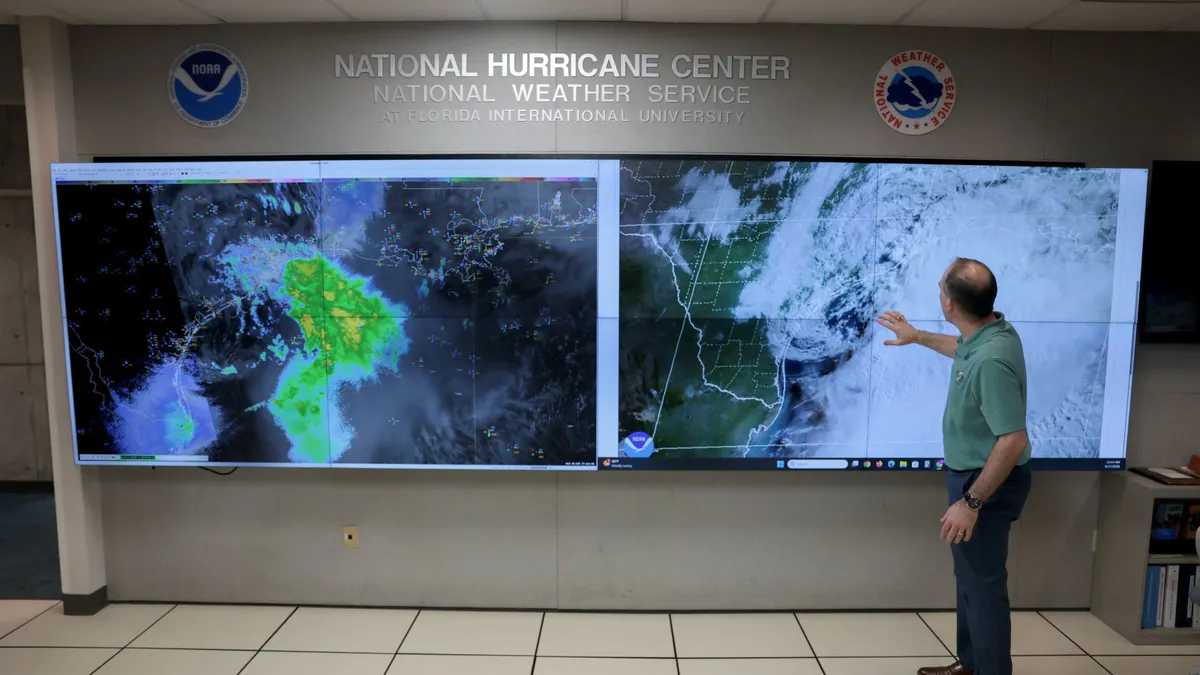
The El Niño outlook comes as policymakers and weather experts debate the future of federal forecasting capacity. The Trump administration has proposed reducing NOAA funding by roughly 26% in fiscal year 2027 while NOAA and the National Weather Service continue efforts to reorganize operations and address staffing gaps.
Critics argue the cuts could undermine weather forecasting at a time when utilities are facing growing exposure to hurricanes, floods, wildfires and extreme heat.
“These cuts diminished our ability to study, monitor, forecast, and warn for hurricanes and other hazards,” said John Morales, meteorologist and Climate Power co-chair, in a formal statement. “Weakening our ability to save lives and property in the face of increasingly severe and frequent extreme weather events is a dangerous mix.”