Dive Brief:
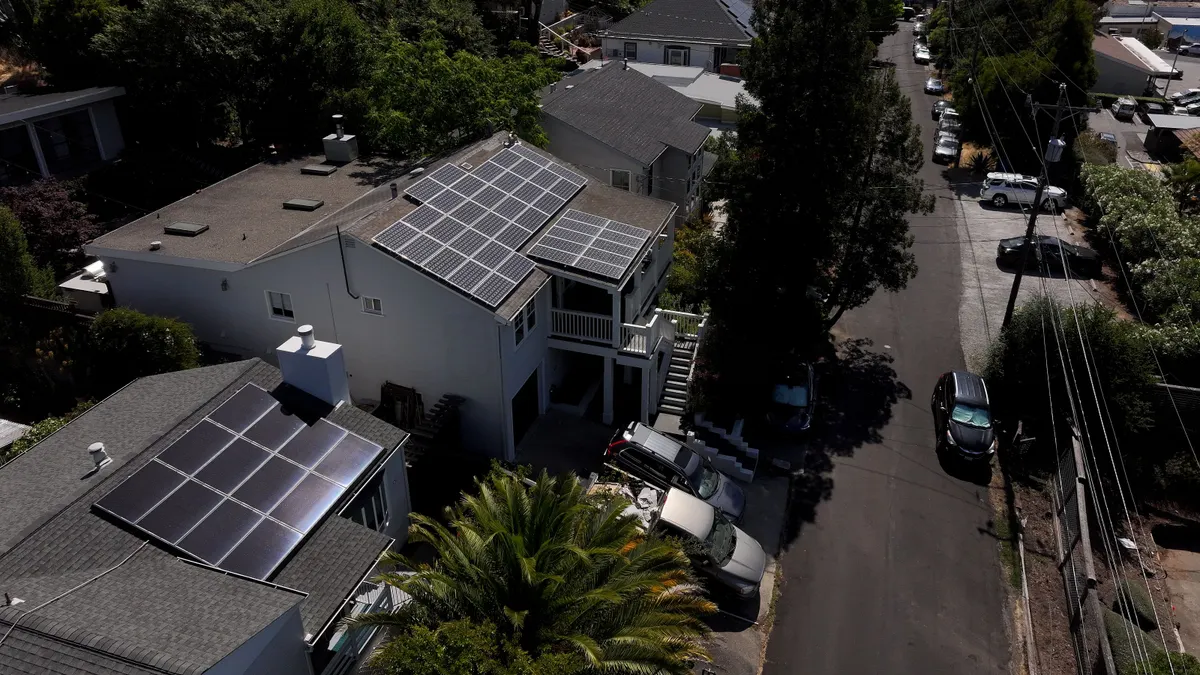
- Pacific Gas & Electric Co. is teaming up with Google, Rewiring America and other partners to enroll tens of thousands of existing and new distributed energy assets in two Northern California counties to support what it says is a new kind of virtual power plant.
- Dubbed SHARE and operated by PG&E and Demand Side Analytics, the “proof-of-concept” VPP aims to create additional capacity, boost reliability and “help put downward pressure on rates” while reducing participating households’ net electricity bills, PG&E said on Sept. 3.
- SHARE appears to be an early real-world test of a proposition floated by Rewiring America last year: that hyperscalers like Google can substantially offset expected near-term power demand from AI compute, and at lower cost than building new gas-fired generation, by subsidizing distributed energy resource deployments at scale.
Dive Insight:
SHARE partners Tesla, Sunrun and Renew Home will begin working with PG&E this fall to enroll nearly 21,000 existing residential flexible energy devices into the program, the utility said.
Tesla and Sunrun are among the United States’ biggest providers of residential battery capacity. Renew Home says it has 4 GW and counting of controllable load across millions of smart thermostats. In June, the three companies said they could collectively unlock nearly 17 GW of flexible energy capacity nationwide.
California alone accounts for 4.7 GW of that capacity, split about 75/25 between batteries and thermostats. PG&E said these existing resources could begin supporting the grid through SHARE later this year.
The program takes a “location-based approach … designed to inform future solutions for transmission constraints, local capacity challenges and rising demand across the electric system,” PG&E said.
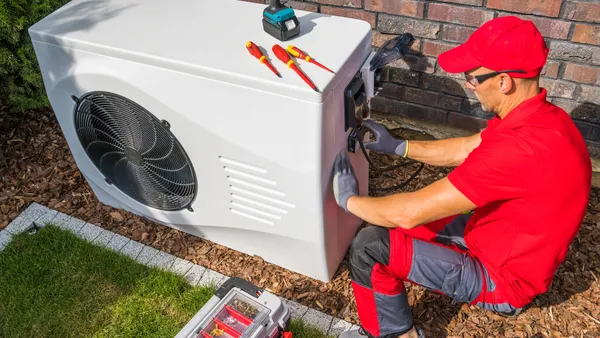
Carrier will support efforts to deploy new resources in support of SHARE, PG&E said. The HVAC giant said last year that it would begin deploying variable-speed, residential-scale heat pumps with up to 10 kWh of integrated battery capacity. It began a pilot last year in partnership with the Electric Power Research Institute to test the devices’ load-shifting capabilities in the real world, according to Canary Media.
Hakan Yilmaz, president of Carrier Energy and the parent company’s chief sustainability officer, said in a statement that SHARE would demonstrate how his company “can help deliver distributed capacity with the firmness to scale as a fast and reliable grid resource.”
Amanda Peterson Corio, Google’s global head of energy and power, said in a separate statement that SHARE would show that with proper optimization, today’s electricity grid can meet rising power demand without burdening ratepayers.
“This program unlocks the potential of local distributed energy resources to strengthen grid capacity and resiliency while delivering meaningful benefits for local communities," Peterson Corio said.
PG&E said that SHARE will be fully funded by Google and run through 2027, with initial findings shared publicly later this year or in early 2027. The proof-of-concept could eventually expand to include commercial, industrial and utility-scale assets, it added.