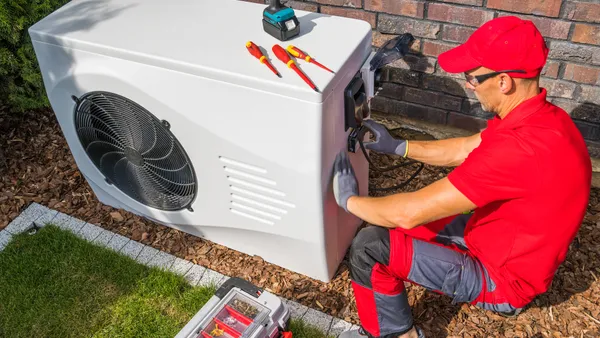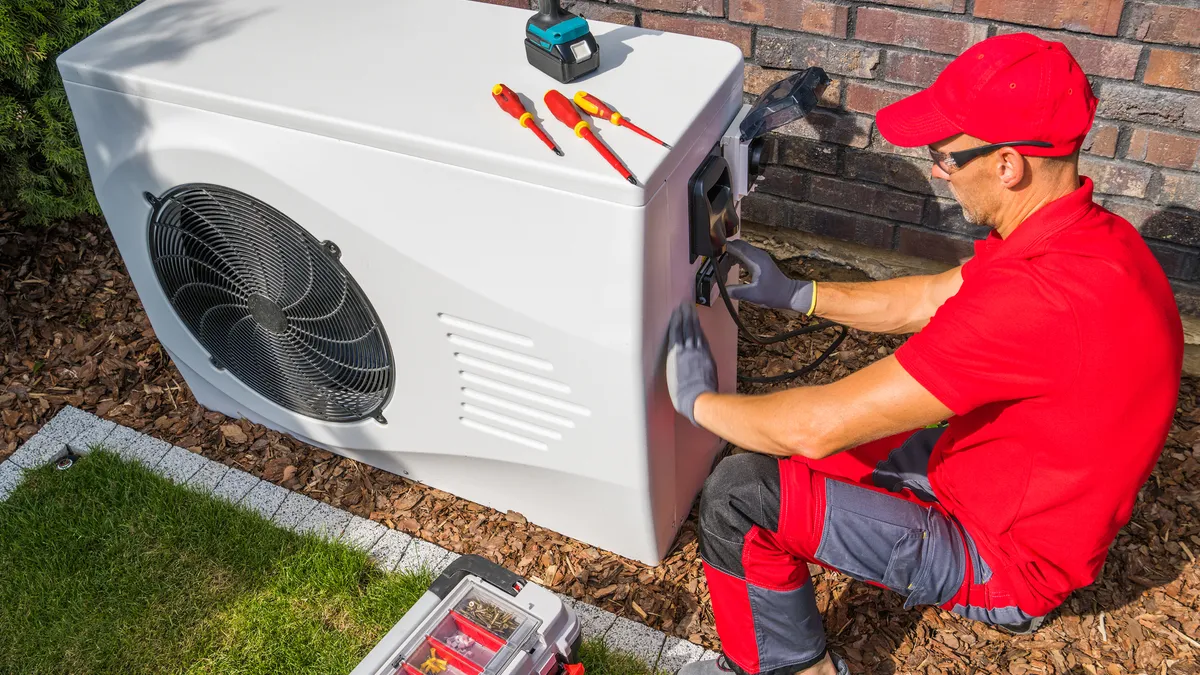
There is sufficient available capacity on the U.S. electric grid for 86 million additional home heat pumps to operate — and adding them could reduce residential electric rates by an average of 13% in summer-peaking states, according to new research from RMI.
There are about 23 million heat pumps operating in the United States today; expanding that almost five-fold with a mix of all-electric and hybrid heat pumps could save $15.6 billion per year — or $200 annually per customer, RMI said. A similar deployment using only all-electric heat pumps could reduce residential rates by an average of 6% across summer-peaking states, the analysis found.
“Strategic heat pump deployment can improve grid utilization and put meaningful downward pressure on residential electricity rates,” RMI’s report concluded. “Load growth doesn’t have to mean higher rates.”
The clean energy nonprofit was founded as Rocky Mountain Institute in 1982 following the energy crisis of the late 1970s, which prompted the federal government to set efficiency standards, among other things.
Its report points out that U.S. national average residential electricity rates are up more than 8% in two years, and that many are blaming new demand, particularly from large-load data centers. But rising demand doesn’t have to drive up costs, the report says.
“Thankfully, we’ve successfully dealt with this before: US electricity demand grew by over 70% between 1980 and 2000, while inflation-adjusted average retail rates fell by approximately 26%,” it said. “One major reason was improved utilization and efficiency of the electric grid. During this same time period, utilization of the bulk power system (i.e., average load relative to installed generating capacity) improved by roughly 18%, allowing utilities to spread fixed infrastructure costs over more kilowatt-hours sold and put downward pressure on rates.”
The report concludes that heat pumps could help do that again, especially in summer-peaking states where filling winter headroom increases sales without requiring new generation resources.
RMI generated its analysis utilizing seasonal generation capacity from the U.S. Energy Information Administration, and hourly load modeling from Evolved Energy Research and National Lab of the Rockies.
States in the Southwest, Upper Midwest and Northeast tend to have “significant” winter headroom, as their grid use peaks in the summer, the report said. Many states in the Southeast and Pacific Northwest have similar summer and winter headroom, “in part because of widespread electric resistance heating,” RMI noted.
It estimated that expanded heat pump deployment could mean $375 in annual savings per customer in Michigan; $390 in New Jersey; and $300 in Pennsylvania.
RMI cautioned, however, that its analysis should be interpreted as “directional estimates that identify where the greatest opportunities exist” rather than precise forecasts.
The biggest way for states to expand heat pump use, particularly following the elimination of federal incentives and weatherization support, is to set heat pump installation goals and redesign utility incentive programs, said Ryan Shea, a manager in RMI’s carbon-free buildings team.
The aim for states is “not necessarily putting more money to incentive programs, because that's a bit challenging right now in the political environment, but rather redirecting where the dollars are going,” Shea said in an interview.
“There's still a lot of incentives for central air conditioners, furnaces and boilers,” Shea said. “Our recommendation is to shift some of that funding away from the one-way air conditioner to a heat pump that does heating and cooling to really better utilize those ratepayer funds.”
Another key is to improve electric rate design so that it is “more cost reflective of the grid today,” Shea said. “Generally, in states where there's this opportunity for winter headroom, that means that electricity costs should be lower in the winter than the summer, and that would help spur adoption.”
Other RMI recommendations to expand heat pump uptake include updating local building codes and adopting standards for new construction to encourage higher efficiency systems.