Shaun Walsh is chief marketing officer at Peak Nano, an advanced materials manufacturer.
There's a moment in the history of every capital-intensive industry when growth hits a wall. The infrastructure can't keep up. The companies that need to keep growing stop asking for solutions and, instead, start building them.
Railroad companies built steel mills. Oil companies built pipelines. Now, AI hyperscalers are building power plants.

For utilities, this moment has arrived from an unexpected direction. The largest customers on the grid have stopped waiting for capacity and started developing it themselves. Hyperscalers face the same three-year lead times for turbines, transformers and switchgear, but they aren’t restricted by the regulatory frameworks that tie utility spending to rate impacts and prudency review. They can move fast and pay whatever it takes. In this environment, building your own generation isn't reckless. It's the only rational response.
Global data center electricity consumption is approaching 1,050 TWh, nearly triple 2024 levels. AI server racks now demand 40 kW to more than 100 kW each, compared with 5 kW to 15 kW for traditional racks. Training a single large language model can consume more than 1,000 MWh.
Grid infrastructure was planned around 1%-2% annual load growth. Utilities built the right system for that world. But now we're in the sharpest demand upswing since the post-World War II buildout, and generation and transmission timelines haven't caught up.
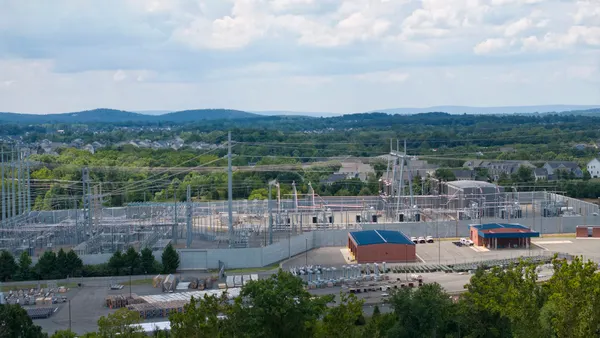
Federal Energy Regulatory Commission Order 2023 has started clearing a 2,000+ GW interconnection queue, but the path to commercial operation still stretches for years. A new Department of Energy-directed FERC rule on large load interconnection is a federal acknowledgment that the existing process wasn't built for today’s loads.
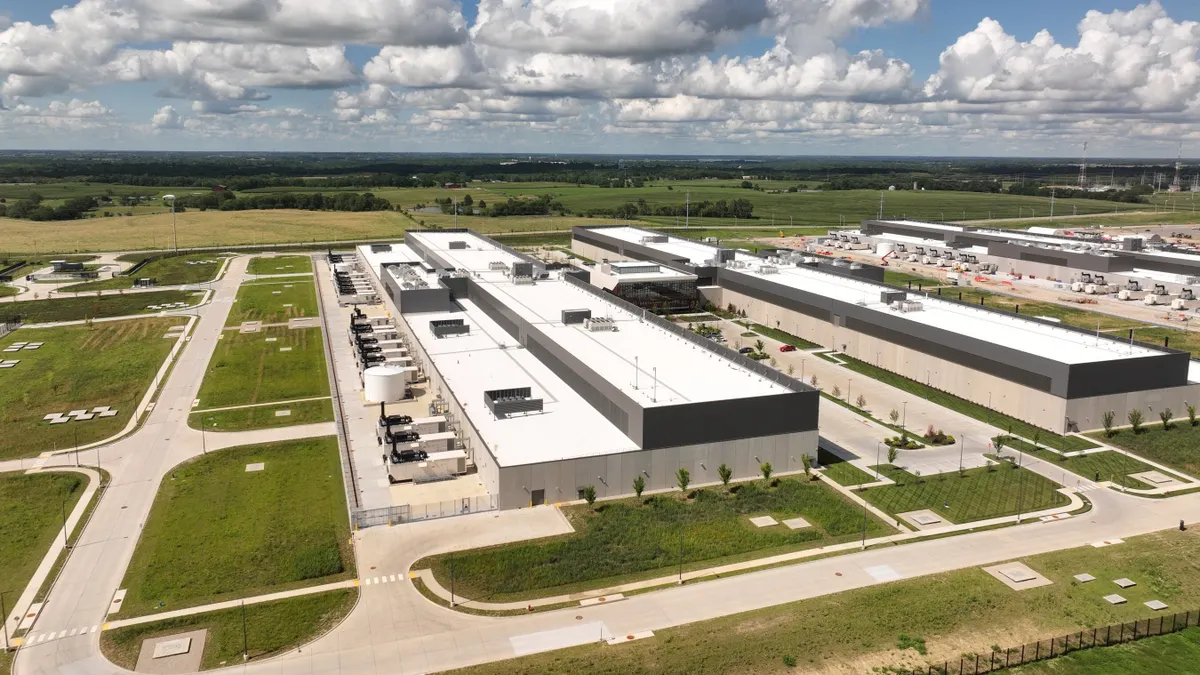
Data center developers are sitting on approved projects they can't power. So they’re building their own supply:
-
Microsoft agreed to buy all of the power from the restarted Three Mile Island under a 20-year contract with Constellation Energy, backed by a billion-dollar DOE loan. This is the first time DOE has finalized a nuclear loan and conditional commitment simultaneously. Microsoft's Brookfield Renewable partnership adds more than 10.5 GW over a $10 billion+ investment horizon.
-
Meta locked up 6.6 GW through deals with TerraPower, Oklo and Vistra, funding 433 MW of nuclear capacity uprates in the process.
-
Amazon secured 1.92 GW from the Susquehanna nuclear facility and is exploring small modular reactor technologies.
-
Google signed the world's first corporate agreement to buy power from multiple SMRs through Kairos Power, targeting 500 MW by 2035. It also announced a $40 billion investment in Texas to build new cloud and AI infrastructure, focusing on expanding its data center footprint into rural areas for the first time.
When infrastructure can't keep up, the largest companies vertically integrate.
Restarting reactors, funding capacity uprates and pledging to cover 100% of facility transmission and infrastructure costs (as Microsoft, Google, Meta, Amazon and xAI did in the March Ratepayer Protection Pledge) are now the fastest ways to fulfill "bring your own energy" commitments.
This is how power companies behave. These tech firms now manage generation assets, transmission risk, load forecasting and grid relationships at a scale that dwarfs most utilities. And their role keeps expanding:
-
NVIDIA's Vera Rubin DSX AI Factory software enables dynamic grid stabilization during peak demand.
-
Tesla's Megapack systems allow hyperscalers to trade energy autonomously in wholesale markets.
-
Google's clean transition tariff formalizes its role as an active grid participant, not a passive ratepayer.
For regulators and utility planners, these developments introduce hard questions about jurisdiction that rate cases, transmission planning proceedings and FERC dockets are only beginning to address.
The shift to 800-volt direct current architecture
Vertical integration doesn't stop at the power plant. It runs through the facility power chain. That's where utilities and hyperscaler engineering converge.
Moving from legacy alternating current architectures to high-voltage direct current changes the economics of every watt. Using NVIDIA's AI power-planning models, 800-volt DC architecture, or 800 VDC, delivers about 42% more GPU capacity from the same generation by eliminating conversion losses and reclaiming rack space.
This change isn't isolated to data centers. FERC Order 1920 identifies HVDC as the preferred technology for long-distance and offshore interconnection.
AC's conversion losses are no longer acceptable. We can optimize every gigawatt committed in these agreements through 800 VDC.
A few core technologies have become make-or-break enablers on both sides of the meter: solid-state switches, solid-state transformers and next-generation capacitors are among them.
The shift to 800 VDC concentrates enormous electrical stress onto components that weren't specified for AI rack environments.
Capacitors, for example, sit at every stage of the 800 VDC chain: They filter the DC bus, protect the busway, tune converters and absorb GPU power spikes. Film capacitors are the only viable technology for the 800 VDC bus, making the dielectric film inside them the foundational material decision for the entire power stack.
When a hyperscaler signs a 20-year nuclear agreement, it's committing to 20 years of power electronics performance inside every facility that agreement serves. The component layer has to match the ambition of the power program.
The supply chain beneath the supply chain
The companies dominating AI computing are becoming some of the most consequential new entrants the utility sector has ever seen. The capital has been committed. The operational responsibilities are binding. And the engineering requirements, from generation assets down to dielectric films inside capacitors, must be held to utility-grade standards.
Capacitor-grade dielectric film production is highly concentrated in China. For the companies now operating as de facto utilities, and for the defense and grid modernization programs sharing the same component supply chain, that concentration is a structural vulnerability that will only grow alongside demand.
The Ratepayer Protection Pledge signals that hyperscalers understand their infrastructure has consequences. Right now, a more than 70% dependence on Chinese-origin dielectric film doesn't reflect that understanding.
For critical infrastructure that must operate for decades under all geopolitical conditions, sourcing materials domestically and through allied nations is a risk-management requirement. It's an area where federal policy, from the Defense Production Act to DOE loan programs, is starting to catch up to the engineering reality.