

Today’s utility work on quantum computing has one key goal: to not be left scrambling to address quantum’s impact on overall electricity demand and its curious load profile, like the electric power sector has been with artificial intelligence.
Quantum computing harnesses the principles of quantum mechanics to process information in ways classical computers cannot, said Jeremy Renshaw, the director of open power AI and quantum with the Electric Power Research Institute. It adds new computing capabilities that complement classical computing, he added.
Those capabilities could reduce AI data centers’ electricity use, improve cybersecurity and optimize power system dispatch.
“In the near future, for the subset of problems where quantum computing holds an advantage, such as large-scale optimization and materials science, it offers polynomial or even exponential speedup,” Renshaw said. “Longer term, quantum computing will be the go-to resource for solving large scale problems.”
Quantum computing is now reaching a “commercial tipping point,” according to an April McKinsey market report. Worldwide, over 300 companies have started trying out the complex technology that grew out of quantum physics, and investment in startups reached $12.6 billion in 2025 — six times the 2024 investment.
While experts agree quantum computing has potential to unlock advances in energy, they say its load profile is still uncertain, presenting a particular challenge to electric utilities.
“This is a toe-in-the-water moment that can show the opportunities and risks of quantum and its potential impacts on affordability and reliability in a gated way.”

Brad Gibson
COO, Middle Tennessee Electric
Duke Energy is among the utilities working to understand quantum computing’s energy use and potential.
“Utilities routinely balance thousands of interconnected variables involving generation, transmission, demand, weather, regulatory constraints and customer impacts,” Isuru Wijesundara, lead enterprise architect for energy strategy and advanced computing at Duke, told Utility Dive in an email.
Optimizing such highly complex calculations would create important value for utilities, he said.
More electricity demand?
The first question anybody in the power sector will ask is whether quantum computing will add another demand surge to the already stressed U.S. power system.
“The load profile is different from anything utilities have planned for before,” said Aparna Prabhakar, chief strategy and sustainability officer, energy management, for power sector hardware and software provider Schneider Electric. It requires 24/7 cryogenic cooling to near absolute zero with added layers of incremental workflow loads, she added.
Planners must “build smarter infrastructure” because more substations will not address this new load profile, Prabhakar said. Software-defined power systems can let utilities see, orchestrate and de-risk the new load and the new load profile in real time, she said.
Although the technology is still emerging, Prabhakar thinks quantum data centers will have reliability and power quality requirements “at least as demanding as conventional data center loads,” even where total power demand is far lower.
Not everyone agrees completely.
“Quantum computing’s processor power use is comparatively small for those large-scale computations,” said Renshaw. Even though many quantum computing modalities require about 15 kW from cooling systems to get and keep certain components at near absolute zero, “the energy to cool even millions of ions or atoms is extremely small compared to the energy used for AI training in GW-scale data centers,” he said.
While Prabhakar and Renshaw differed on how they see quantum computing’s load profile developing, they agreed that due to its potential impact on the grid, utilities should be in the earliest conversations about standards.
Utilities working with quantum now
Quantum computing is still an emerging technology, but not one business leaders can afford to ignore, McKinsey said. Companies that build capabilities and test use cases are the ones likely to have part of the up to $2.7 trillion in economic value that quantum is estimated to have in the 2030s, it added.
McKinsey identified over 300 organizations from medical technologies and pharmaceuticals to financial services, energy, and material sciences, including Airbus, E.ON, and JPMorgan Chase, collaborating with quantum technology companies. Quantum computing companies generated “more than $1 billion in revenue worldwide in 2025 — and that could grow to as much as $4.4 billion by 2028,” it said.
Pilots at EPB, Chattanooga’s municipal utility, and electric cooperative Middle Tennessee Electric, have already begun to study power system optimizations using quantum computing.
With partners like private sector quantum computing leader IonQ, the Oak Ridge National Laboratory and the University of Tennessee, EPB has had a quantum communications network since 2023, said Patrick Swingle, EPB’s manager of quantum systems and strategic initiatives. It will install a quantum computer with 36 logical qubits later this year, he added.
EPB will use the quantum computing to plan locations and dispatch for the 150 batteries on feeders across its 200,000 meters and 112 substations, Swingle said. It will also optimize planning for the charging and discharging of the batteries for supply-demand and peak load forecasts, and prepare the utility for future real time dispatch as loads and weather change, he added.
EPB will initially use a hybrid of quantum and classical compute built on NVIDIA’s CUDA-Q platform that allows work across QPUs, GPUs and CPUs, Swingle said.
MTE is working with similar partners and Middle Tennessee State University’s QRISE Center, said Brad Gibson, the utility’s chief operating officer. The initial interest was cybersecurity, but, like EPB, it is now exploring quantum’s potential applications for the 82 or more batteries it will soon have across its 365,000 meters, 2,200 square mile service footprint, he added.
“This is a toe-in-the-water moment that can show the opportunities and risks of quantum and its potential impacts on affordability and reliability in a gated way,” Gibson said.
Other utilities are also taking notice.
Commonwealth Edison announced with fanfare in 2025 that it is powering the Illinois Quantum and Microelectronics Park, a 128-acre, multibillion-dollar campus on the site of the former U.S. Steel South Works on Chicago’s South Side that will be devoted to quantum technology and microelectronics innovation.
The park is managed and operated by a research organization owned by the board of trustees of the University of Illinois and its anchor tenant, PsiQuantum, plans to house the first utility-scale, error-corrected quantum computer there. Other tenants include IBM and Infleqtion.
The announcement said ComEd is delivering “the advanced energy infrastructure needed to support utility-scale quantum computing, including cryogenic cooling systems and grid enhancements.”
Gil Quiniones, President and CEO of ComEd, said in a news release that quantum technology has “extraordinary potential” to fuel breakthroughs in major economic sectors, including energy.
Constellation Energy is also supporting research at the park focused on quantum computing use cases in the energy sector, including nuclear reactor fuel assembly, according to an April statement.
In an email to Utility Dive, Constellation Spokesperson David Snyder said quantum computing systems are projected to require relatively modest amounts of power and are unlikely to materially affect power demand in the foreseeable future.
Duke Energy is working with IBM Quantum and others to build “foundational quantum literacy” as the technology evolves, said Wijesundara.
It is “one of the lowest-risk and highest-value investments we can make” in something that is “potentially transformative” for utilities, he added.
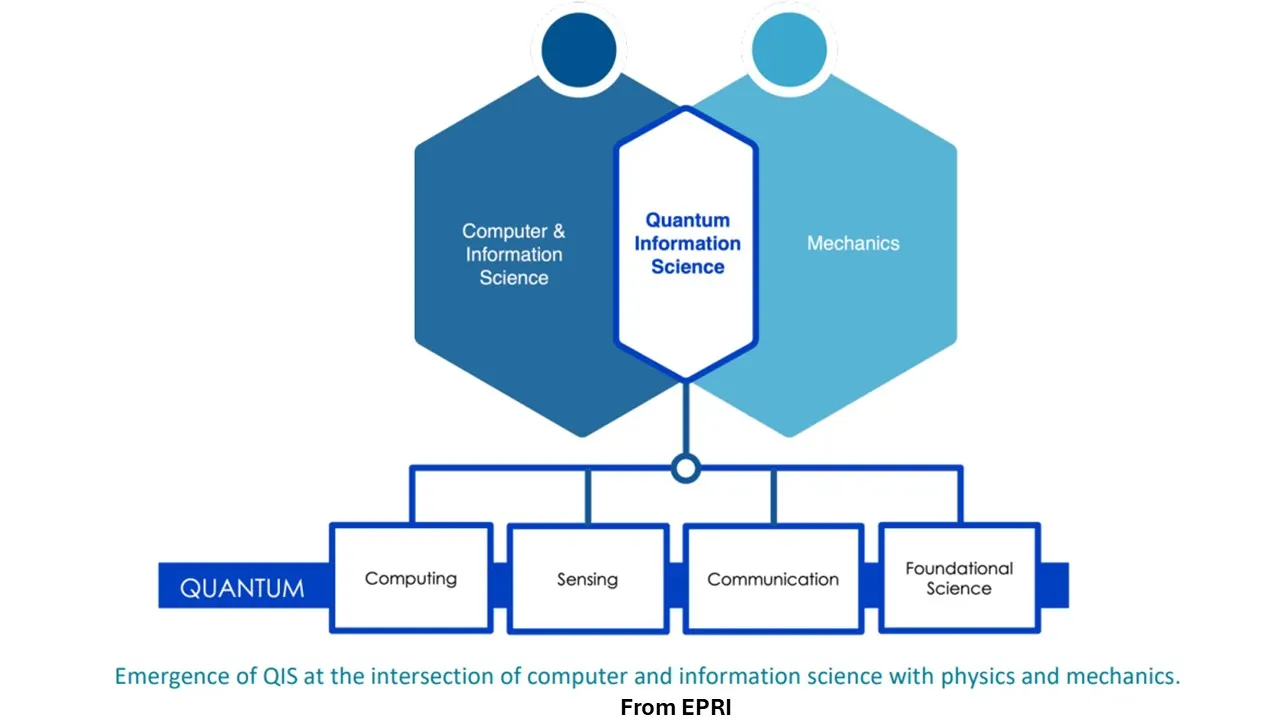
What is quantum computing?
Instead of computer code’s ones and zeroes, quantum computing uses qubits, which can exist as both zeros and ones through the principles of quantum mechanics, EPRI’s Renshaw said.
Qubits allow quantum computers to work in “vast solution spaces simultaneously, exponentially speeding up problem solving,” he added.
Physicists widely disagree on why particles can simultaneously be in two states, and the biggest agreement is only among 36% of respondents to a 2025 Nature poll. But the principles of quantum mechanics have been experimentally verified since 1927 and physicists have found important use cases for it, like laser technology, Nature said.
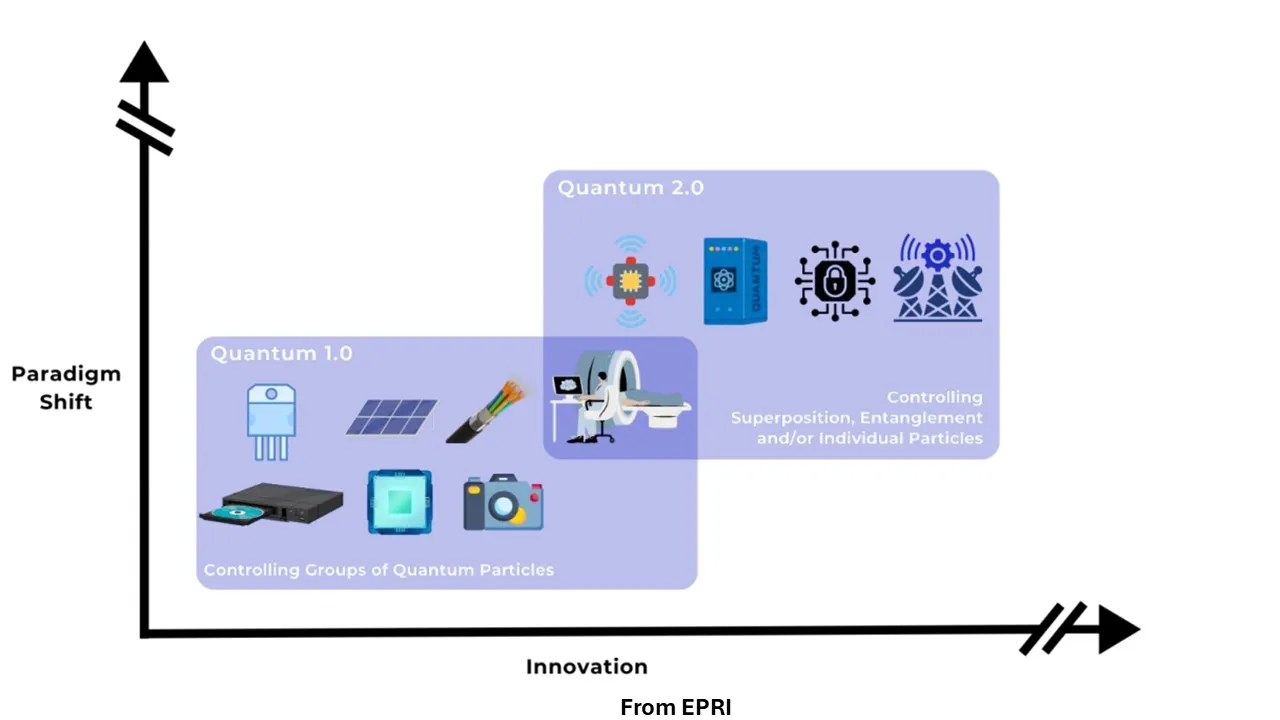
The implications for those that know how to use quantum computing will be potentially paradigm-changing solutions across the economy, but for a relatively small set of challenges in each sector, experts say.
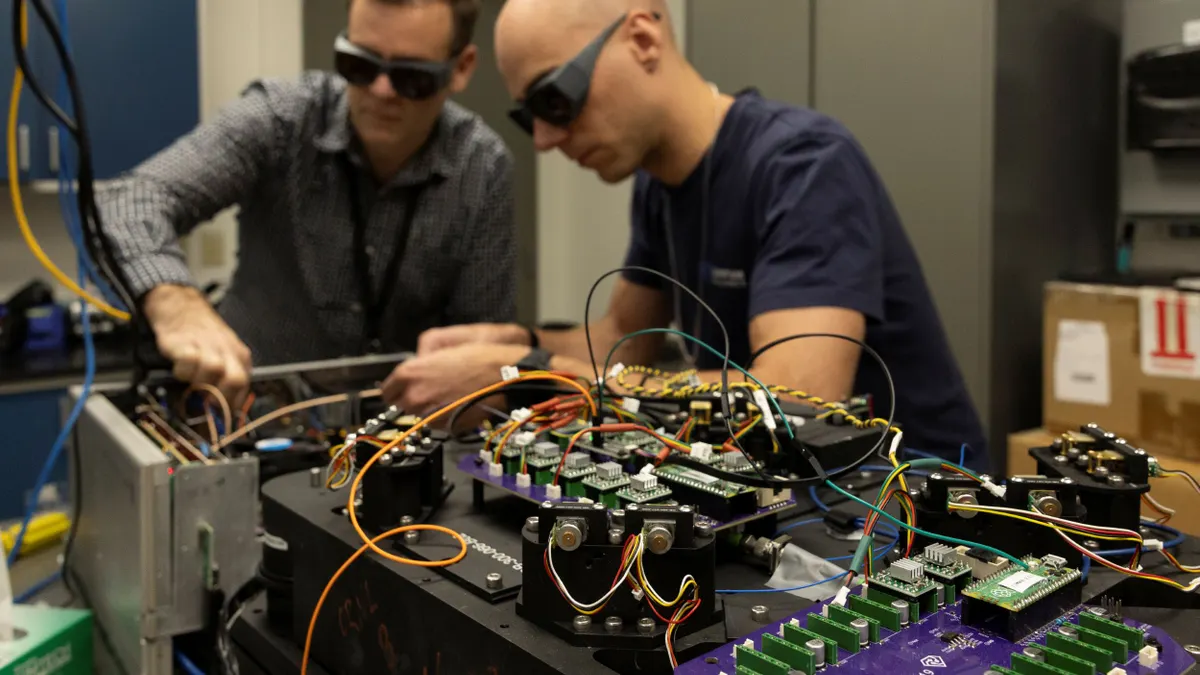
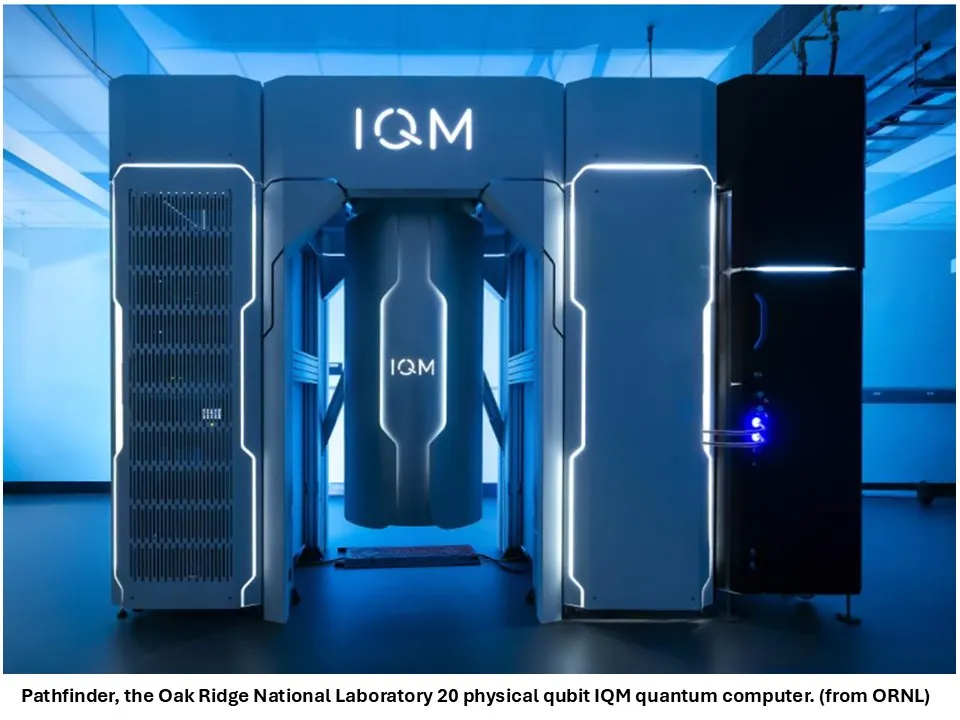
Quantum computing uses particles like photons, ions and atoms as “qubits” to store quantum information, EPRI’s Renshaw said. But in today’s “noisy intermediate-scale quantum” computing, qubits are fragile, often lose quantum information, and cause errors, he added.
To prevent errors, researchers form “logical” qubits from multiple physical qubits that “behave as one stable, reliable qubit,” Renshaw said.
It is those logical qubits that are enabling more accurate “fault-tolerant quantum computing” to emerge. As a result, quantum computing is making near exponential improvement that will lead to maturity much faster than in classical computing, he added.
Renshaw said he expects that the market tipping point will be around 2028 to 2030 when quantum processing units, or QPUs, can process 100 logical qubits. That amount of accurate quantum computing could enable optimizing a microgrid or small service territory, he said.
Bob Sorensen, chief analyst for quantum computing at Hyperion Research, said on the July 16 episode of Latitude Media’s Catalyst podcast that some 85 companies are vying to be quantum computing hardware suppliers. That does not count research centers or utilities in pursuit of how to use that hardware.
He cautioned, however, that significant performance gains may be four years away and widespread use is likely a decade away. Aspiring quantum hardware providers could go belly up, which could slow technology investment and progress, he added.
Prabhakar, from Schneider, said that though quantum computing is not commercially available at scale, the near-term future will include hybrid computing with AI CPUs and GPUs and quantum computing QPUs.
AI will continue “to unlock value across more use cases,” and quantum computing will unlock value “in high-stakes, computationally intractable problems where no other tool works,” she said.
Cybersecurity threats, costs and other uncertainties
In addition to its promise, quantum computing also poses a threat. It will make currently used encryption methods “obsolete,” energy technology company Landis+Gyr wrote in late 2025.
“As soon as 2030, a sufficiently powerful quantum computer could break that encryption in minutes,” it warned.
Anticipating that quantum cybersecurity issues will soon be a threat to the power system, NIST finalized post-quantum cryptographic standards in 2024, Schneider’s Prabhakar said. Utilities must act to meet those standards now, because “waiting is not a defensible posture,” she added.
Beyond cybersecurity, optimizing real-time dispatch is the use case most likely to first meet the energy-per-useful-solution metric that will define quantum computing’s value to utilities, she said. Just as AI is now being measured in tokens per watt, quantum computing will be held to what works at a “total system energy cost” that makes it worth deploying, she added.
Utilities must also plan infrastructure to meet the new loads, which “is the lesson AI did not follow,” Prabhakar continued.
While it remains uncertain how much space or energy demand quantum computing will ultimately require, utilities need to track quantum developments and translate them into infrastructure decisions “inside the planning process,” she said.
Schneider’s Aparna sees three uncertainties in how quantum computing will evolve into utility use.
First, utilities cannot waste resources by over-committing too soon, but they must also not make the same mistake they made with AI by ignoring it for too long, she said. They should “build optionality into infrastructure decisions now,” she added.
That flexibility will also resolve the uncertainty of the market’s ultimate choice among today’s competing “superconducting, ion trap, photonic, and neutral atom” modalities, Prabhakar said.
The third uncertainty is quantum computing’s electricity demand, which is why utilities need to be part of the early discussions about standards for electricity use, she added.
EPB’s Swingle agreed. Utilities need to establish a presence in the Quantum Economic Development Consortium, which is developing ties with policymakers, he added.
But the greater and more immediate need is for utilities to organize their data in preparation, he said, adding that quantum computing’s ability to work with an unprecedented depth of data will be less valuable if utilities do not have the data readily available to process.
For Duke, the biggest uncertainty about quantum computing is when large-scale, fault-tolerant, economically advantageous systems will become available to begin developing planning and dispatch optimizations, Wijesundara said.
“Hardware scalability, error correction, software tooling, and algorithm maturity remain active areas of research,” as are the applications of greatest value, he said. All of these factors would contribute to the maturity needed for utilities to use quantum computing to optimize dispatch.
But quantum is coming and it is coming fast, Renshaw said. Just as things like drones, cloud computing and AI were thought to be hypothetical in the last decade and are now normal, quantum computing could be widely deployed and normal in the 2030s, he said.
Clarification: This story has been updated to clarify Aparna Prabhakar's views on quantum computing and its implications for grid management.
Clarification: This story has been updated to better reflect quantum computing's electricity demand.
Correction: This story has been updated to correct the title of Middle Tennessee Electric's chief operating officer, Brad Gibson, in a pull quote.