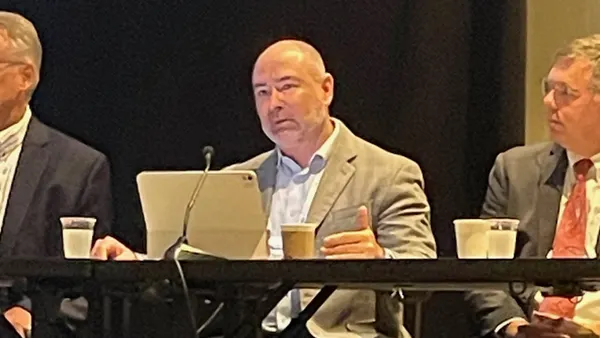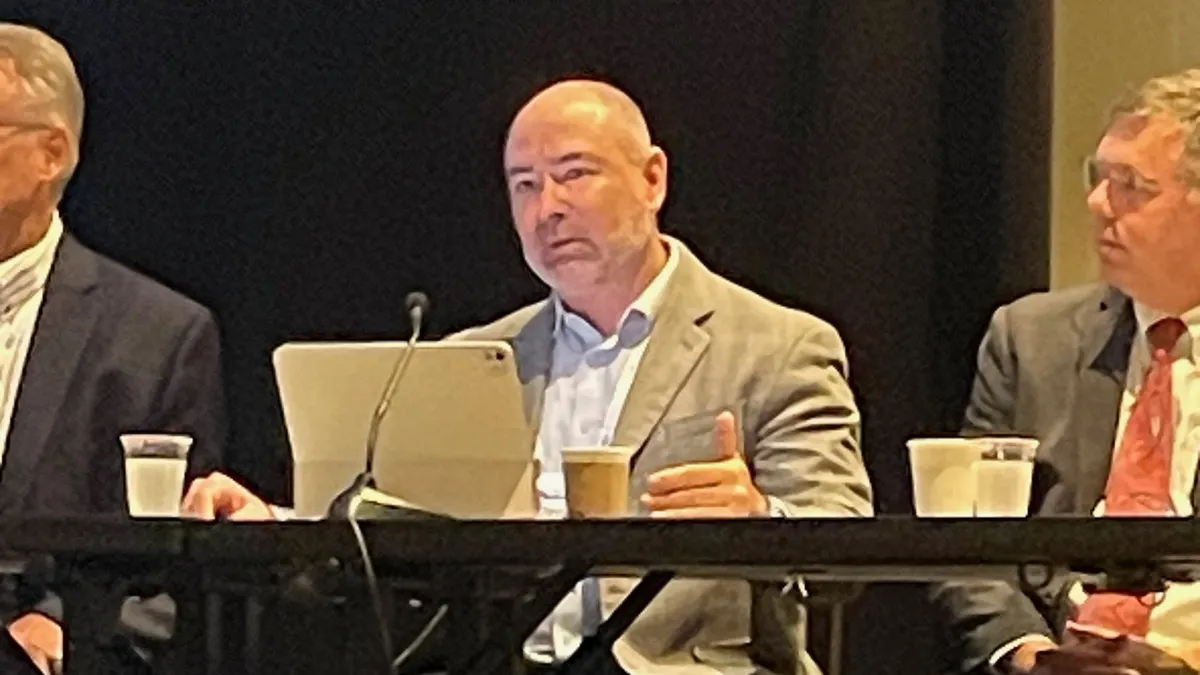
Utility Dive met with David LaCerte, a member of the Federal Energy Regulatory Commission, on Monday at the National Association of Regulatory Utility Commissioners’ annual meeting in San Juan, Puerto Rico. Never shy about expressing his views, we wanted to hear his perspective on how federal energy regulators are dealing with large load interconnection, the PJM Interconnection and keeping electricity affordable.
LaCerte, a Republican, joined FERC in October 2025. In mid-May, the Senate voted to confirm him for a full term that ends in June 2031. Before joining FERC, he held key positions at the U.S. Office of Personnel Management and the U.S. Chemical Safety and Hazard Investigation Board, and was Secretary of the Louisiana Department of Veterans Affairs.
This interview has been edited for length and clarity.
UTILITY DIVE: How could the midterm results affect FERC?
DAVID LACERTE: I think [the results are] helpful in many ways. Having Americans' voices be heard about these affordability issues, which have been top of mind for us for a long time, is helpful.
And I wish we'd have more [Congressional] oversight committee hearings. I wish we talked about these issues more because the more we can talk about it, the more we can educate our partners on the Hill as to what the real issues are and how we can actually solve them, not from a political sense, but the real-world economic sense. The more those conversations happen, the better. So I welcome more oversight.
From an outside view, it feels like the five FERC commissioners do a pretty good job of talking to each other and reaching consensus.
We can't let ideology get in the way of a lot of our decisions. Now, I think ideology does get in the way of a lot of [other] decisions, especially at the state level, when state politics get inserted — we just don't want a pipeline, or we just want to exclusively run offshore wind. I don't think those results are good for Americans. And if the market demands natural gas in a region, we need to find a way to get it to them.
Do you think if politics weren't involved, we probably wouldn't have offshore wind?
I think that's a legitimate question. Or would we have natural gas generators in Maryland? Right now, we can't have that conversation because politics are making decisions for us. If I had a magic wand, I would let every area of the country have an energy mix that makes economic sense for them.
I think you see a lot of compromise in this permit reform bill. There is hunger for bipartisanship and consensus for both parties to work together on these issues, and I think that's by and large what's on the table.
So the question becomes: We have Democrats coming in and controlling both the Senate and the House. Are we going to be parties that want to work together to actually build stuff, or do we want to just let the status quo be maintained?
The only way we're going to get out of the affordability mess is by building more things. The only way forward is by building more generation, building more transmission. And to do that, we need to clear the deck on roadblocks, which have stymied us for decades. That's what Americans want. That's what Americans deserve.
Are there things that you feel the power sector could be doing better?
There's some areas of the country that are doing better. You see generators being able to be incentivized more in some regions than others.
I think the [PJM Interconnection capacity] price collar has a lot to do with that as well. I think there's a lot of heartburn on the price collar that was implemented in the spring, and what we do with that price collar in the upcoming auction in May as well, because we have to send the right market signals. We can't expect investment to occur if no one's making money. So the right price signals are paramount. We can't live under this price collar forever. But we also need to protect consumers. We can't let the market run unfettered. Our mandate is to have just and reasonable rates and reliable electricity delivered. So we have to balance all these things. But it's an environment where, if we don't send the price signals, new gen will never come.
There's a whole range of issues PJM is dealing with — interconnection, governance, the backstop auction, the capacity auction — so, how are you feeling about how PJM's been responding?
I think PJM has shown more responsiveness as of late. But we still need faster action, and we have a stakeholder process there that has been proven to be detrimental to improvements in PJM. We have an entrenched incumbency in PJM that has, by and large, been successful in their own operations, but we need new entrants. We need new investment, and we need to focus on how governance impacts all of that. These states have opted into PJM, and a lot of their mandates now go through the region. So I do think it's important that the states have an appropriate-sized role in governance.
On cost allocation, formula rates and other issues, how do you think about transparency in terms of people understanding what's happening, what's in their rates?
Transparency has been a big problem in the entire utility industry, and a lot of that is just a product of how monopolies were created within the [Federal Power Act]. And for a while, we got by because the need to more strictly scrutinize the actual rates wasn't there ... because the cost crunch on the average American wasn't felt.
But now we're at a different period of time, and real Americans are struggling to pay their bills, and … we need to require more transparency in every angle, because I do think that the utilities have been incentivized to use some of their own knowledge of how electricity is distributed to their own advantage.
Do you see anything FERC can do around transparency?
I think you see that in some of our orders. We came out and we first required utilities to consider grid enhancing technologies and advanced transmission in their consideration of a new [transmission] line, and then we took that a step further. We said, not only do you have to consider it, you have to show why you didn't choose one of the other options. We need to let the market decide what is best for utilities and ratepayers, and to do that we need more transparency in the entire process.
We have all these new technologies that come on board, and we also have a heavily entrenched transmission lobby who are incentivized to build more stuff because they get that guaranteed rate of return. But if there is an instance where we can use a new technology that brings a resource online faster and cheaper, we need to show that we're being prudent because this is not our money. This is real Americans' money.
We’re at NARUC, so are there areas where states need to be stepping up?
I think we need to get the states more in line with large load retail tariffs. I want [the states] working in directions which dovetail their state-level retail tariffs on large loads to some of the work that we're doing at the federal level. And I think by pairing those two together, you're going to get an environment that protects consumers more. It provides more market certainty, and it gives all the investors the rules of the road.
I'm sure you're also hearing from states on things FERC should be doing better.
The No. 1 thing we'll hear about is just jurisdictional in nature because there has been an evolution — a necessary evolution — on where the line ends on retail services and where it begins on wholesale or interstate services, because as things are becoming more and more interconnected, that line gets blurred.
And also, over the past several decades, the federal courts have, in my opinion, expanded what FERC’s jurisdiction may be. I come from a state background. I’m a big advocate of states making decisions for their backyards. So it's paramount to me that we don't encroach upon that line unless we absolutely have to.
Do you see issues right now where FERC is dealing with the federal-state divide?
I think you can see where we went with the [Department of Energy’s large-load rulemaking request]. We declined a full rulemaking and instead incorporated a balance with each individual [regional transmission organization] coming back to us to show us that [its] large-load tariffs are not unjust and unreasonable. It also creates a dialog. It allows for comment for all those entities, and a region-specific comment, which I think is of paramount importance.
Otherwise, it’s a generic rulemaking, which in today's day and age, with electricity being so dynamic ... it just breeds staleness within some of your regulations. [In] the rulemaking process, the timeline, the comments, the reply comments, the protests and then the court challenges — because you have all your eggs in one basket with a rule.