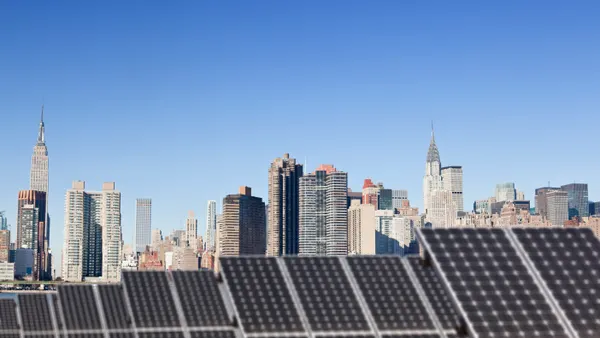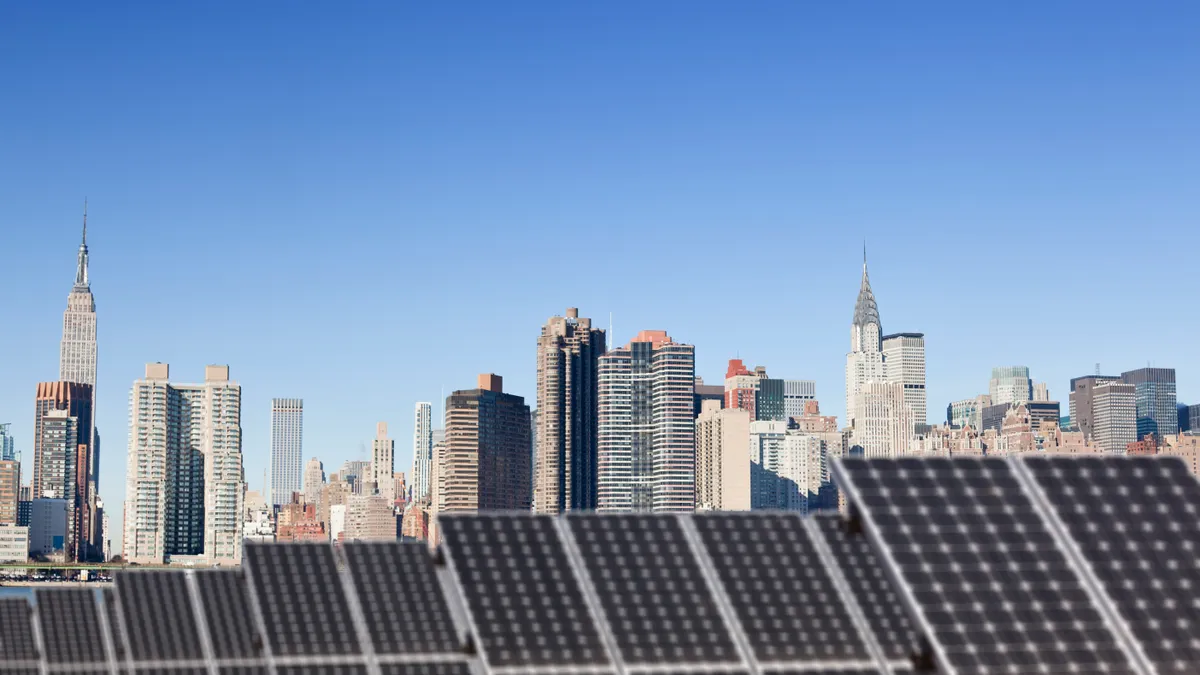
New York has installed 8 GW of distributed solar capacity across the state, Gov. Kathy Hochul, D, announced July 2, and is ahead of schedule to meet its statutory goal of deploying 10 GW by 2030.
That 8 GW is “underpinned by community solar and the state’s signature NY-Sun Program,” Hochul’s office said in a release, and provides enough energy to power 1.3 million homes and businesses. The release said the 8 GW is supplied by more than 276,000 projects, and another 2.7 GW of capacity is in development.
NY-Sun is a New York State Energy Research and Development Authority program that offers financial incentives for residential, nonresidential, and large commercial and industrial solar projects.
Tony Smith, chair and co-founder of the Virginia Distributed Solar Alliance, told Utility Dive in an email that he thinks New York’s success comes from pairing NY-Sun’s “predictable, market-based incentives with a statewide standardized interconnection process for projects up to 5 MW, developed collaboratively by the [state’s] Joint Utilities, regulators, and industry.”
“Together, these policies reduce soft costs, provide investment certainty, and remove utility-specific interconnection barriers while maintaining grid reliability through modern inverter standards and continuous stakeholder collaboration,” Smith said.
Hochul’s release noted that New York broke its record for solar installations in a single year in 2025, installing 1.28 GW, and the state’s budget for 2027 includes $200 million for the NY-Sun program.
According to the Solar Energy Industries Association, $200 million in NY-Sun funding will support around 1 GW of incremental rooftop and community solar capacity.
To facilitate similar expansion of distributed solar in other states like Virginia, Smith said the lesson “is to adopt proven models rather than pilot new ones: establish uniform statewide interconnection standards, create a permanent utility-regulator-industry technical working group, and align utility incentives with grid optimization through DERs rather than primarily rewarding new capital investment in central generation.”