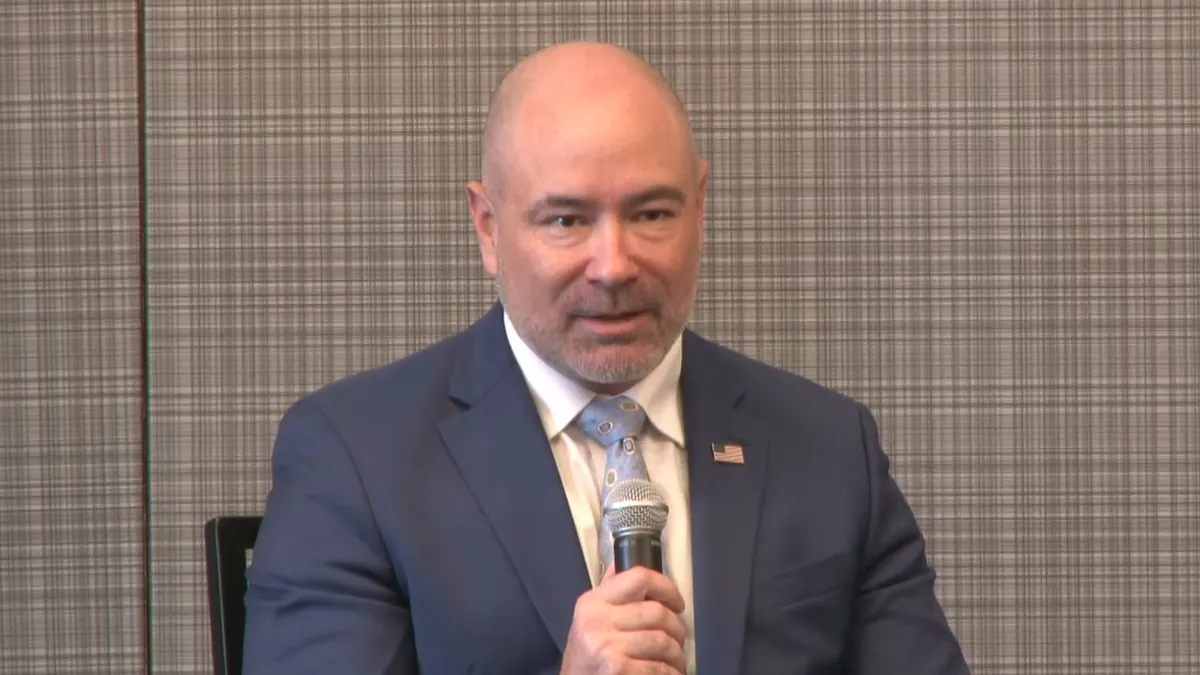
The PJM Interconnection’s “status quo is really untenable,” David LaCerte, Federal Energy Regulatory Commission commissioner, said Thursday.
PJM’s stakeholder process has “continued to just grind into gridlock,” he said at a meeting in Philadelphia hosted by WIRES, an advocacy group for utilities and others in the transmission sector.
FERC is slated to hold a technical conference on July 23 focused on PJM’s governance issues. Among other things, the conference aims to discuss “potential concrete actionable reforms to improve the effectiveness of the PJM stakeholder process and create fast-path or time-bound review procedures for critical issues.”
Some sectors use PJM’s stakeholder process to defend their business interests to the detriment of the wider region, according to LaCerte.
“If you're a generator and you hate the [capacity] price collar, and you think that continuing the status quo with stakeholder engagement, blocking measures by PJM, is going to be successful, how'd you get the price collar in the first place?” LaCerte asked. “This current system is not helping you.”
“Looking at things differently is hard, especially in entrenched utilities that have been doing this for a long time,” he added.
Even so, PJM has to change, according to LaCerte.
“We have a lot of other models at other RTOs and ISOs across the country that are much more functional, so we can pick and choose which work, which don't,” he said. “We can pick which might alleviate concerns to get people on board, but we can't have a group of stakeholders that are incentivized to vote one way economically that are driving us into the ground for an entire region of the country.”
PJM, the largest U.S. grid operator, runs the grid and wholesale power markets in 13 mid-Atlantic and Midwestern states and the District of Columbia.
FERC eyes transmission incentive reform
FERC is considering revising the incentives it provides to spur transmission development, according to LaCerte.
“We need to make sure that the incentives that we give are properly tailored to actually meet the goals, and we're not just throwing money out the window,” LaCerte said.
FERC offers a range of benefits to transmission developers. They include an extra 0.5% return on equity for being a member of a regional transmission organization and “construction work in progress,” which allows a utility to recover its expenses while it is building a project instead of waiting for a rate case after it is placed into service.
“We have a history of adopting an incentive structure and then putting it on a shelf and not revisiting it for 20 years sometimes, and I think those days have got to be over,” LaCerte said.
FERC needs to be sure that its incentives lead to specific outcomes, according to LaCerte.
“I don't think we do the best job [of] doing that at FERC,” he said. “We need to make sure we do it in a way that is laser-focused on outcome and laser-focused on [legal] durability as well.”
Revising the incentives is challenging, according to LaCerte.
“It's kind of like we're flying a helicopter here and trying to land it on a really small landing pad in the middle of the ocean,” LaCerte said. “It's a difficult thing to get right … we're trying to look at things differently than we used to.”
As part of FERC’s effort to keep electricity prices as low as possible, LaCerte said the agency will continue to focus on advanced transmission technologies, also called grid-enhancing technologies.
When considering GETs, LaCerte said he wants to know its cost savings and whether the technology is ready to be deployed, “whether that be an advanced transmission line, whether it be dynamic line ratings — which I think we could do much better on — I think we need to consider it.”