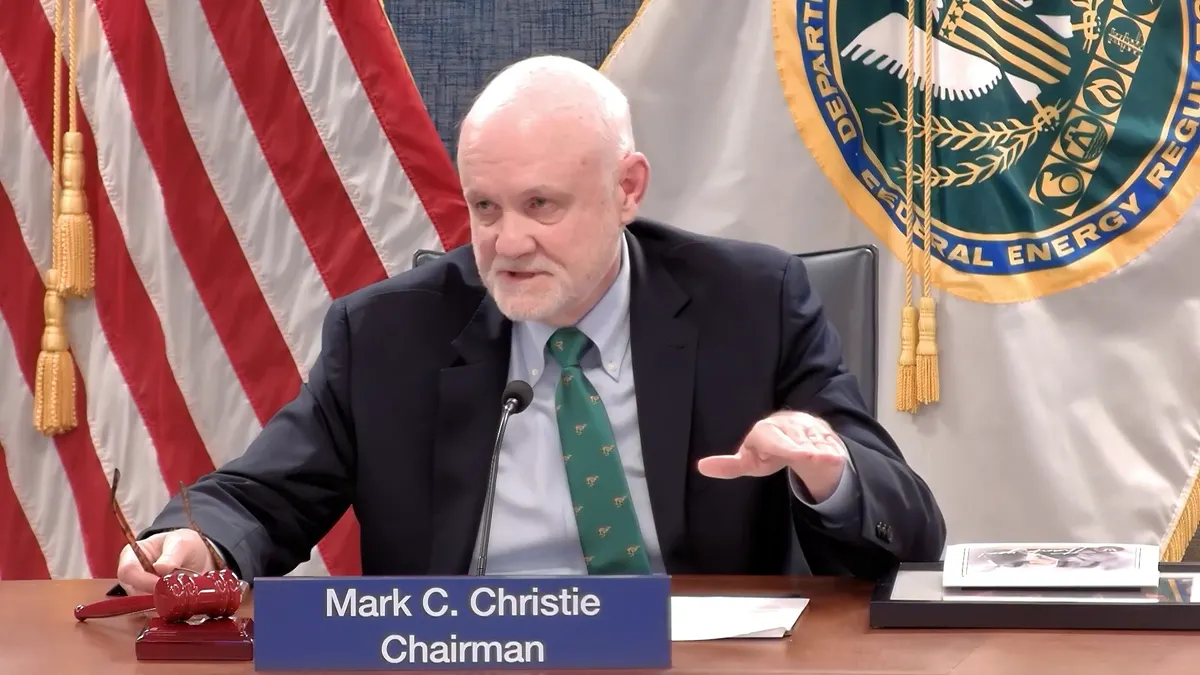
Mark Christie is a former chairman of the Federal Energy Regulatory Commission and former chairman of the Virginia State Corporation Commission, and is the director of the William & Mary Law School Center for Energy Law and Policy.
Every true compromise in a polarized legislature contains candy for each side, but also requires each side to swallow some hairballs. In the Senate permitting reform bill (SB 5653), the true permitting reforms hold a welcome potential to get needed infrastructure built faster. The transmission provisions, however — which are not permitting reforms at all — contain some provisions that are indigestible if you care about rising consumer costs and respect for historic state authority over utilities.
The bill’s best transmission provisions seek to ensure that large-load customers pay the full costs they impose on the grid. The worst transmission provisions, however, can be fixed with the amendments described below. Before considering these amendments, it is important to understand that the Federal Power Act for nearly a century has recognized a clear and logical division between state and federal authority over the power grid: The states have authority over the siting and permitting of all physical assets within their borders, including generation and transmission. The Federal Energy Regulatory Commission has authority over the rates for interstate transmission services and wholesale power sales.
The current Senate bill blows up this century-old balance of authority by giving FERC the sweeping power to order a transmission line built in any state, without regard to the state’s own decision on the project or the opposition of the state’s residents who will be directly affected. Congress has enacted so-called “backstop siting authority” before, most recently in the Infrastructure Investment and Jobs Act in 2021, but Congress strictly limited the geographic reach of FERC’s backstop authority to narrow geographic corridors established by the U.S. Department of Energy and only after DOE made a finding that the national interest required the establishment of each corridor.
The Senate bill contains no geographic limits on FERC’s permitting power. It expands FERC’s authority to override the states to every square inch of the country, a breathtaking expansion of federal power at the expense of a core state function: the permitting and construction of utility assets within their own borders, projects that could have huge impacts on the lives of their residents.
Fortunately, targeted amendments can minimize the most negative consequences of the bill’s overreaching provisions. Here are three recommended amendments:
The bill allows FERC to order the construction of transmission lines based on a nebulous “public interest” standard. Such a standard is a blank check for FERC to approve trillions of dollars’ worth of transmission lines for whatever reason a presidential administration finds is in the “public interest,” as long as FERC adds general findings of some reliability improvements or consumer benefits, which can be claimed for every transmission line ever proposed. In the short term, FERC could use the bill’s grant of new authority to order transmission lines built to serve hyperscale data center development, a Trump administration priority. A future FERC could find that the public interest requires trillions of dollars of new transmission to meet “Net Zero” climate goals.
So my first recommended amendment is to remove the “public interest” and other general criteria, and instead require that FERC must find that the proposed line is the optimal solution to meet a proven reliability need at just and reasonable rates, compared to alternative solutions.
My second amendment addresses the critical role of states in cost allocation. FERC Order 1920 guaranteed to states in a multi-state region the right to reach an agreement on cost allocation for regional transmission projects and have that agreement submitted to FERC. The Senate bill should add an explicit guarantee that for regional transmission projects the states in each region have the right to agree on cost allocation and FERC shall presume such state agreement is just and reasonable.
My third amendment concerns one of the most onerous and frankly insulting provisions in the Senate bill. When we at FERC implemented the Infrastructure Investment and Jobs Act’s backstop siting authority, we gave each affected state one full year to conduct its permitting proceeding before FERC would start its own backstop proceeding. That allowed the state to develop a factual record and issue a decision within a reasonable period of one year.
The Senate bill allows FERC to start its backstop proceeding simultaneously with the state proceeding. That effectively renders the state proceeding meaningless, and states will perceive it exactly that way. Why should a state spend its time and limited resources on its proceeding when FERC is already doing its own? Any evidentiary record developed in the state proceeding may not even be available to FERC before it overrides the state. This provision in the Senate bill is nakedly punitive and overreaching and should be amended to give the states one full year to act before FERC can begin its own backstop proceeding.
Even if you don’t care about respecting state authority, you should care about the bill’s impact on consumers already struggling to pay their power bills. Over the past decade, transmission has been one of the fastest-growing drivers of power bill increases. The Senate bill as drafted could result in literally trillions of dollars of new transmission being ordered by FERC to serve whatever policy goals a president wants. These costs will flow right into consumers’ monthly bills.
Every compromise offers candy and hairballs. With these amendments, the bill can be made a lot sweeter.