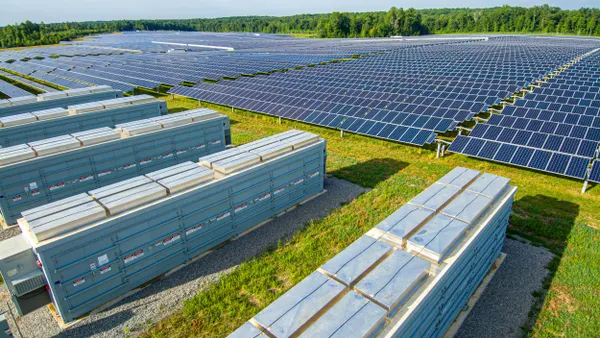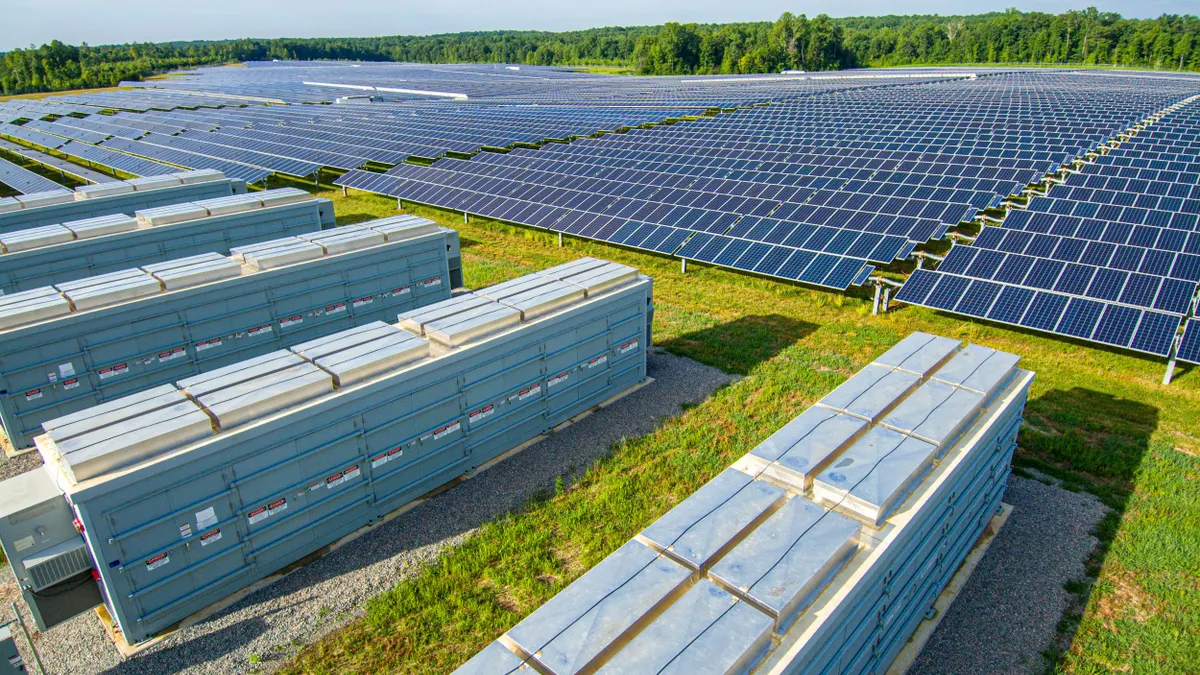
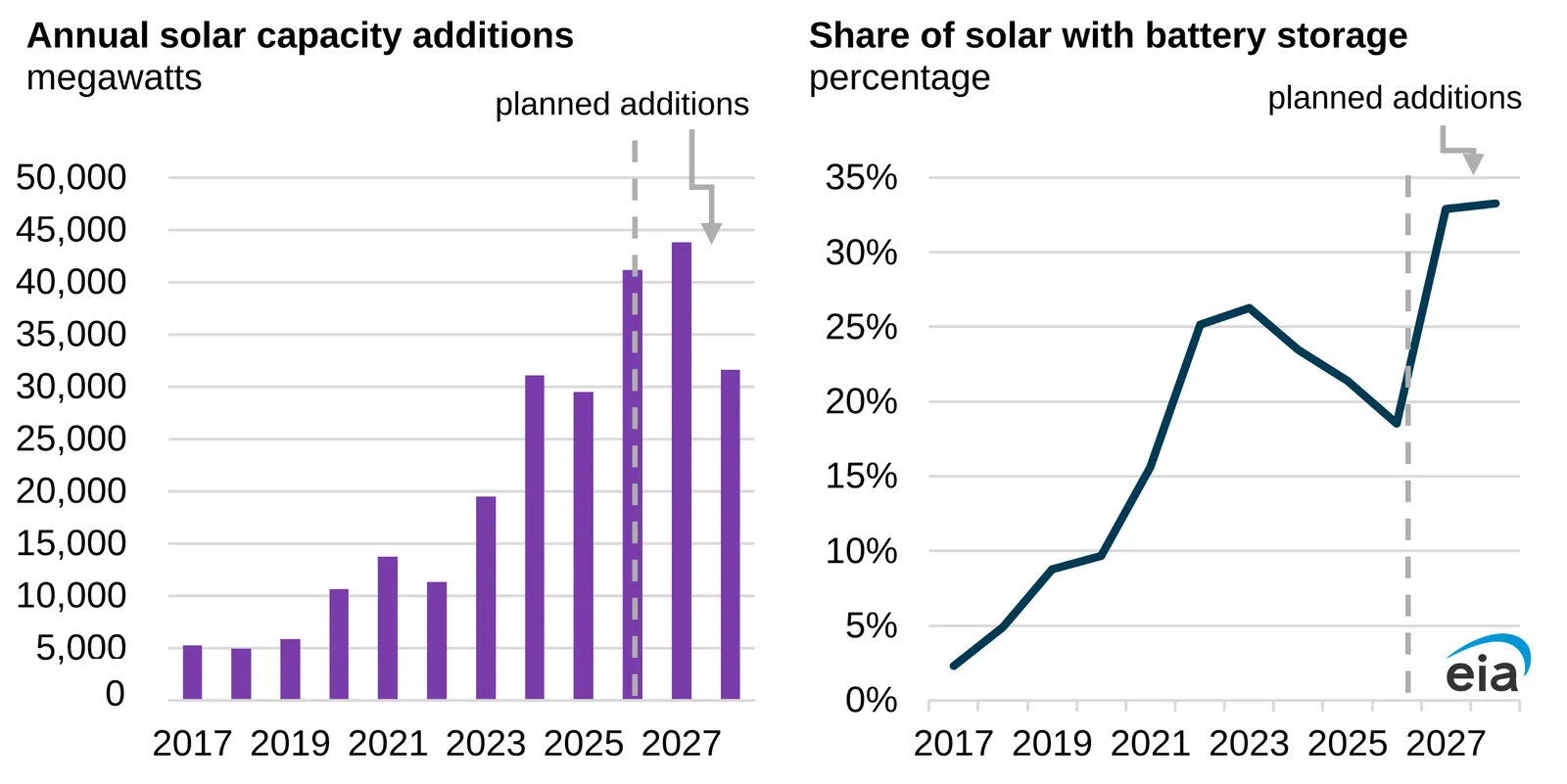
The share of new solar projects deployed with co-located battery storage this year is 16% — or about 41 GW — as of September, and may reach 19% by year’s end, said an Oct. 30 report from the U.S. Energy Information Administration. It is likely to pass 30% in the next two years, the agency estimated.
The trend has increased significantly over the last decade, as only around 2% of projects, or 5 GW, of new solar capacity was co-located with storage in 2017. In 2023, co-location jumped to 25% of projects, then fell over 2024 and 2025, according to EIA’s data — but is projected to pass 30% over the next two years, based on planned additions.
“When operators co-locate battery storage with solar, they can direct solar electricity output to the grid or to the battery, depending on the wholesale prices,” EIA’s report said. “Wholesale prices in regions with large solar participation tend to fall when solar contributions are high and rise as they decrease.”
“Plants with both solar and battery storage can manage the combined output of their generating resources to maximize their value in a changing wholesale price environment,” EIA added.
An Oct. 22 report from the Solar Energy Industries Association found that from 2021 to 2026, “solar generation increased 421% in Texas and 90% in California, while battery storage capacity grew more than 26-fold in Texas and nearly sevenfold in California.”
When comparing the same June to August period, SEIA found that “CAISO used 2.5% more power than the same time in 2021 with an average wholesale electricity price 40% lower after accounting for inflation. ERCOT used 30.1% more power than the same time in 2021 with an average wholesale price 42% lower after accounting for inflation.”
EIA’s report noted that Southwest states “have higher-than-average solar capacity shares relative to their total generating capacity and also have higher levels of co-located utility-scale solar and battery capacity.”
“As of September, 13% of the total U.S. utility-scale generating capacity is solar photovoltaic, and 18% of that is co-located with battery storage,” EIA said. “The share of solar generation co-located with battery capacity in California, Arizona, New Mexico, and Nevada is more than double the national average.”
A September analysis from Lawrence Berkeley National Laboratory found that at the end of 2025, there were 436 co-located solar-plus-storage projects in the United States, with a total of 29 GW of solar capacity and close to 17 GW of storage capacity.
Within the interconnection queue, LBNL found that solar-plus-storage facilities comprise 86% of proposed hybrid facilities, at close to 361 GW of planned capacity.