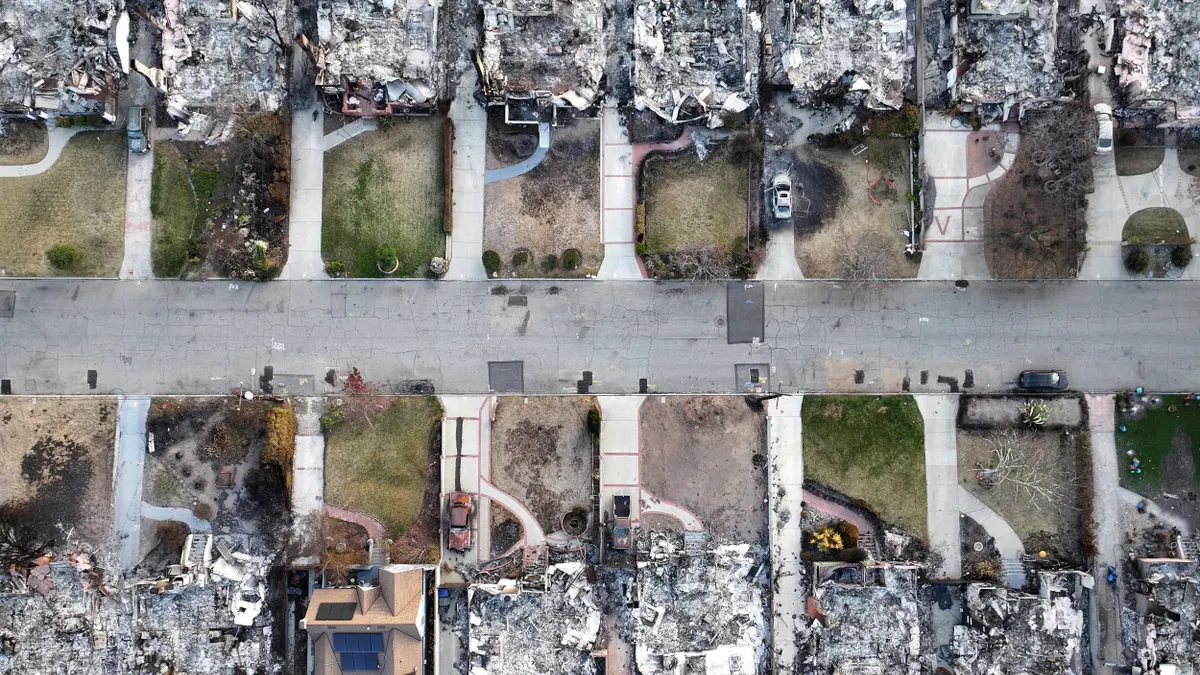
UPDATE: Sept. 2, 2026: The California Legislature did not vote on a wildfire reform bill during a special session Tuesday, effectively killing the proposal. The bill had implications for electric utilities.
Assembly Speaker Robert Rivas issued a statement saying lawmakers will continue to work on the issue.
“Over the past several weeks, we have spent hundreds of hours at the table with Californians from every side of this fight, and the verdict is clear: The proposal before us does not yet deliver the relief, accountability or meaningful reform that Californians deserve," Rivas said. "So, we are going back to work — and we will not stop until we have done everything in our power to deliver real results.”
California lawmakers passed a number of notable energy bills during the legislative session that ended Monday, including proposals to legalize balcony solar and remote inspections for some home energy projects.
But they rejected an attempt by Gov. Gavin Newsom, D, to limit utilities’ wildfire liability, and are expected to pass a bill allowing insurers to pursue utilities for wildfire losses in a special session Tuesday.
Other proposals headed to Newsom’s desk include a requirement for the California Public Utility Commission to look into new opportunities for data center rate structures and customer-owned clean energy devices being able to qualify as official resource capacity.
Newsom had proposed amending Senate Bill 492 to shift wildfire liability costs away from utilities. As written, the legislation preserves the ability for wildfire survivors, local governments and insurers to pursue wildfire-related claims against utilities and does not cap damages.
The news that lawmakers had rejected Newsom’s proposal caused California utility stock prices to fall on Monday, with PG&E Corp.’s stock dropping by 20%, and Edison International's dropping by 23%. PG&E owns Pacific Gas and Electric Co., and Edison International owns Southern California Edison. This was Edison International’s largest single-day decline in more than 25 years, according to 24/7 Wall Street. As of Tuesday morning, their stock prices had not recovered.
In a Monday joint letter to the Legislature, the two utilities wrote that SB 492 puts California “at risk of constrained investment, higher utility bills, less spending, and fewer jobs.”
Other significant energy bills from California’s 2026 legislative session include:
- SB 868: Legalizes portable solar generation devices, also known as balcony or plug-in solar, in California. Passed and is awaiting signature.
- AB 1738: Legalizes remote inspections for home improvement and energy projects on one- or two-family homes, including heat pump water heaters, solar energy systems with a rating of 15 KW or less, and energy storage systems. Passed and is awaiting signature.
- AB 1813: Revises the requirements of the customer renewable energy subscription program to promote participation by low-income households and limits the size of participating projects to 5 MW of generation capacity and 5 MW of storage. Passed and is awaiting signature.
In a Sunday release, Californians for Local Affordable Solar and Storage praised AB 1813 and urged Newsom to sign it. California’s 2022 community solar law, AB 2316, produced “a program built to fail, and not a single community solar project has come online under it,” the group said. “Governor Newsom now has an opportunity to sign AB 1813, positioning California to build the nation’s largest community solar and storage program.”
- SB 1168: Requires the California PUC to “assess opportunities for rate structures to ensure data centers pay a reasonable share of their costs associated with transmission and distribution needs.” Passed and is awaiting signature.
- AB 2589: Requires the CPUC to evaluate the full effect of federal laws such as the One Big Beautiful Bill Act, determine whether the projected expenses and tax liabilities “that the commission has authorized in the rates for a public utility are materially affected by the enactment,” and adjust the utility’s rates to reflect the law’s impact, as needed. Passed and is awaiting signature.
- AB 2313: Requires the CPUC to solicit proposals for a Gas Distribution Service Line Replacement Alternatives Program, “to provide certain residential gas customers served by a gas distribution service line that will be replaced with a monetary incentive to deploy gas distribution service line replacement alternatives.” Passed and is awaiting signature.
In a Friday release praising AB 2313, Earthjustice said, “The legislation will reduce bills for all customers because the money that a homeowner receives through the program will be less than what their gas utility would spend replacing the gas service line to their home.”
- SB 913: Requires the CPUC to enhance “existing market-integrated pathways for aggregated distributed energy resources … to qualify as resource adequacy capacity” and “establish conditions for the use of aggregated distributed energy resources while ensuring net energy metering customers and net billing tariff customers do not receive duplicate compensation.” Passed and is awaiting signature.
- SB 905: Requires the CPUC to adopt multiple initiatives, including evaluating each electrical corporation’s “opportunities for alternative methods of financing capital investments in electrical distribution, electrical generation, and electrical transmission that reduce costs for ratepayers,” and the creation of frameworks for electrical corporations to track metrics such as their utilization of distributed resources. Passed and is awaiting signature.
Regan George, CEO and founder of SOLRITE, a solar company that operates in California, told Utility Dive in an email that both SB 905 and SB 913 can “help create an environment where virtual power plants can scale to optimize the California power grid and help alleviate the state's incredibly high electricity costs.”
“What these bills have already accomplished is opening the door for more strategic conversations about the true value of the distributed energy resources that are already in place at homes across California, and what could be possible if we begin treating them as aggregated grid resources rather than as individual assets sitting behind the meter,” George said.
Brandon Garcia, California director at Advanced Energy United, said in an interview with Utility Dive that SB 905 “has a number of just general good governance utility reforms.”
“We're particularly excited about there being some language about publicizing grid utilization information, having the utilities report that to the commission and identifying, where is our grid constrained?” he said. “Where do we have more capacity? Because we would argue that there is a lot of capacity on the grid that is being underutilized.”
- AB 2493: Requires the CPUC to require each electrical corporation to retain an independent auditor to review its transmission- and interconnection-related submissions, its progress on completing network upgrades, and its compliance with any remedial actions ordered by the commission. Passed and is awaiting signature.
Garcia said United also supported AB 2493, as “we're really interested in reducing the interconnection delays for different kinds of large scale projects.”
One of United’s disappointments this session was the state’s decision not to fund its Demand Side Grid Support program, which in May saw its 2027 funding zeroed out in a biennial budget revision.
Advocates for the program have called DSGS one of the largest virtual power plants in the country. Last summer, its aggregated distributed energy resources dispatched more than 500 MW of average output over two hours.
“We're excited that the legislature rejected the proposal to gut the program, so we're kind of in this middle place,” Garcia said.
“We think that there's going to be a super El Niño coming next year and the end of this year, and I certainly would rather have DSGS online with this very large extreme weather event than not,” he added. “I’m hoping nothing bad happens, but it just made sense to have this extra reliability on the grid.”
In a Tuesday research note, Bank of America downgraded Edison International from “buy” to “neutral,” and its price objective to $51 from $81.
“With wildfire risk elevated and no policy clarity likely for another year, uncertainty should continue to weigh on EIX,” analysts wrote.
In their letter to the legislature, PG&E and Edison International said they must attract tens of billions of dollars in private investment each year to reduce wildfire risk, strengthen the electric grid, maintain reliability and support economic growth while achieving the state’s clean energy goals.
“Today, those investors face risks in California unlike in any other state” and therefore “demand a higher return or invest elsewhere,” the utilities said. “Either outcome makes essential infrastructure more expensive and places additional pressure on electricity rates. These financial risks will have cascading impacts on the State’s economy and its climate ambitions.”
Correction: This story has been corrected to clarify that SOLRITE operates in California but is not based there.