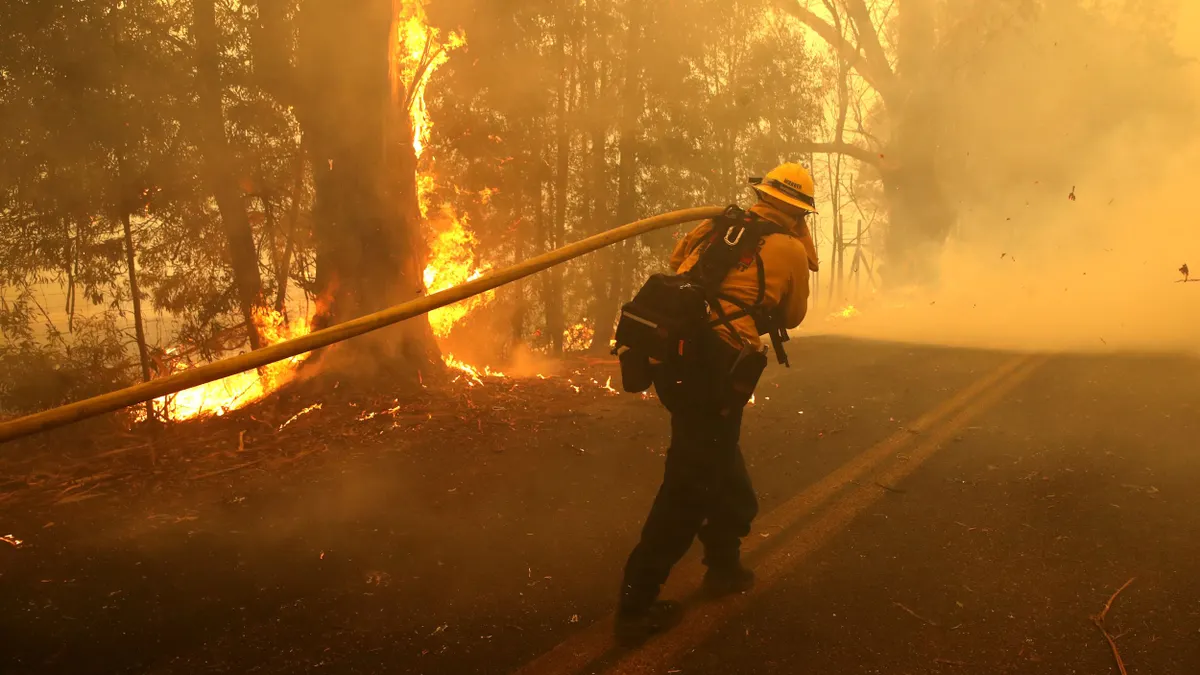
Although PG&E does not plan to make any changes to its $73-billion five-year capital plan, CEO Patti Poppe said that could change if the California legislature fails to pass an acceptable package of wildfire reforms by the end of August.
Speaking during the company’s first quarter earnings call last week, Poppe said the utility would support a range of potential reforms, but that she would prefer a holistic package that would include changes to the state building codes to harden communities against wildfire.
At minimum, she said, the company needs to be satisfied that any reforms create the stability that is needed for shareholders to “feel comfortable investing your clients' pension funds and retirement funds through our infrastructure here in California.”
The utility continues to reckon the significant financial impact of past wildfires. It assigned an aggregate liability estimate of $1.325 billion for the 2019 Kincade fire; $2.15 billion for the 2021 Dixie fire; and $400 million for the 2022 Mosquito fire, according to its quarterly report to the Securities and Exchange Commission.
“These estimates do not include all categories of potential damages and losses,” the utility said in its filing, adding that recorded liabilities in connection with the Kincade and Dixie fires have exceeded potential amounts recoverable under applicable insurance policies.
PG&E has filed with state regulators to recover more than $7 billion in wildfire mitigation and losses. In February, the California Public Utilities Commission approved $1.9 billion out of the utility’s request for $2.18 billion in wildfire mitigation and catastrophic events cost recovery filed in 2023. The utility filed an application for rehearing in March.
As of November, 2025, the utility had drawn $674 million from the California Wildfire Fund, it said.
“This amount will increase as the Utility continues to resolve claims and draw from the Wildfire Fund,” according to its filing. “The [California Public Utilities Commission] may require the Utility to reimburse the Wildfire Fund to the extent that amounts drawn from the Wildfire Fund are determined not to be just and reasonable.”
As part of the utility’s mitigation plan, it intends to underground 1,900 miles of lines by 2027 and 5,000 miles from 2028-2037, according to its earnings presentation. To date, it has undergrounded about 1,240 miles resulting in more than $100 million in cumulative avoided costs, according to an investor presentation. It has hardened 2,596 miles since 2018 and expects 11,000 total miles to be hardened by 2037, including overhead.
Other fire mitigation efforts include clearing 4.4 million trees, and installing more than 1,600 weather stations and more than 700 high definition cameras with “AI capability.”
The company says its efforts are paying off, reporting a significant reduction in PG&E ignitions leading to fires that burn more than 10 acres. Nearly 80% of its $73 billion spending plan is earmarked for transmission and distribution.
A decision in the company's ongoing general rate case is expected in 2027. For electric, the company is seeking average annual rate increases for all customer classes between 2.8% and 5% over the four-year period from 2017 through 2030
Large loads
Although California is not seeing the same level of large load growth as other parts of the country, it is seeing some. As of January 2026, the California Energy Commission forecast data center load in the ISO to increase by 1.8 GW by 2030 and 4.9 GW by 2040.
At PG&E, 1.8 GW is also how much large load Poppe said she expects to have online by 2030. The utility had 4.6 GW of data centers in final engineering as of March 2026, up from 3.6 GW at the end of last year—though the overall data center pipeline at PG&E declined from 7.3 GW to 5.4 GW over the same period as projects dropped out of the application and engineering process.
A new cluster study, launched earlier this year, has attracted more than 10 GW of pre-application interest from potential large load customers, who Poppe said are now starting to show greater interest in sites located outside the Bay Area. She described speaking with a large data center developer at a recent conference who was unaware California had the capacity to serve large load customers.
“I think we still have a job to get the word out that California is open for business,” she told analysts during the company's first quarter earnings call. “We've added 33 GW of capacity to the California grid, and we've got 22 GW more under contract for the next four years. That is significant capacity being added on a grid that is underutilized because of our low air conditioning demand.”
But Poppe said the company remains selective about which large load projects it ultimately signs.
“We're committed to only adding load that is definitively rate-reducing,” she said, adding that projects that meet these criteria will advance from the cluster study to the company's preliminary engineering pipeline over the next six months.
Executive Vice President and CFO Carolyn Burke said the company believes there is an additional $5 billion in opportunity outside the plan. But Burke and Poppe said the company remains focused on improving its credit rating and avoiding additional debt while borrowing costs remain high and the company's stock price low.
“Anything we add to the plan at this juncture means something else is coming out,” Poppe said.
Editor’s note: A mispelling of Carolyn Burke’s name was corrected in this story.