Xcel Energy’s Public Service Co. of Colorado has asked the state Supreme Court to weigh in on an eminent domain dispute that is preventing the utility from connecting two nearly complete wind farms totaling more than 1 GW to the grid.
“This case presents an important statewide question at the intersection of Colorado’s eminent-domain, utility regulation, and clean-energy laws: whether a regulated electric utility may condemn easements for transmission lines connecting renewable generation to the grid,” PSCo said in its July 31 court filing.
The utility-owned 603-MW Singing Grass and 450-MW Cheyenne Ridge II projects are part of PSCo’s plan — approved in January 2024 by state utility regulators — to add about 6.1 GW to its system.
In June, a district court judge rejected PSCo’s effort to acquire roughly 550 feet of easement via eminent domain.
The land is needed for gen-tie lines to connect the wind farms to a substation, and the decision is “significantly delaying” both wind projects, and “preventing customers from receiving the energy and economic benefits they expect,” Lisa Andersen, an Xcel spokesperson, told Utility Dive in an email.
The cost of the wind projects is confidential, and Andersen declined to provide it to Utility Dive.
Wind farms installed in 2024 — before Trump administration tariffs generally increased infrastructure costs — cost $1.85 million per MW on average, according to the most recent land-based wind report from Lawrence Berkeley National Laboratory. That would put the cost of the projects in the $1.8-billion range.
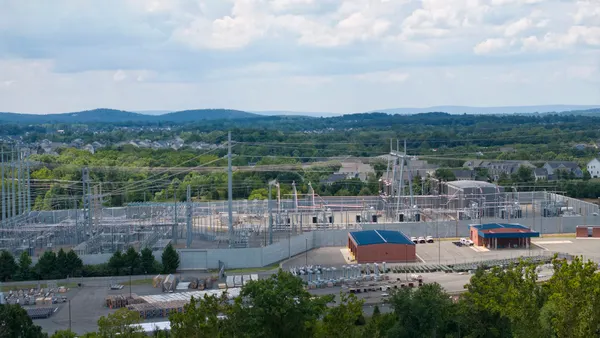
PSCo is building the projects near Burlington in eastern Colorado, close to its roughly $1.7-billion Power Pathway transmission project, which is partly designed to provide grid access for renewable energy projects in the area. However, the two wind projects have hit a snag in connecting to the grid: access to the Goose Creek substation through land owned by Dryland Partners.
Dryland Partners “remains open to a market-based resolution,” Brad Haight, a representative for the landowner, said in an email to Utility Dive. “The [Colorado] PUC should be prepared for PSCo to seek recovery of fuel costs and imprudently incurred [Allowance for Funds Used During Construction] accruing while its otherwise-complete projects are not interconnected.”
Delays, statewide impact
PSCo has asked the Colorado Court of Appeals to review the district court judge’s decision, but it could take more than a year for the case to be decided, according to Andersen
The district court ruling will “disrupt the legal framework governing how renewable projects connect to Colorado’s grid and delay critical renewable energy development statewide,” PSCo told the Colorado Supreme Court when the utility asked it to take the case from the appeals court.
“If permitted to stand, the Order would let any landowner controlling the sole access point to critical energy infrastructure dictate the terms of that access — free from any check by condemnation authority — holding renewable energy projects hostage to private pricing demands and raising costs for Colorado ratepayers statewide,” PSCo said.
But even before the district court ruling, the wind projects had been delayed due to the condemnation process PSCo pursued to obtain the land rights into the Goose Creek substation, the utility said in a mid-May filing with the Colorado Public Utilities Commission.
In the filing, PSCo said it expected the Cheyenne Ridge II project would be operating in May 2026 and the Singing Grass project would be online three months later. All the wind turbines for the Cheyenne Ridge II project were built and 108 out of 134 wind generators at the Singing Grass project were “topped out,” according to the report.
The delays are adding to project costs, according to PSCo.
“There are significant additional cost pressures from transmission line permit delays in Cheyenne County, the company is accruing significant standby time and costs for transmission line crews,” the utility said about the Singing Grass project in the redacted filing.
The Cheyenne Ridge II project requires a 5.4-mile tie-line to connect to the substation and the Singing Grass project needs a 28.8-mile tie-line, according to Andersen.
The utility acquired the rights for nearly the entire length of the two tie-lines from more than 100 landowners, she said.
“Despite years of negotiations, one remaining landowner issue, involving approximately 550 feet of easement, remains unresolved after extensive efforts to reach an agreement,” Andersen said.
What’s a transmission line?
The district court case centered on whether PSCo had the right to take Drylake Partner’s land via eminent domain. Cheyenne County District Court Judge Mike Davidson ruled that PSCo’s effort failed to meet legal requirements.
Colorado law allows utilities to condemn land for transmission lines. But Davidson rejected PSCo’s argument that the tie-lines between the wind farms and substation were transmission lines. The utility repeatedly referred to the lines as generation tie-lines in various documents, not as transmission lines, according to to Davidson.
Also, PSCo negotiated with Drylake Partners in bad faith, he said.
In 2022, Dryland Partners sold PSCo about 90 acres for $585,000 so the utility could build the Goose Creek substation, the decision states. Dryland then worked with PSCo to create corridors for the needed tie-lines.
However, PSCo switched gears and moved to take a Dryland parcel needed to interconnect its wind farms, according to Davidon’s ruling. PSCo planned to pay Dryland less than $20,000 for the land the utility wanted to take by eminent domain, making it impossible for the landowner to secure agreements with renewable energy developers worth millions, the court decision states.
“PSCo identified an alternative route for its generation tie lines, and then ignored it, together with years of collaboration by Dryland, believing it could simply take a different segment of Dryland's property by eminent domain,” Davidson said. “Further, PSCo knew that the route it seeks to condemn was reserved by Dryland as an oil and gas easement, the loss of which will have a significant economic impact on Dryland.”
Dryland complied with PSCo's requirement that it treat all generation developers equally in accessing the Goose Creek Substation, according to Davidson. Dryland, for example, entered into an easement agreement that reflected market rates to allow the interconnection of NextEra Energy’s 500-MW Dusty Rose wind farm to the Goose Creek Substation, he noted.
“Dryland reasonably believed that PSCo should pay a similar rate to NextEra because PSCo required that Dryland treat all developers equally,” Davidson said. “PSCo, now acting as a private energy developer after purchasing the Singing Grass and Cheyenne Ridge II wind development projects, did not want to pay the fair market price that Dryland and NextEra established for connecting generation tie lines to the Goose Creek Substation.”
The compensation sought by Dryland Partners is “substantially higher” than agreements reached with other landowners, according to Andersen.
Besides resolving the land dispute, PSCo needs a permit from Cheyenne County for a portion of the Singing Grass tie-line, according to Andersen. The county has said it won’t act on the permit until the land-rights issue is resolved, she said.
Once the permit is received, PSCo expects it could finish building the tie-line in about three months, with an additional month of testing needed before the wind farms could begin sending energy to the grid, according to Andersen.