
As rack densities climb toward 1 MW and beyond, traditional low-voltage alternating current (AC) architecture is being pushed into territory it wasn't originally designed to handle. A primary reason the industry is increasingly looking toward 800 VDC to support the next generation of high-density compute.
But the bigger question isn't whether direct current (DC) can power these new racks. It's where the conversion to DC should happen and how much of the traditional power architecture is still necessary.
Sidecars offer a bridge to 800 VDC
One near-term answer is the sidecar, a power-conversion unit positioned next to the compute rack.
Sidecars give operators a practical way to introduce 800 VDC racks into facilities built around existing low-voltage AC distribution. Rather than redesigning the facility, operators can convert AC power to DC beside the rack.
That makes sidecars an important bridge between today's infrastructure and emerging DC compute. But much of the existing electrical architecture remains in place. Power still moves through transformers and low-voltage UPS infrastructure before another conversion takes place near the rack.
Each stage introduces losses and nearly all of that lost energy ultimately turns into heat, putting more pressure on the cooling system to remove it.
SMA's white paper models the difference. In the architecture studied, delivering 1 MW through a traditional AC system with rack-level conversion results in approximately 80 kW of power loss per megawatt delivered to the rack. Converting medium-voltage AC to 800 VDC outside the building and distributing DC directly reduces that loss to approximately 20 kW.
At data center scale, the difference becomes more than significant.
Moving power infrastructure outside
Efficiency is only part of the equation. Data center operators are also under pressure to maximize one of their most valuable resources: white space.
A native DC architecture takes a different approach. Instead of generating 800 VDC beside the rack, conversion from medium-voltage AC to DC happens once, outside the data center building. Native 800 VDC is then distributed throughout the facility.
Much of the supporting electrical infrastructure can move outside as well, including power-conversion equipment, switchgear and energy storage.
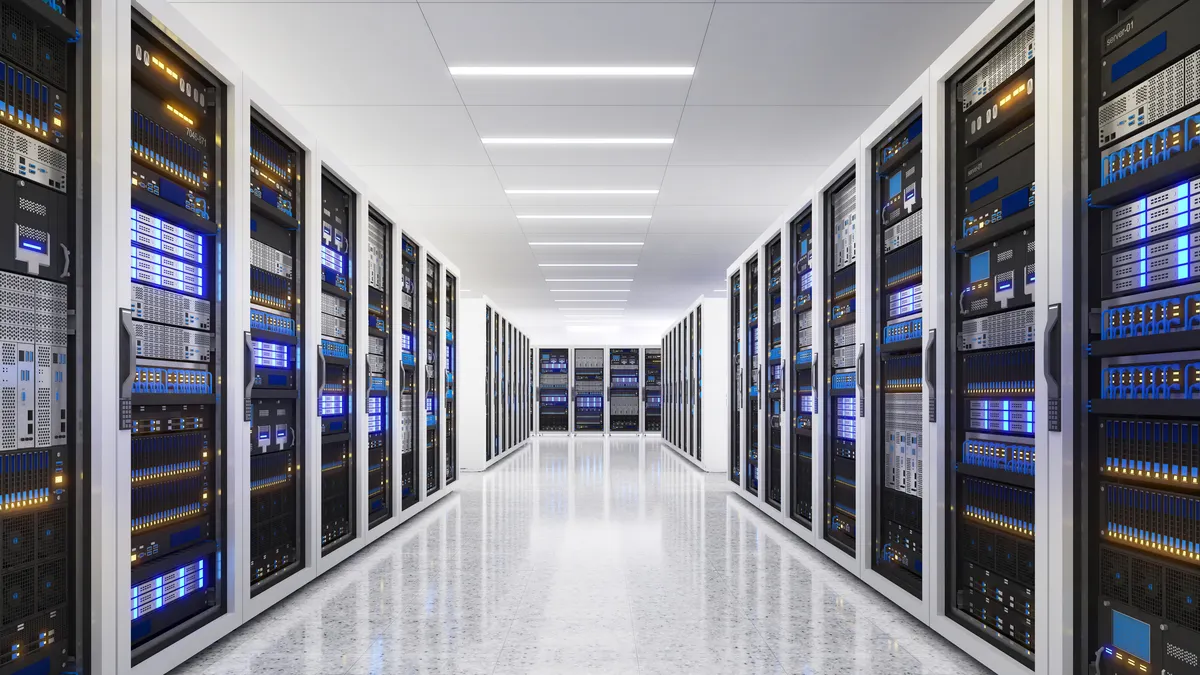
Inside, the architecture becomes more simplified: compute, cooling and DC busway. There are fewer conversion stages, fewer pieces of electrical equipment and more room for compute.
Rethinking redundancy and energy storage
Any new data center architecture still must meet demanding resilience requirements.
DC creates new options. A rack can be supplied by two independent DC paths, each capable of carrying the full load. During normal operation, both can remain active and share the load.
Unlike AC sources, DC sources don't have phases that must be synchronized. With the appropriate protection architecture, both sources can continuously supply the rack, potentially eliminating the need for a traditional transfer event. Sharing the load between two paths also reduces current on each path, helping lower electrical losses without sacrificing redundancy.
Moving energy storage outside the building can expand its role.
Instead of primarily waiting to provide backup power, storage integrated into an external DC power system can help smooth large power swings from AI workloads, provide ride-through during grid disturbances and control how quickly a facility returns to full power following an event. Depending on the system and market, storage could also support other grid services.
Designing power around compute
Sidecars have an important role as data centers begin adopting 800 VDC. They provide a practical way to deploy new compute infrastructure without rebuilding existing electrical systems.
But the longer-term opportunity is bigger than changing the voltage delivered to the rack.
Moving conversion outside the building and distributing native DC can reduce conversion stages and electrical losses, free up valuable space for compute, simplify redundancy and give energy storage a more active role.
For an industry racing to add enormous amounts of computing capacity, those aren't incremental changes. They represent an opportunity to rethink data center power architecture from the grid to the rack.