Dive Brief
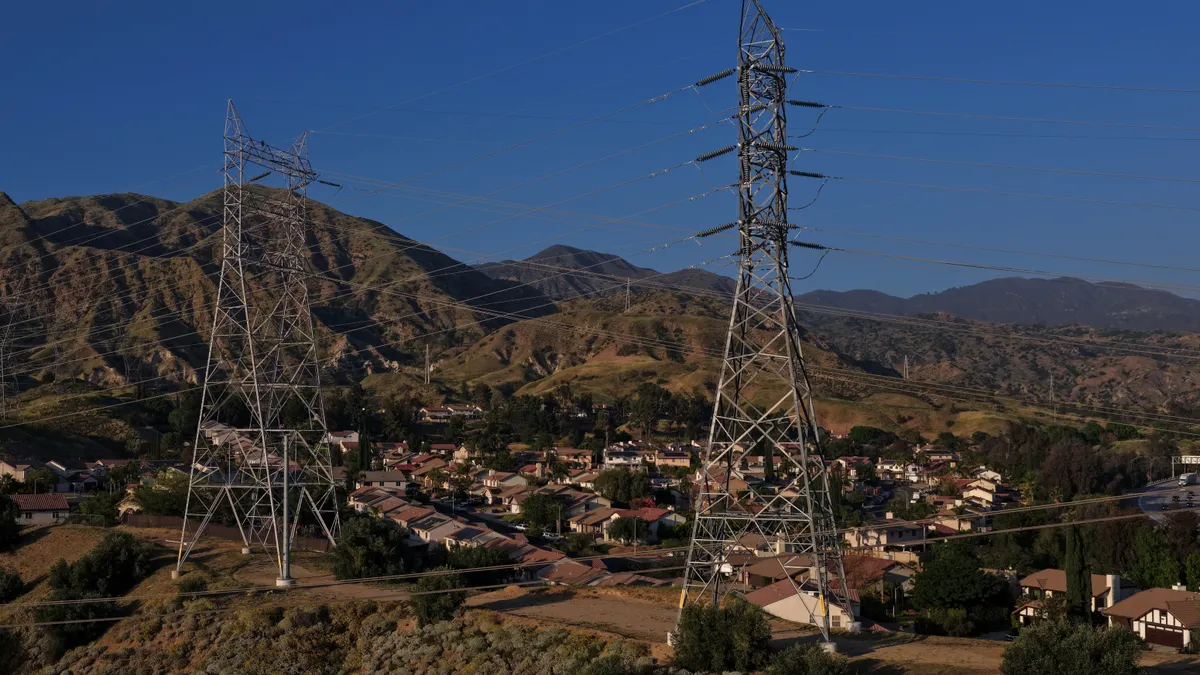
- The California Independent System Operator Board of Governors approved the ISO’s transmission plan for the state last Tuesday, making official its recommendation for California utilities to spend around $6.7 billion to build 38 transmission projects in the next 10 years.
- More than half of the projects are driven by forecasted load growth, marking an evolution in transmission planning from an emphasis on accessing low-cost renewable generation to “now also reliably meeting growing customer demand,” CAISO’s plan said.
- While California is not seeing as much demand from large-load data centers as some other markets in the West and Mid-Atlantic, the state has forecasted that it will need an additional 107 GW of installed capacity by 2040 to meet rising demand from building and transportation electrification, manufacturing and large loads, including data centers.
Dive Insight
The board of governors approved the plan in a 5-0 vote.
CAISO said the plan should enable the grid to “accommodate forecasted load growth and critical resource development” that the California Public Utilities Commission identified in its integrated resource plan, including 45 GW of solar generation in parts of California, Nevada and Arizona; 8 GW of in-state wind generation in Tehachapi; more than 2 GW of geothermal development, primarily in the Imperial Valley and in southern Nevada; and the import of over 10 GW of wind generation from Idaho, Wyoming and New Mexico.
Specific recommended transmission projects include a 500 kV line from Trout Canyon to Lugo; an expansion of the 230 kV Tesla–Trimble–Metcalf transmission corridor to supply the south Greater Bay Area; and series compensation on the existing Gates to Los Banos 500 kV transmission corridor.
The plan “includes 12 reconductoring projects that increase transmission capacity without having to build new transmission from scratch,” CAISO said in a release about the plan’s approval. “Three of these will employ advanced conductors,” a grid-enhancing technology.
The release noted that the approved plan cancelled the planned Serrano-Del Amo-Mesa 500 kV transmission reinforcement project in the Los Angeles Basin that was approved in the 2022 to 2023 planning cycle, based on “updated cost information from transmission owners.” Those reliability needs will be met instead by “smaller, lower-cost upgrades and increased reliance on energy storage development planned in key areas on the grid,” it said.
“We are constantly striving to find ways to meet system needs in the most affordable way possible,” Neil Millar, CAISO’s vice president of transmission planning and infrastructure development, said in the release. “This year’s plan does that in a number of different ways while also making sure we have the right infrastructure in place to accommodate all of the new resources that are being added to the system.”