Dive Brief:
- Zinc-based batteries are poised for wider deployment as energy storage demand surges and potential lithium shortages loom over the next few years, officials with the International Zinc Association told Utility Dive this week.
- U.S. zinc battery production is hindered by the high cost of scaling production and safety standards written for far more flammable lithium-ion batteries, according to a June 30 white paper coauthored by Josef Daniel-Ivad, head of the IZA’s Zinc Battery Initiative. Andrew Green, the IZA’s executive director, said in an interview that more work needs to be done to increase awareness of and comfort with zinc batteries among utilities and other end users.
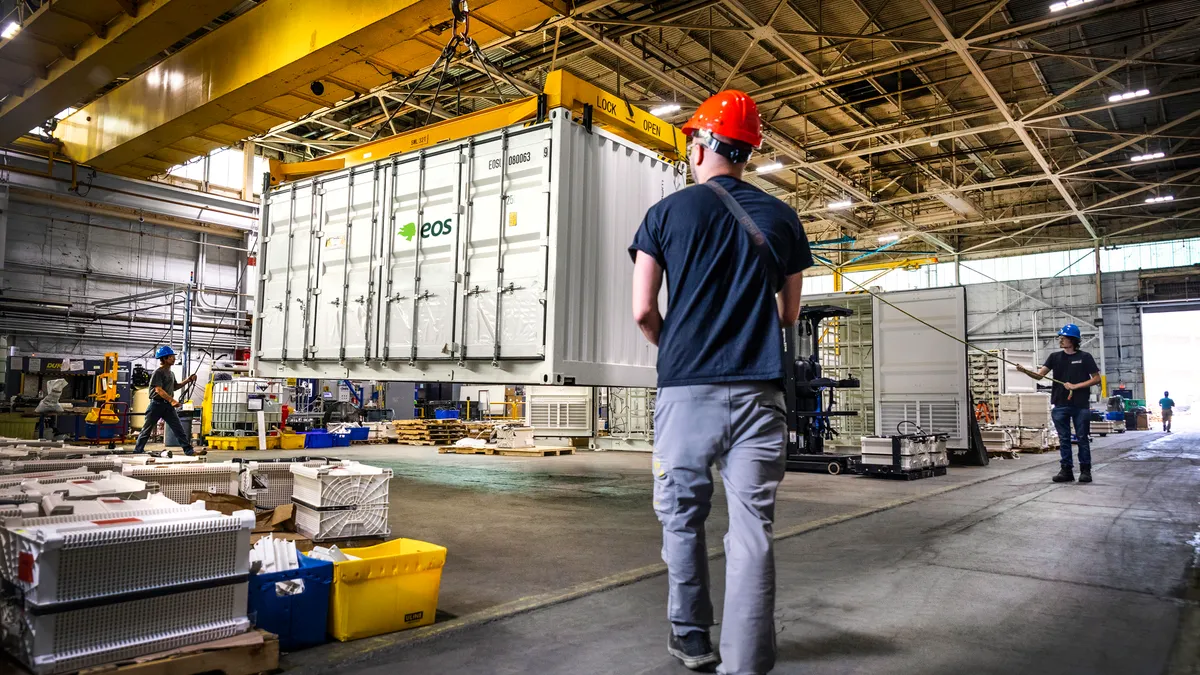
- The U.S. has relatively few grid-scale zinc battery installations operating today, with most deployments hosting 1 MW of capacity or less, according to the U.S. Department of Energy. With notable exceptions like Eos Energy, which aims to double production capacity to 8 GWh within two years, most manufacturers operate at smaller scale, Daniel-Ivad told Utility Dive in an interview.
Dive Insight:
Zinc battery capacity remains a rounding error in comparison to now-dominant lithium-based chemistries, which saw tens of gigawatts of U.S. deployments in 2025, according to Benchmark Mineral Intelligence.
The IZA hopes to convince more utilities, independent power producers and large or critical-load customers to install more zinc battery capacity by emphasizing the technology’s advantages over lithium. Those advantages include thermal stability, a 25% longer service life, better performance in extreme temperatures, and cost-effective recycling through established channels, Daniel-Ivad and his coauthors wrote in an industry “roadmap” that arose out of an April meeting convened by the IZA and West Virginia University.
Zinc batteries’ thermal stability eliminates the need for the thermal management and fire suppression systems that add significant cost to lithium battery assemblies, contributing — alongside longer service lifespans — to lower total cost of ownership, according to the white paper.
Zinc-based batteries are also more economical for maximum-power discharge durations longer than eight hours, Green said. Daniel-Ivad told Utility Dive that some zinc battery chemistries, such as zinc-air, can provide economical multiday storage, which energy system experts say will be increasingly important for stabilizing power grids with high renewables penetration during longer periods of low wind and solar output.
Ample U.S. zinc mining capacity, recent or planned mine starts or expansions in the Mountain West, and the federal government’s “critical mineral” designation for zinc last year means the industry has a “head start” on securing domestic supplies, Green said.
That’s a powerful tailwind for the industry amid geopolitical tension between the United States and China, which controls much of the global supply chain for lithium-based battery materials and components, Green added. Some experts predict regional shortages of lithium by 2030 as global demand for electric vehicles and stationary energy storage accelerates.
Boosting U.S. zinc battery production to account for 10% of U.S. zinc demand would enable 40 GWh of annual energy storage production capacity while only marginally increasing imports of refined zinc, according to the white paper. Although the U.S. imports about 77% of its refined zinc, most of it comes from neighboring Canada and Mexico, Daniel-Ivad and his coauthors wrote.
More support from the federal government is needed to scale zinc battery production and accelerate uptake by utilities, independent power producers and other end users, starting with support for new manufacturing lines, Green and Daniel-Ivad said.
“This is clearly a case where more incentives need to be put in place by [the U.S. Department of Energy] to help scale up manufacturing lines,” Green said.
Daniel-Ivad and his coauthors said DOE and other agencies should help stand up a pilot manufacturing line specifically devoted to zinc battery chemistries. DOE’s Office of Critical Minerals and Energy Innovation and the Office of Energy Dominance Financing — formerly known as the Loan Programs Office — should also provide grant and loan financing for scaled-up manufacturing lines and stand up an industry advisory board to support continued research and development, they said.
Finally, the whitepaper says federal agencies should forge public-private links aimed at emphasizing the benefits of zinc-based batteries and getting prospective end users more comfortable with a potentially important complement to lithium-based batteries.
“Awareness is a big thing, and [also] people don’t want to change — they want to do what they are used to doing,” Daniel-Ivad said.