Dive Brief:
- Data centers are driving higher load growth in Texas and the PJM Interconnection region faster than in the rest of the country. That rapid growth could increase electricity prices and gas and coal consumption under some scenarios, the U.S. Energy Information Administration said in a Thursday analysis.
- The Electric Reliability Council of Texas and PJM Interconnection regions are forecast to see annual electricity load averages grow 10% and 3.2%, respectively, between 2025 and 2027, EIA said. However, EIA also modeled a high-demand scenario that would result in growth in those regions of 15% and 4.7%, respectively.
- Most regions can accommodate higher-than-expected electricity demand growth without large price impacts, EIA said its analysis shows, “but the modeled price effects in ERCOT highlight some of the challenges grid operators have in managing large increases of load in the near term.”
Dive Insight:
New EIA analysis, based on its February Short-Term Energy Outlook, shows rapid data center load growth has the potential to drive higher electricity prices and shift the generation mix, particularly in ERCOT and PJM.
From 2005 to 2019, U.S. electricity demand growth averaged 0.1% annually, according to EIA, the energy data arm of the federal government. From 2020 to 2025, demand grew about 1.7% annually.
In its February STEO, EIA forecast U.S. electricity load to increase by 1.9% in 2026 and 2.5% in 2027. In some regions, however, load will grow significantly faster. And if that growth outstrips planners’ expectations, prices will rise, EIA said.
“We expect that the regions of the country whose grids are managed by ERCOT and PJM will experience the fastest growth in electricity demand from data centers through 2027,” EIA said. The Thursday analysis considered a high-demand scenario in which the 2026 and 2027 load growth rates were 50% higher than the baseline forecast in the February STEO.
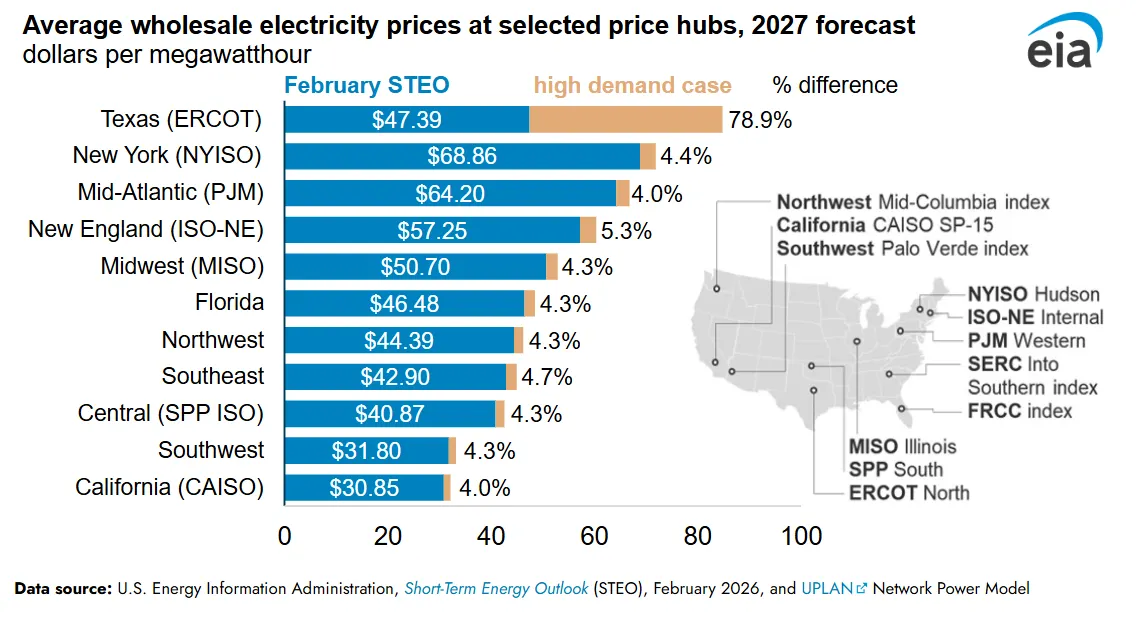
While high-demand-case price increases run 4%-5% for most regions, in Texas, average wholesale electricity prices at the ERCOT North hub could be 78.9% higher than the $47.39/MWh forecast in the STEO, EIA said.
ERCOT did not immediately respond to questions about the analysis.
In PJM, the annual average price increase in a high-demand scenario was limited to about 4% higher because the regional grid “is interconnected with other regions in the eastern United States and has access to more coal and natural gas generating capacity,” EIA said. The New England grid could see prices 5.3% higher in a high-demand scenario, and the New York ISO could see a 4.4% increase, EIA said.
Price impacts across all regions “would be relatively minor in 2026 given the ramp up time of the increasing load in the high demand scenario, but the effect is more evident in 2027, as higher demand in this scenario increases the utilization of existing generating capacity,” EIA said.