The addition of 58 GW of summer resource capacity has the U.S. grid in good shape heading into the summer months, but risks are growing during the shoulder seasons, the North American Electric Reliability Corp. said Tuesday in its annual summer assessment.
The watchdog’s report flagged four areas at risk of energy shortfalls or local constraints during extreme heat conditions this year, down from six in 2025.
The pace of electricity demand growth continues to rise, and NERC officials highlighted difficulties in demand forecasting due to data center interconnection issues and evolving operational data. Summer peak demand this year will be about 865 GW, according to the assessment, up from about 842 GW in 2023.
A “large influx” of bulk power system resources over the past year “has outpaced demand and is boosting reserves,” according to the report. Resources available to meet peak demand this summer jumped by over 58 GW over last year, including 16 GW of solar, 15 GW of storage and 7 GW of gas capacity.
Another 19 GW of capacity additions include other types of resources and changes to generator availability, including the completion of nuclear outages and maintenance plans. NERC said 16 of its 23 assessment areas have increased available capacity ahead of summer.
“Overall, this is a positive story,” NERC analyst Suzanne Edwards said in a call with reporters to discuss the assessment.
The Midcontinent Independent System Operator and Electric Reliability Council of Texas markets both saw “a robust jump” in year-over-year anticipated resources, of 7% and 12%, respectively, allowing each to shed the “elevated” risk assessment from the previous summer’s assessment, Edwards said.
NERC’s report flagged parts of New England, the Northwest, SaskPower’s territory in Canada and a local area in West Texas as facing elevated risks in extreme heat.
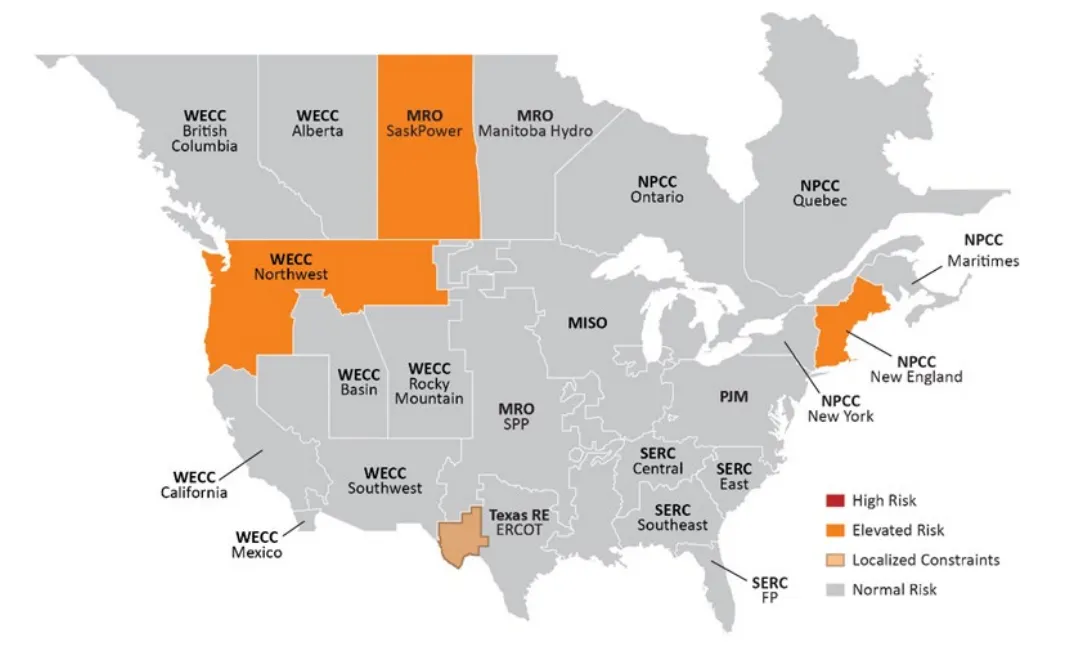
In NPCC-New England, firm import commitments have declined since last year “resulting in lower operating reserves and increased reliance on non-firm supplies from neighboring systems to meet high demand,” NERC said. In WECC-Northwest, persistent drought conditions, rising demand and a decline in resource capacity “could increase vulnerability during more extreme summer conditions.”
In the SaskPower area, a higher demand forecast reduced operating reserves. And while ERCOT was broadly removed from the “elevated risk” designation, a small area in the western portion of the state “remains at risk for load disruption when solar and wind output is low and transmission constraints limit the flow of imports.”
West Texas “has a bit of everything, with respect to our big reliability topics of the day,” Edwards said. “There is definitely large load growth, and that's complicating the load forecast when the rate of completion is not super stable.”
Data center growth has muddled the demand picture in Texas, and ERCOT in April preached caution on its own projections. The grid operator estimated summer peak load to range between 90,500 MW and 98,000 MW, significantly cutting the 112,000 MW peak it forecast in a previous report that included large-load demand estimates from utilities at the direction of state lawmakers.
The Texas Interconnection is “widely at a normal risk level” this summer due the jump in anticipated resources as well as a 4.5% decline in projected net internal demand, NERC said. The lower demand forecast is the result of “updated load modeling that reflects the observed behavior of load during peak periods and more demand response from large computational loads.”
“On a regional basis we have seen some downward revisions in the demand associated with large load interconnection rates in certain areas,” Edwards said. Large loads, including data centers, have “been difficult to time, with respect to the speed at which they connect to the grid. Slower than expected interconnection rates have spurred these adjustments to the near-term load forecast,” she said.
“The trend is also visible in [the PJM Interconnection], with lesser growth expected. It's not quite as stark as a full on decline in demand, but lesser growth,” Edwards said.
In January, PJM trimmed its load growth forecast through 2032 on stricter data center vetting and the economic outlook in its operating footprint.
NERC warned that sudden load reduction events or disconnections are a growing concern with data centers and “pose operational challenges for the upcoming summer.” Earlier this month, NERC issued a Level 3 alert and mandatory actions, following instances of data centers unexpectedly dropping load or oscillating demand rapidly, creating reliability concerns.
Other reliability risks NERC is watching this summer include wind droughts. The bulk power system grew its wind capacity 3% year on year, NERC said.
“The impact of wind ramp events — particularly down ramp — must be anticipated and planned for such that appropriate resources are ready to replace the energy lost during these conditions,” the summer assessment said. “It is not uncommon for areas to experience several thousands of megawatts of wind energy coming off-line during these events.”
Increasing grid complexity, rising demand and shifting temperatures are also driving up reliability risks in the spring and fall, seasons typically thought to be safer from reliability challenges, officials said. The overlap of early summer heat and spring maintenance outages can lower operating reserves, the assessment noted.
“There is trending higher risk in shoulder periods than in ... the summer peak conditions, and I think that's a really reflection of how we're using electricity [and] the types of resources that are being provided to us,” said John Moura, NERC director of reliability assessments and performance analysis.