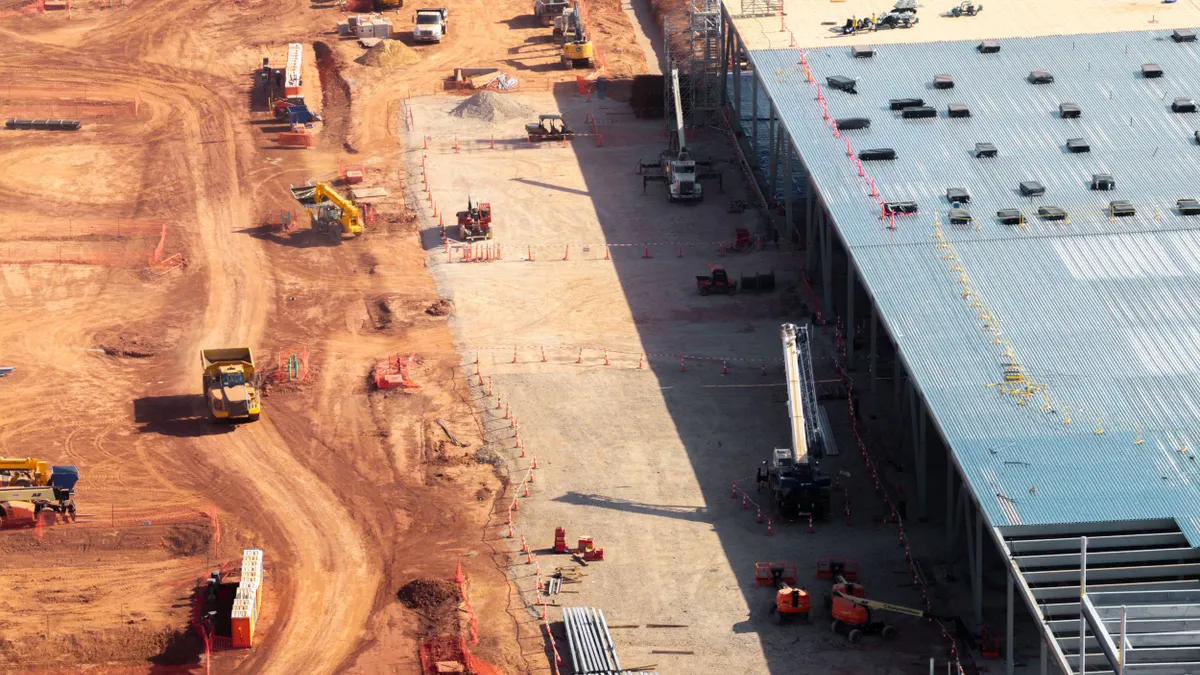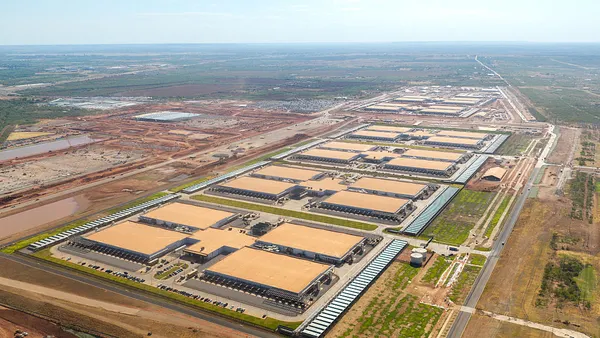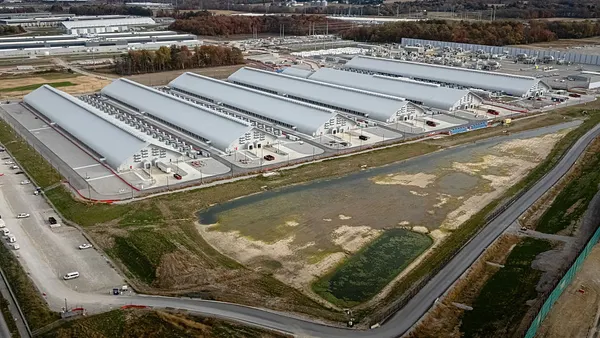
Utilities could be left holding the bill for billions in infrastructure spending committed in anticipation of artificial intelligence data centers that are delayed, downsized or canceled, industry observers and experts told Utility Dive.
Opposition to data center construction has crossed traditional party lines, while Democratic gains in the midterms are adding pressure on earlier-stage investments across key markets. Together, these dynamics raise the stakes for project approvals and utility cost recovery, they say.
“From a financing perspective, prolonged uncertainty will increase the cost of capital, reduce available leverage and make investors more hesitant to commit significant development dollars before power is secured,” said Andrejka Bernatova, managing partner of investment firm Dynamix Capital Partners, which invests in energy infrastructure.
Even in regions that theoretically have enough capacity to accommodate new large loads, projects may struggle to secure a credible path to power on the timelines they need.
“Interconnection, permitting, and financing all matter, but they are part of the same execution question of whether the team can get reliable power to the site and actually deliver,” Bernatova said. “A customer commitment or a large announced capacity number does not answer that by itself.”
Ultimately, Bernatova expects investors to favor markets that offer certainty around power availability and timelines, potentially eroding the competitive advantage of markets like Texas, which until recently attracted substantial data center investment.
Over the summer, Gov. Greg Abbott, R, announced a pause on new data center interconnections pending an audit of the queue. In the midterms, he lost his bid for reelection to Democrat Gina Hinojosa, who has pledged to maintain pressure on the industry after taking office next year.
Ballot-box rebuke puts utility investment safeguards in focus
Nearly all of the 46 municipal ballot measures tracked by Bloomberg that addressed data center development resulted in restrictions, moratoriums or bans.
That unfavorability extends to a substantial share of the development pipeline. An estimated 191 GW of planned data center capacity faces new risk, with exposure concentrated in Texas, Ohio and Georgia, where incoming Democratic governors campaigned on pausing or restricting construction, according to a report from energy analytics firm Orennia that was shared with Utility Dive.
Texas accounts for nearly half of the pre-construction in development in the U.S., so a statewide approval freeze would have an outsized impact on the national buildout, but the “impact of delayed or unrealized data center build-out on power prices varies widely across technologies and markets,” Orennia said.
If 20% of projected data center demand in the Electric Reliability Council of Texas region fails to materialize, solar and wind generators could see their average wholesale revenue fall 38% and 37%, respectively, according to the report. Implied heat rates, a measure of the economics of gas-fired generation relative to fuel costs, could decline 39%. In the same scenario, two-hour battery storage arbitrage spreads could fall below new-build break-even requirements.
In PJM, delaying half of the planned data center buildout by two years could reduce four-hour battery storage arbitrage spreads by 16% and lower solar and wind capture prices and implied heat rates by about 12% through 2030, the modeling suggests.
The election results are unlikely to produce sweeping federal AI legislation but could lead to congressional hearings and greater transparency requirements, according to D.C.-based research and advisory firm Capstone. Its analysts expect much of the policy debate to take place at state utility commissions and local siting boards.
Despite a proliferation of large-load tariffs over the past year, safeguards may still leave customers exposed in the event of a slowdown, some say.
“Existing tariffs and regulatory frameworks likely won’t fully protect customers because they were designed for a different century,” Louisa Eberle, principal at the Regulatory Assistance Project, warned in a written statement.
Eberle also called for reforms to utility business practices “to turn this data center surge into updated infrastructure, cleaner energy and a better deal for average customers.”
The push for lower electricity bills is prompting policymakers to look more closely at how utilities use existing grid infrastructure.
Richard Caperton, vice president of policy at SPAN, a maker of smart electrical panels, anticipates greater emphasis on data center projects that can be served without major new grid investments.
“I’m really thrilled to see governors like Abigail Spanberger [in Virginia] campaign on affordability and then embrace utilization as the solution,” he said.
In April, Gov. Spanberger signed legislation requiring Dominion Energy and Appalachian Power to report how effectively they use existing grid infrastructure. The State Corporation Commission can use those metrics to establish improvement targets and evaluate utility spending.
“Winning candidates who emphasized lowering electricity prices are already looking for ways to deliver on their promises quickly,” Caperton said. “I expect that will lead to more policies and programs that boost grid utilization being ratified and implemented in early 2027. How those policies affect data center development and utility investments will vary by state.”
A ‘necessary’ shakeout puts project commitments to the test
Stephen Rose, CEO of infrastructure software provider Render Networks, said he expects to see a “pause and necessary shakeout” in data center development.
“Fully permitted projects with real capital will keep moving,” Rose said. “The speculative end takes the hit: developers land-banking without firm power, and the contractors who staffed up for projects that won't break ground.”
Rose cited AEP Ohio's large-load tariff, approved in July 2025, which requires new data centers above 25 MW to pay for at least 85% of requested capacity for up to 12 years, with exit fees and financial guarantees. The utility’s data-center pipeline subsequently fell by more than half from more than 30 GW to about 13.
Rose expressed concern, however, that a broad slowdown wouldn’t affect hyperscalers as much as it would the businesses and people that build data centers. He recalled delays in Louisiana's Broadband Equity, Access and Deployment program in 2025, where service providers bore the costs of equipment and crews while waiting for approvals.
“When timelines stalled, the hit didn't land on big tech balance sheets. It landed on local drilling, civil and fiber contractors,” Rose said. “A data center slowdown hits the same people first, and Texas risks the same fallout.”
Scrutiny could shift where projects get built
Permitting hurdles could make data center developers more selective about where they build and under what terms.
Andy Roehr, managing director in the tax advisory firm Baker Tilly’s energy and infrastructure practice, sees developers as more likely to redirect capital than abandon projects – though that could lead to a winnowing of queues in some jurisdictions.
“A developer is typically evaluating three, four or five sites at any given moment, so when permitting, regulation or local opposition makes one location difficult to read, the project is far more likely to be delayed or redirected than canceled,” Roehr said.
Roehr said states and municipalities competing for projects that can no longer move forward elsewhere could find themselves in a “bidding war.”
"The most interesting thing I am seeing is that these moratoria are creating a developer’s market since they have the assets, tax revenues and jobs that communities want or need,” he continued.
Some developers may shift to “less optimal sites where projects can get done at an effective price point and time-to-market, but the regulatory and legislative environment is less hostile,” he said.
Changes in expected demand could also lead to repricing across the supply chain, from gas turbines and processor racks to construction costs.
Another uncertainty is the possibility of federal permitting reform, which could make it easier to build certain kinds of energy projects.
The Bipartisan American Affordability and Jobs Act, which advanced in the Senate last week, faces a difficult path to passage following the midterm elections, analysts say.
Democrats are split over the proposal, with some expressing concerns over changes to environmental protections in the bill and urging party leaders to wait until next year when the Democrats will control both the House and Senate to pursue their priorities.
Roehr said in his view, the BAAJA takes an “all of the above” approach and would be as meaningful to solar as to nuclear or natural gas. But what the industry needs most, he said, is stability.
“Developers, investors and host communities need certainty to keep committing capital and local resources to these projects,” Roehr said. “These are 20-, 40-, even 60-year investments, and if the environment keeps whipsawing then jobs don’t appear, tax payments don’t appear and capital moves on — there will be no winners.”