Southern Co. could see its five-year capital plan increase to $100 billion on natural gas investments, nuclear uprates and additional generation, executives told investors and analysts during a third-quarter earnings call last week.
They also downplayed the potential for sweeping political change following the midterm elections to impact the company’s strategy, particularly with regards to large-load customers like data centers that are fueling its growth plans. Anger over energy costs, including electricity bills, helped Democrats seize control of Congress and many state leadership positions, including in Georgia, where they won the governor’s office and a majority on the Public Service Commission.
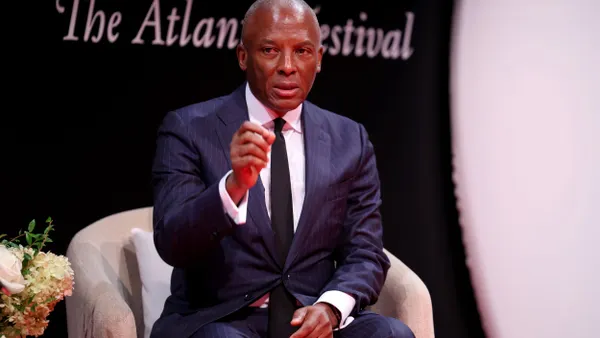
“I feel pretty confident about what we have in place,” CEO Chris Womack said.
He said he has not heard “any talk about retroactive” data center freezes or “looking backwards” at signed contracts.
“We have strong confidence in ... what we've done in the contracts that we signed that are in place and are in effect,” Womack said.
David Poroch, the company’s executive vice president and CFO, said even if development slows down and data centers don’t ramp as quickly as expected, its contracts contain provisions for minimum bills that cover at least 100% of the cost being introduced into the system.
“Before the kilowatt moves over the meter, we are recovering our costs embedded in those minimum bills,” Poroch said. “So we've kind of disengaged ourselves from the need for a customer to achieve their ramp rate for us to recover our cost.”
Womack also listed several large loads that are not data centers, which he said will continue to fuel economic growth in the South, including projects from Airbus, Mitsubishi Power, Audi and others. Mitsubishi Power plans to greatly expand its gas turbine manufacturing facility in Savannah, Georgia, helping meet rising power generation needs, he said.
The company added about $4 billion to the $81 billion base capital plan the company rolled out in February. The additions include 400 MW of uprates at existing natural gas facilities and an expansion of the Southeast Connector gas pipeline.
In the third quarter, the company's Georgia Power subsidiary also received approval for an agreement with Google to expand nuclear capacity through uprates over the next several years, said Poroch. The company is also bidding on new generation contracts in Alabama and Georgia, he added.
“To the extent potential company-owned resources are selected through these processes and ultimately authorized by the respective [regulators], this could represent substantial incremental investment, together with opportunities for additional investment across all our businesses,” Poroch said.
In response to an analyst’s question, he said he expects more than 90% of new investment to target state-regulated projects versus competitive power markets and interstate pipelines.
In the third quarter of 2026, retail electric revenues were $6.6 billion compared to $5.7 billion for the corresponding period in 2025, and $16 billion year to date compared to $15.1 billion in 2025, according to its quarterly filings with the Securities and Exchange Commission.
The company attributed the increase to changes in rates and pricing, and higher contributions from commercial and industrial customers.
Southern saw weather-normalized electricity sales across all customer segments rise 3.5% in the third quarter and 2.7% year to date, led by commercial sales, which were up 7.3% compared with the third quarter of 2025.
“This large load customer demand is translating into increasing usage,” Womack said. “Notably, data center usage was 59% higher this quarter and is now up 52% year to date, primarily due to accelerating load ramps from data center customers.”
He said the company’s portfolio of signed large-load contracts has grown to 21 GW with an additional 7 GW in late stages across Alabama, Georgia and Mississippi.
“Now, are we going to land 75 GW of projects? Probably not,” said Womack, referring to the company’s speculative pipeline. “I mean, we'll continue to risk adjust it, but I think it's a clear indication and a demonstration of the interest in our territory.”