Dive Brief:
- The U.S. electric power sector will generate almost 4,390 billion kWh this year, up 2.7% from 2025 — a new production record driven by “rising demand from the commercial sector and increased cooling needs from warmer-than-average summer temperatures,” the U.S. Energy Information Administration said in its November Short-Term Energy Outlook published Tuesday.
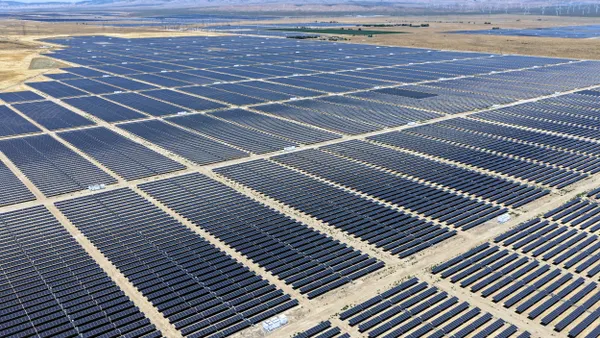
- Rising electricity demand “is met primarily by increasing generation from renewable energy sources,” EIA said. Although the rate of generation growth is expected to slow next year, the share of total U.S. generation supplied by utility-scale solar plants will rise from 7% in 2025 to 8% in 2026, reaching nearly 10% in 2027, according to the report. Wind generation’s share is expected to rise from 11% in 2025 to 12% by 2027.
- EIA also expects the utility sector will install more than 25 GW of battery storage next year, reaching 91.7 GW of installed capacity by the end of 2027 — an increase of nearly 40% over expected 2026 totals.
Dive Insight:
Solar and wind generation are expected to add new capacity of about 72 GW and 20 GW, respectively, this year and next, EIA said.
"Generation from other energy sources is likely to remain relatively flat or decrease,” it added.
While commercial and industrial sector demand will continue to see robust growth next year, that could be “offset somewhat by lower residential electricity demand resulting from forecast milder summer weather next year,” EIA said.
The federal government’s energy data arm is forecasting U.S. gas generation’s share of the electric power generation mix to hold relatively steady at an average of about 40% in 2026 and 2027, and nuclear’s share to average 18%.
Coal’s share of generation will likely decline from 17% in 2025 to 15% by 2027 as 13 GW of capacity is scheduled to retire by the end of next year, EIA said.
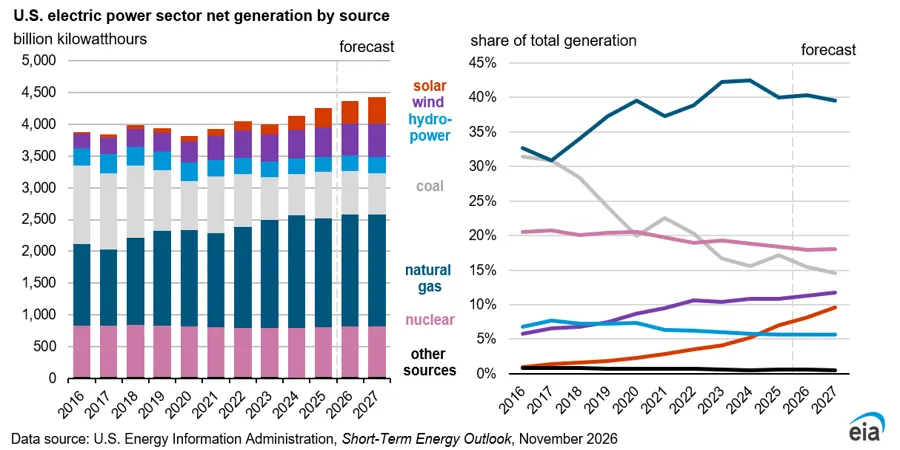
“Although the share of generation from those fuels is falling, total generation from those fuels is relatively flat in the forecast, remaining in line with the combined generation from 2025,” according to the short-term outlook.
The electric power sector’s coal consumption has declined, relative to 2025, in eight of 10 months so far this year, EIA noted.
“The decreases have been driven by significant increases in wind and solar capacity as well as a 9% decline in the average natural gas price in the electric power sector during the second and third quarters of this year,” EIA said. “We expect coal consumption to decline an additional 5% in 2027, driven by a 19% decrease in natural gas prices for electric generating plants and further increases in wind and solar capacity.”
EIA’s report also forecasts significant battery storage growth. Capacity will rise from 28.9 GW in the first quarter of 2025 to 66 GW by the end of this year and 91.7 GW at the end of 2027, counting systems with a capacity of 1 MW or greater.