
Dive Brief:
- Ford Motor Co. announced a major shift in its electrification plans featuring extended-range hybrid vehicles, more affordable and smaller electric vehicles, growth in its stationary energy storage business and new truck models powered by efficient internal combustion engines by 2030, the automaker announced in a press release Monday.
- The company plans to hire thousands of new workers to boost U.S. production, including building new pickups built at BlueOval City in Tennessee, and a new gas and hybrid van to be produced at its Ohio Assembly Plant.
- “This is a customer-driven shift to create a stronger, more resilient and more profitable Ford,” said Ford president and CEO Jim Farley in a statement. “The operating reality has changed, and we are redeploying capital into higher-return growth opportunities.”
Dive Insight:
Ford is shifting its focus away from pure EVs like the Mustang Mach-E and F-150 Lightning to more profitable vehicles, including hybrids. Ford said realigning its strategy for large trucks and SUVs better aligns with customer demand for capability, towing and range, which includes adding extended-range electric options to its truck lineup.
The automaker plans to offer a hybrid or multi-energy powertrain choice for nearly every vehicle it sells by the end of the decade. Ford also aims to launch five new affordable vehicles within the same timeframe, four of which will be assembled in the U.S.
Ford is targeting annual improvements beginning in 2026, with plans to put its Model e EV division on a path towards profitability by 2029. The Model e EV division has lost billions over the past several years due to higher development costs and less than expected demand for its fully electric models, including the F-150 Lightning.
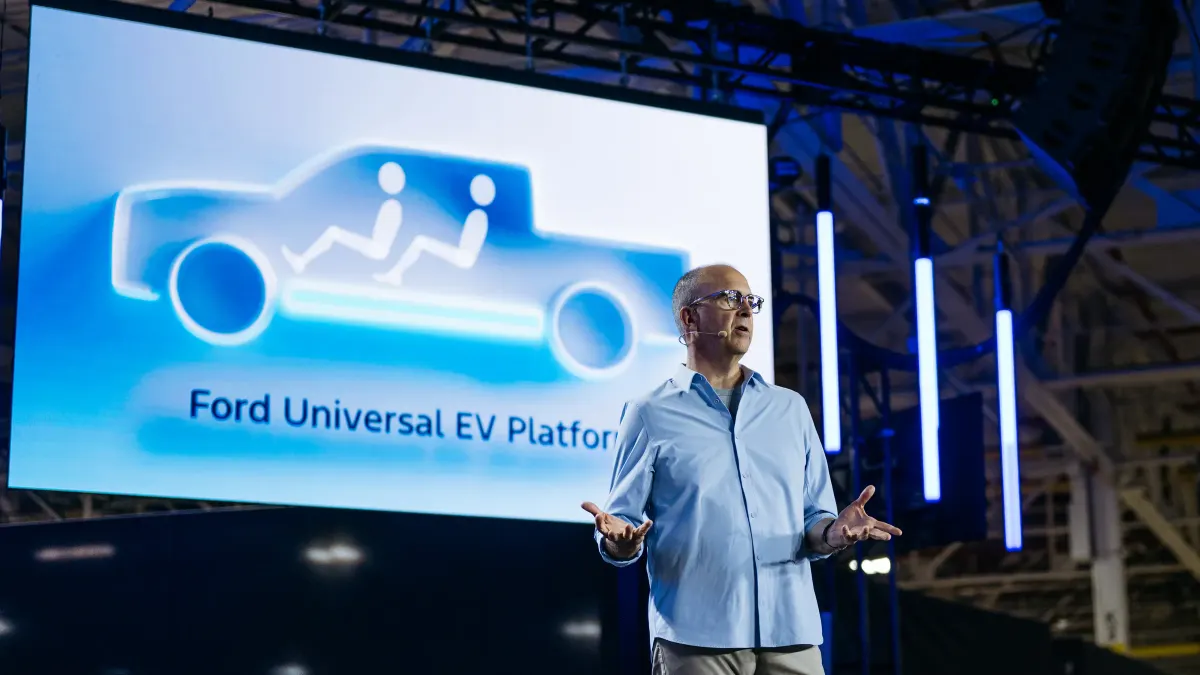
Ford said it will now focus on the development of new EVs built using its next-generation, low-cost, flexible “Universal EV Platform” for the North American market. The platform will underpin a family of smaller, highly efficient and low-cost EVs designed to be accessible to millions of customers. The first EV built on the new platform will be a fully connected midsize pickup truck assembled at its Louisville Assembly Plant starting in 2027.
But by 2030, the automaker expects that roughly 50% of its global sales volume will be hybrids, extended-range EVs and fully electric vehicles, up from just 17% in 2025.
Ford is also abandoning its previous plans to offer an electric commercial van for North America, replacing it with a new, affordable version equipped with both a gas and hybrid powertrain. The new commercial van will be manufactured at Ford’s Ohio Assembly Plant starting in 2029.
The Ohio plant will become a central hub for growing the automaker’s Ford Pro commercial business. The plant will also assemble F-Series Super Duty chassis cab trucks for commercial customers.
The automaker’s Tennessee Electric Vehicle Center located on its BlueOval City campus, is being renamed the Tennessee Truck Plant. The plant will produce all-new truck models beginning in 2029, replacing a previously planned next-generation electric truck.
Ford also said it no longer plans to produce a new electric commercial van for the European market, but will continue to maintain its full lineup of hybrid vans.
Last week, Ford announced a partnership with Renault to launch two new EVs tailored for the EU market. The first vehicle is expected to launch in early 2028.
To support the growth of its battery storage business to meet demand, Ford will leverage plants in Kentucky and Michigan to produce lithium iron phosphate batteries. The Kentucky plant will be converted to manufacture 5 MWh+ battery energy storage systems, including 20-foot DC container systems. These large battery units are used by data centers, utilities and large-scale industrial and commercial customers.
Ford plans to begin shipping the first energy storage units in 2027 with 20 GWh of annual capacity. The automaker plans to invest around $2 billion in the next two years to scale its battery storage business, which also includes manufacturing smaller Amp-hour cells for residential energy storage units at its BlueOval Battery Park Michigan.
Ford expects to record about $19.5 billion in non-recurring costs as part of its new long-term strategy, a majority of that in Q4. The company expects about $5.5 billion in costs associated with canceling specific vehicle programs and preparing its plants to produce new models, the majority of which will be paid in 2026 with the remainder in 2027.
Ford also raised its 2025 adjusted EBIT guidance to around $7 billion based on its current business strength and ongoing cost improvements, per the release.