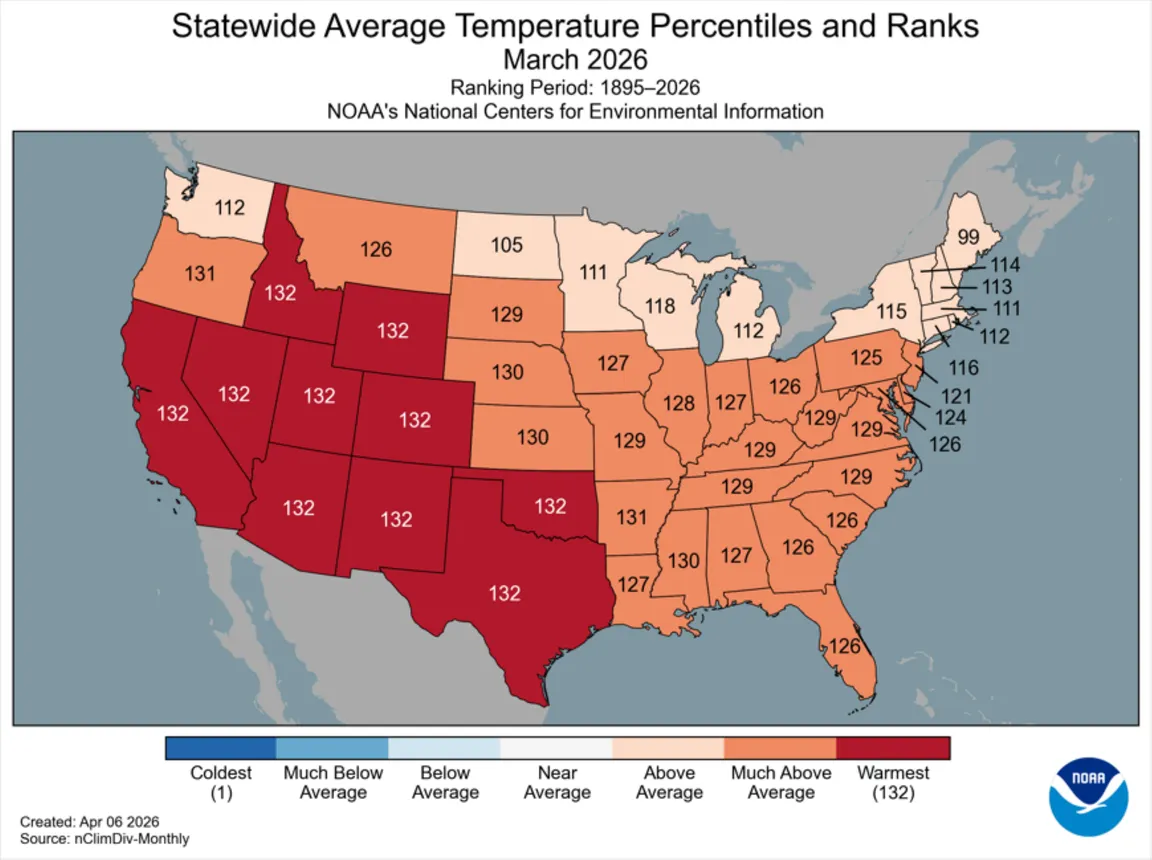
Net U.S. electricity generation increased 4.5% year over year in March as a large swath of the West — from Texas to California and up to Idaho — saw its warmest March on record dating back to 1895, the Energy Information Administration said Friday.
The region also received “much below average” rainfall heading into wildfire season. California experienced its hottest and driest March in 132 years.
Nationwide, retail sales increased by 2.3% while retail prices climbed 7.2% across all sectors to 14.2 cents/kWh in March compared with March 2025.
The commercial sector saw the largest jump in retail sales among the sectors named in the report, up 4.5% from last year, it said. The sector saw a year-over-year price increase of 5.8% to 13.9 cents/kWh.
Retail sales to the industrial sector were up 2.4% while prices for that sector grew 3.9%, to 8.6 cents/kWh.
The residential sector saw a slight decrease in retail sales, down 0.1%, while residential prices were up 10.2%, to 18.8 cents/kWh.
The transportation sector also saw a decrease in sales, down 6.9%, along with the steepest price increase — up 26.5%, to 17.8 cents/kWh.
“The changes in electricity generation from the previous March were broadly positive across all regions of the country,” the report said, with the West, Texas, Southeast, Florida, Central and Mid-Atlantic regions all seeing year-over-year increases. The Northeast was an outlier, with “virtually no change in electricity generation compared to the previous year,” it said.
“The region-by-region increases in electricity generation were generally a result of warmer temperatures compared to last year, driving higher cooling demand across much of the country,” it added.
The contiguous U.S. average temperature was 9.4 degrees F above the 20th-century average, making March 2026 the warmest March in the 132-year record, according to the National Oceanic and Atmospheric Administration. The period from April 2025 to March 2026 “now stands as the warmest 12-month span ever recorded,” it said.
According to the EIA report, 32 states saw a decrease in heating degree-days — the number of degrees that the daily average temperature falls below 65° F — in March compared with the same month of the previous year.
“Arizona had the highest percent year over year decrease, down 77%, followed by California, down 76%, and Nevada, down 63%,” it said.