Dive Brief:
- The PJM Interconnection on Monday urged the Federal Energy Regulatory Commission to dismiss a complaint from Monongahela Power, a FirstEnergy subsidiary, that seeks to recoup $145 million in losses the utility incurred during Winter Storm Fern earlier this year.
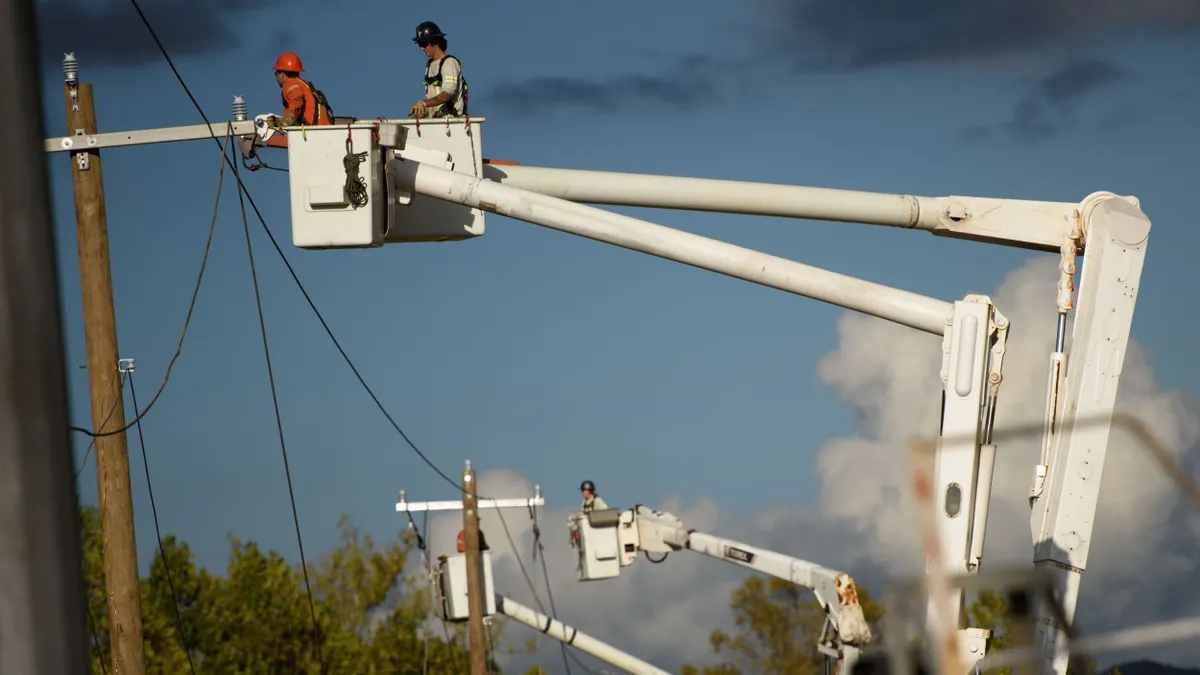
- Mon Power’s Oct. 6 complaint asked regulators to investigate whether PJM exceeded or misused its advance-scheduling and commitment authority, resulting in inappropriate costs for the utility. In its response, PJM called the complaint “a fishing expedition without substance.” The “most obvious and significant” driver for the locational marginal price differences Mon Power faced during the storm was downed power lines on the utility’s system, PJM said.
- Independent power producer trade groups said they were sympathetic to Mon Power’s plight but that FERC should reject the complaint. “Mon Power’s requested remedy — to retroactively rerun, resettle, or reallocate market outcomes long after the clearing of the day-ahead and real-time markets — violates core principles of market finality, undermines investment certainty across the PJM footprint, and conflicts directly with longstanding Commission precedent disfavoring retrospective market reruns,” the PJM Power Providers Group and the Electric Power Supply Association said.
Dive Insight:
During Winter Storm Fern in late January and early February, PJM relied on advanced scheduling of gas-fired power plants to meet demand instead of using its normal market-driven practices.
PJM scheduled ahead of time more than 50,000 MW a day of gas-fired units from Jan. 26 through Jan. 31, and it scheduled more than 45,000 MW on Feb. 1, according to Mon Power, which has about 400,000 customers in West Virginia. PJM had nearly 89,000 MW of gas-fired generation on its system as of Dec. 31, the utility said.
At the same time, Mon Power’s cheaper coal-fired generation was dispatched by PJM at or near economic minimum levels, according to the utility.
“This phenomenon — Mon Power generation plants having lower-cost energy available yet not being dispatched beyond their economic minimum levels — appears to have occurred repeatedly,” the utility said. “That outcome raises serious questions about PJM’s advance-scheduling practice — questions only fulsome discovery can answer.”
Mon Power said its $145 million loss was “the largest net expense” in its history and, without FERC intervention, would be paid by “ordinary West Virginia citizens.”
PJM has said it needed to schedule the gas-fired units in advance to give them financial certainty so they could procure fuel more than a day before they were slated to run, Mon Power said. However, many of those units were obligated to be available because they had cleared in the capacity market, the utility noted.
“Absent a showing that these units would likely have failed to perform through normal market processes according to existing market rules, PJM’s unprecedented gas-focused advance-scheduling actions were unnecessary and harmful,” Mon Power said.
The Public Service Commission of West Virginia and the West Virginia Attorney General’s Office asked FERC to accept the complaint and investigate whether PJM’s practices during Winter Storm Fern complied with the grid operator’s rules.
“The next winter storm will no doubt arrive before this proceeding ends, and the Commission should ensure that the gaps Winter Storm Fern exposed are closed before it does,” the AG’s office said.
Mon Power was not alone in raising concerns with PJM’s scheduling practices.
Vistra, an independent power producer, told FERC that PJM’s extensive use of committing gas-fired generation ahead of time can distort markets, drive up customer costs and undermine efficient price signals.
Even so, Vistra said it opposes Mon Power’s request for retroactive relief.
“Resettling the market is contrary to Commission policy against market re-runs, would penalize market participants that played a critical role in maintaining reliability during Winter Storm Fern, and would increase reliability risks by creating a disincentive for generators to take the steps necessary to ensure that they can perform in future emergencies,” Vistra said.
Instead, Vistra said, PJM should work with its stakeholders to develop market-based solutions that limit the need for advance commitments.