Until about 10 years ago, homeowners seeking reliable backup power had little choice but to shell out thousands of dollars for a professionally installed standby generator.
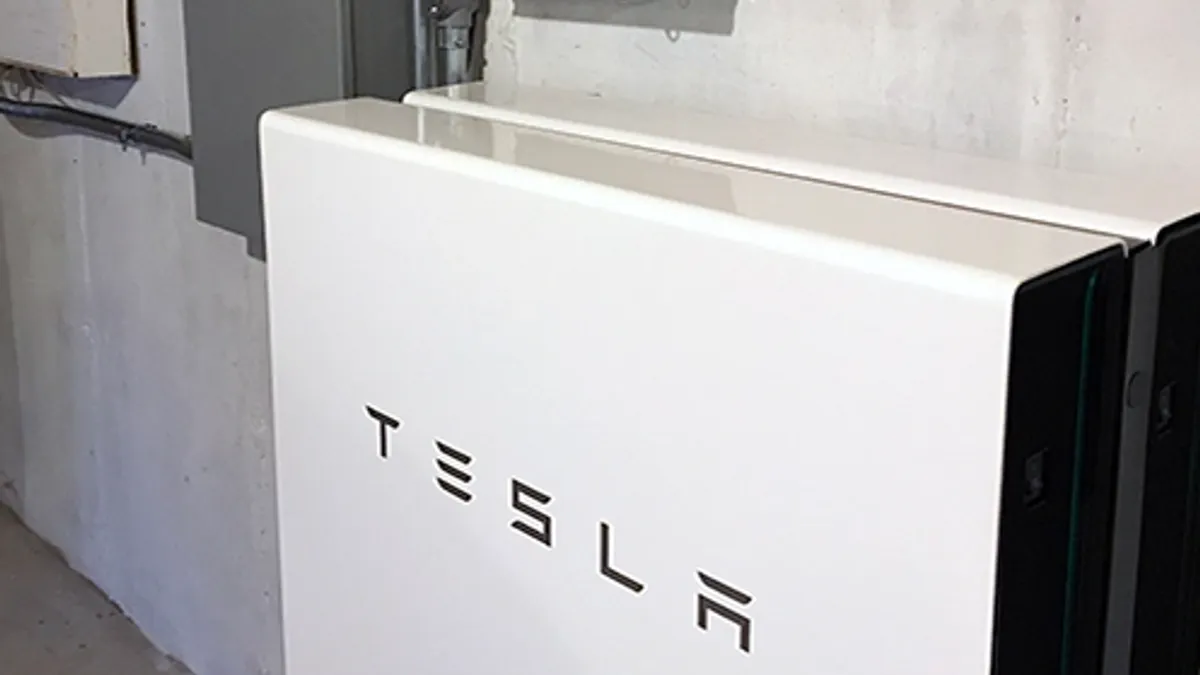
Stationary batteries added a cleaner, fuel-free choice to the mix, but they can be even more expensive to purchase outright than diesel or natural gas generators, putting them out of reach for most middle-class homeowners. With import tariffs, country-of-origin restrictions and other factors putting upward pressure on component and module pricing for small battery systems, this dynamic seems unlikely to change soon.
Yet distributed battery adoption could still grow, propelled by retailers marketing home batteries for little or nothing up front and a monthly fee that in some electricity markets costs a little more than a top-tier Netflix or Hulu subscription. Company representatives and distributed energy experts tell Utility Dive the model works — at least for now — because small-scale batteries are uniquely positioned to deliver value to their hosts and to the distribution grids that serve them.
Texas: ground zero for battery subscriptions
Base Power, an Austin, Texas-based startup that began operations in 2023, markets itself as an energy choice retailer to millions of Texans, no battery required. It offers backup-only battery subscriptions to customers of Texas public power entities including Austin Energy and Guadalupe Valley Electric Cooperative, charging customers a one-time initial fee of a few hundred dollars — sometimes waived — to place an oversized battery that it owns and promises to operate and maintain for 10 years. Customers normally pay $19 to $29 per month for the service, but Base waives the fee for some, including Guadalupe Valley Electric Cooperative members.
To customers served by the Oncor and CenterPoint Energy transmission networks, Base Power offers a separate energy-plus-backup plan that bundles an up-front payment that ranges from about $700 to $1,000 for one or two 39.2-kWh batteries, a monthly subscription fee under $30, and an energy rate under 14 cents/kWh, according to its website. The plans lock in subscription and energy pricing for the first 36 months.
Palmetto, a North Carolina-based company that offers solar and backup battery plans in about two dozen states, has a similar retail product for eligible Texas customers.
The Palmetto plan is new enough that it doesn’t have an official name — “internally, we’re calling the program ‘Lonestar’ until we come up with a better name,” Jesse Brennan, Palmetto’s director of business development, battery and home electrification, said in an email — but customers can expect an “effective cost” of $25 to $50 a month after rebates, Brennan said. “Lonestar” joins other recent battery-enabled retail entrants into the Texas market including Terra Energy’s TerraOne product and the planned launch of Octopus Energy’s PowerStore.
Action in Illinois
These retail arrangements aren’t unique to Texas. Base Power offers an even less-expensive energy-plus-backup deal in the northern Illinois territory of Commonwealth Edison, which is in the westernmost PJM Interconnection load zone. The 24-month plan offers a $95 installation fee and on-peak energy for less than 8 cents per kWh. That’s at least 25% less than ComEd charges, it says.
Will Kenworthy, senior Midwest regulatory director for Vote Solar, said Base can likely offer such favorable pricing in Illinois, a retail choice state, because of a 2022 tariff change that allows load-serving entities to aggregate their customers’ capacity obligations, including those of customers with on-site batteries that may export power at demand peaks, to reduce the LSE’s total net load — potentially down to zero. (The California Independent System Operator has proposed a similar aggregation methodology in its territory.)
“So when an electric supplier is trying to figure out what it costs to serve their customers, they can shape those customer loads to make it cheaper to supply energy and, thus, make it cheaper for the customers themselves,” Kenworthy, who is not affiliated with Base Power, told Utility Dive in an interview.
“That business model is kind of amazing … the opportunity has been there for a number of years, and I’ve always wondered why competitive suppliers didn’t jump on it earlier,” he said.
In June, Illinois regulators approved ComEd’s proposal for a battery-based “scheduled dispatch virtual power plant” that Andrew Plenge, ComEd’s vice president of strategy and energy policy, said in a statement would strengthen the regional grid while “helping customers receive additional value for their support at a time when supply costs are rising.”
Kenworthy said the SDVPP could attract more battery-toting energy suppliers to Illinois.
“Attention is turning to this as a particularly powerful tool for not just helping customers manage their own energy requirements, but also providing value to the grid,” he said.
Justin Lopas, Base Power’s co-founder and chief operating officer, said in an email to Utility Dive that “market dynamics” led his company to choose Illinois for its first venture outside Texas. ComEd’s supply rates have increased about 50% in 18 months, due mainly to a capacity shortage in PJM, which sets the stage for distributed storage to alleviate grid strain while lowering customer bills, he said. Similar potential exists in energy choice markets across the region, he added.
“Illinois is our first state in the PJM region, but certainly not our last,” Lopas said.
Responding to grid constraints
Distribution-connected battery aggregations “could play a disproportionate role in terms of mitigating power price volatility” on transmission-constrained regional grids like PJM and the Electric Reliability Council of Texas, Kasim Khan, a senior research analyst in Wood Mackenize’s power and renewables practice, said in an email.
These aggregations are especially useful when there’s not enough transmission capacity connecting areas with abundant generation resources, like renewables-rich West Texas, to demand centers like the cities and industrial zones of Central and East Texas, Khan said.
Those constraints create incentives for utility-scale developers to deploy batteries closer to demand centers, but permitting and siting challenges sometimes get in the way, he added.
Distributed battery providers are also working to solve localized grid constraints.
Fresh off a 10-MW residential battery deployment in its home state, California-based Haven Energy expanded into New England last month with a targeted offer for National Grid and Eversource customers in four Massachusetts counties. Pricing varies by location, utility and whether the customer already has solar, but early customers in particularly constrained grid pockets may qualify for pricing similar to that in Base’s Texas plans: a one-time up-front fee of a few hundred dollars and an ongoing subscription fee of $29/month.
These customers are generally eligible for Massachusetts’ new ConnectedSolutions+ VPP, an effort to bring more managed electric vehicle charging, stationary batteries and other types of flexible capacity onto distribution feeders that are particularly constrained due to high peak demand or daytime solar saturation.
Haven Energy co-founder and CEO Vinnie Campo said Haven uses real-time pricing signals from distribution utilities to determine how to value the batteries it manages and develop accurate pricing for its customers, who make one monthly payment to Haven and another to their utility.
“The value of a battery to the grid can be fundamentally different even one mile apart,” Campo told Utility Dive in an interview.
While battery lease economics turn on multiple factors, including state-level net metering permitting and interconnection rules, pricing is generally lower in markets with well-developed VPP programs, Palmetto’s Brennan said.
“The short-term opportunity we're most focused on is markets where VPP program development is accelerating because that's where the value proposition is strongest for homeowners and where we can move quickly,” Brennan said. The most enticing prospects in those markets are homeowners with existing solar arrays, for whom a backup battery means a step change in resilience, he added.
“It’s a natural next step [that] helps them to ‘upgrade’ their solar and get the most out of their batteries, since they can charge up with their [photovoltaic system] during an outage,” Brennan said.