Dive Brief:
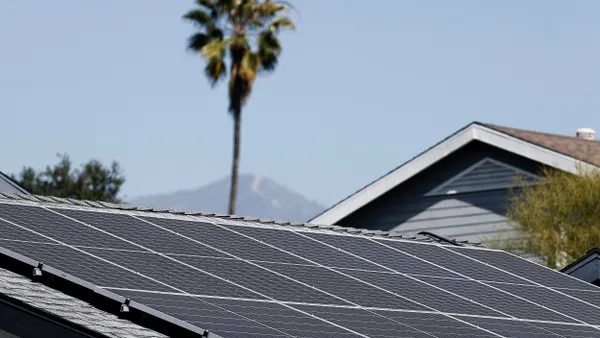
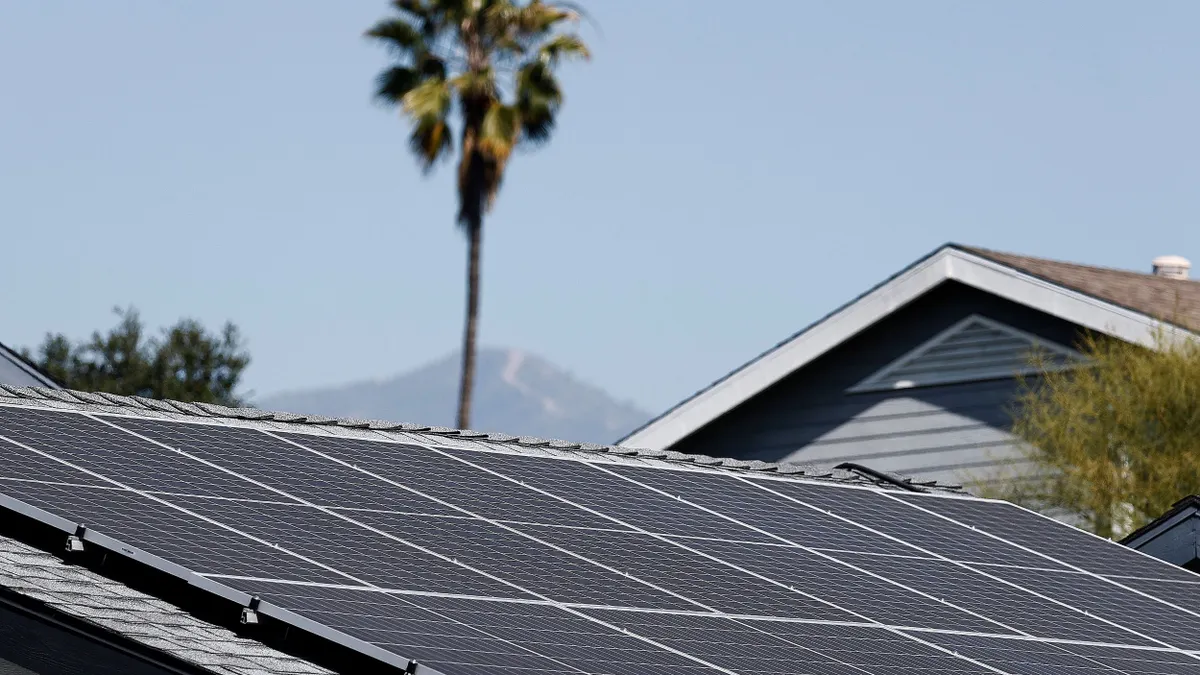
- More than 1 million customers now have solar energy systems connected to Pacific Gas and Electric’s grid — more than any other utility in the U.S., PG&E announced June 4.
- “As customer-sited solar scaled rapidly, PG&E's focus expanded beyond simply connecting these systems to also modernizing the grid for safe and reliable two-way power flows at an unprecedented scale,” the utility said in a release.
- PG&E has recently focused on virtual power plant deployment. In July it executed the largest-ever coordinated demand response test, with its VPP delivering 535 MW for two hours. In February, PG&E and Sunrun completed a hyperlocal VPP deployment, using the storage-plus-solar systems of Sunrun customers to “[export] energy to alleviate local grid constraints, with the goal of helping PG&E avoid or defer distribution upgrades,” Sunrun said.
Dive Insight:
PG&E has invested in “grid automation, advanced forecasting, streamlined interconnection, and the growing integration of solar paired with battery storage,” the company said in its release. “These efforts signal a broader industry shift: from a one‑way grid to an interactive system where customer energy resources are increasingly part of the solution,” it said.
PG&E customers have access to California rebates like the Self-Generation Incentive Program, which subsidizes the installation of residential storage or solar-plus-storage, as well as credit rates for solar generation under the state’s net metering program. California is the top state for residential solar in the U.S. and for overall solar capacity, according to the Solar Energy Industries Association.
Residential solar can also offer relief from the state’s high electric rates, and solar plus storage can provide backup power during public safety power shutoffs, which the state’s utilities deploy to mitigate the risk from wildfires and extreme weather events. PG&E has used PSPS 31 times in the past seven years, the utility said in an April report.
In a 2019 report, SEIA said that increasing consumer interest in residential solar, and solar-plus-storage, was particularly strong in California due in part to “dissatisfaction with California utilities.”
“This disaffection has a long history but most recently stems from Public Safety Power Shutoffs (PSPS) which have left hundreds of thousands of utility customers without electricity, often for days at a time,” SEIA said. “These developments have combined to renew a latent demand in solar and resiliency options in California.”
Surpassing 1 million solar interconnections “underscores a broader transformation underway in California's energy system: The grid of the future will be more distributed, more digital, and more participatory,” PG&E said. “And customer‑owned solar, especially when paired with storage and connected through virtual power plants, will play a central role in delivering clean, reliable energy at scale.”