The U.S. Department of Energy has issued Grid United a $2.8 billion conditional loan commitment to finance a 1.8-GW, high-voltage, direct current transmission line in Wyoming — the latest in a series of funding decisions that could add about 7 GW of transfer capacity between the Western and Eastern interconnections.
In 2021, the DOE said a collection of back-to-back converter stations enabled just 1,320 MW of electricity to flow between the two networks. Increasing transfer capacity could save money and boost grid reliability and resilience, it says.
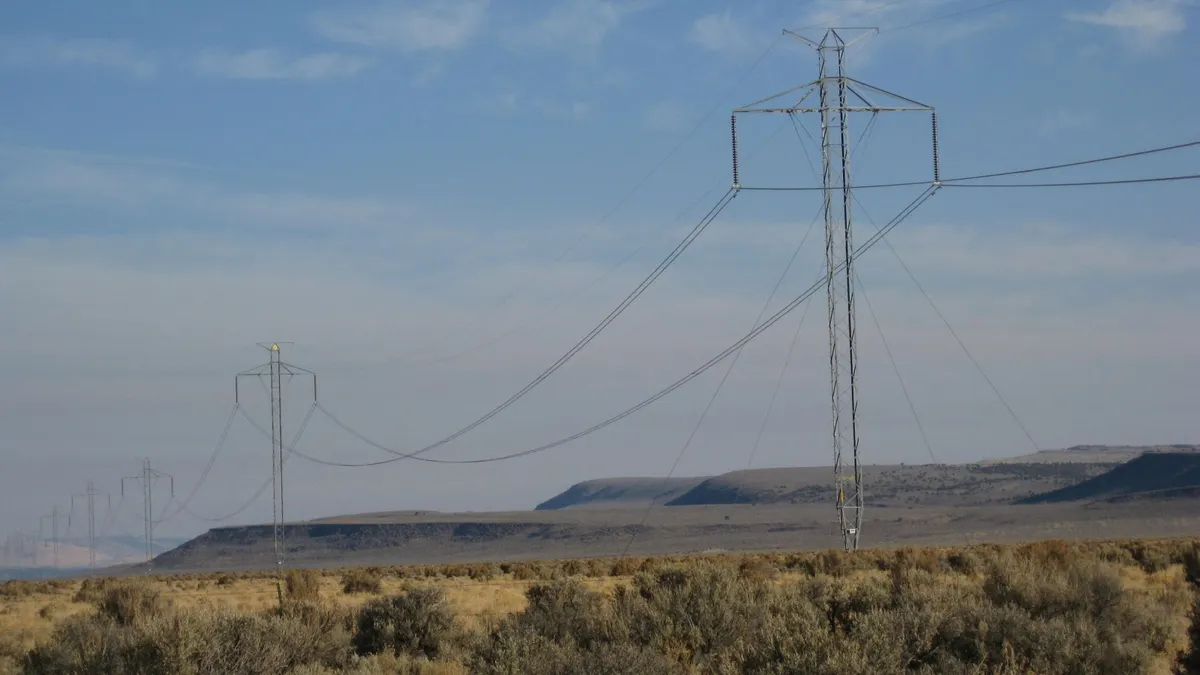
The Wyoming Intertie project would run about 106 miles between a converter station in Wyoming’s Platte County and an existing substation in Carbon County, linking the Southwest Power Pool and the Western Electricity Coordinating Council. The area around the project is rich in wind resources.
Also, that part of Wyoming “sits at the confluence of major grid expansion projects in WECC and SPP, which makes it a particularly advantageous location for a grid-to-grid connection,” Ashley Kang, a Grid United spokesperson, said in an email.
Grid United expects to complete the permitting for the project in 2029 and begin construction in 2030. The company plans to bring the project online in 2032 or 2033, depending on its procurement of needed HVDC equipment, according to a company fact sheet.
The Houston-based transmission company is developing three other projects that would also add lines between the Eastern and Western interconnections. They include the 3-GW North Plains Connector project between North Dakota and Montana; the 1.8-GW Three Corners Connector between Oklahoma and Colorado; and the 1.5-GW Pecos West project between SPP’s footprint in Texas and WECC in New Mexico.
In separate funding decisions, DOE has recently agreed to help finance the Three Corners and North Plains connector projects. Taken together, the department has agreed to help fund about 6.6 GW of East-West transmission infrastructure by Grid United.
DOE has also agreed to help fund a 490-MW expansion project between Colorado and Texas. The project, planned by Xcel Energy, could be expanded to a total of 2 GW.
The DOE's draft 2026 National Transmission Needs Study found that average price differentials along the seam between SPP's eastern footprint and the Western Interconnection ranged from $18/MWh to $33/MWh from 2012 to 2023.
The Wyoming Intertie project could produce $39 billion in cost savings for ratepayers, help meet growing demand and improve grid resilience during periods of high electric use and extreme weather, DOE said Tuesday. Closing conditions on the loan include Grid United obtaining full project right-of-way, contracts for capacity on the line, and federal, state and local permits.
The conditional, 30-year DOE loan would finance 80% of the project’s construction costs, reducing interest expenses by about $500 million compared with typical financing sources, according to Grid United.
The low-cost, federal loan can be assigned to utilities that may buy capacity on the transmission line, translating into savings for ratepayers, Grid United said.
Increasing transfer capacity between the Eastern and Western interconnections could reduce wholesale power costs, SPP said in August when its board approved a plan to study potential transmission additions between the regions.