Dominion Energy saw a 15% year-over-year rise in net income, including a $137 million increase associated with the rate increase its subsidiary Virginia utility received in 2025, the company announced during its Friday third-quarter earnings call.
Dominion Energy Virginia also saw a $55 million increase associated with weather, and a $112 million boost from rider equity returns.
Bob Blue, the company’s Chairman, President and CEO, said during the call that Dominion’s year-to-date operating earnings per share “benefited from better-than-budgeted sales, better-than-normal weather, and higher-than-expected 45Z credit income, combined with strong overall financial and operational execution.” 45Z is the Inflation Reduction Act’s technology-neutral clean fuel production tax credit.
Dominion installed 44 of 176 turbines at its Coastal Virginia Offshore Wind project, representing more than 640 MW of generating capacity out of CVOW’s total anticipated 2.6 GW of nameplate capacity, Blue said during the call. He noted that installation of the 45th turbine was happening “now,” and that turbine installation “continues to average approximately two days.”
CVOW is around 85% complete, according to Dominion’s presentation slides, and construction is still on track to conclude by the end of 2027. To date, project investment totals $10.1 billion with $1.5 billion remaining in project costs – $800 million of which will be funded by Dominion.
As state and federal regulators weigh NextEra Energy’s proposal to acquire Dominion, Blue said during the call that he is “looking forward” to the Virginia State Corporation Commission’s first evidentiary hearing on the merger, scheduled for Nov. 17th.
In response to an analyst’s question about the 57 conditions that SCC staff proposed Dominion and NextEra commit to before the commission approve the merger, Blue said, “a chunk of them are conditions that we had already voluntarily proposed, so I think it's important to keep that in mind.”
“But fundamentally, as you heard from [CEO John Ketchum] on NextEra's call a week or so ago, we're still focused on the statutory standard, which is ‘no harm’,” he added. “That's what the judges are going to follow.” Dominion’s rebuttal to staff and respondent testimony is due Monday.
In response to another analyst question about the proposed merger conditions, Blue declined to go into detail, but said, “We're going to continue to present what we think is a very strong package through that regulatory process.”
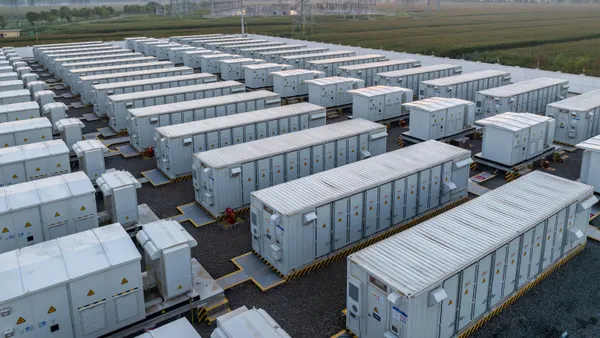
Blue said that the company expects energy storage to “play an increasingly important role as use cases continue to broaden and the technology continues to advance,” and Dominion is “actively evaluating both short-duration battery storage and emerging long-duration technologies.”
“Looking longer term, the proposed combination with NextEra Energy would bring together significant capabilities and experience in energy storage,” he said.
The company’s third-quarter net income rose 15% from $1 billion in 2025 to $1.16 billion this year, according to an earnings release. Dominion also took a $719 million impairment charge associated with its nonregulated renewable natural gas facilities.
Of the 54.9 GW of data center capacity that Dominion has in “various stages of contracting,” over 12 GW of capacity [is] contracted under electric service agreements,” Dominion Chief Financial Officer and Executive Vice President Steven Ridge said during the call. “To put that in context, we have added over 6 GW of contracts, or 13%, since the end of last year. In conclusion, I am highly confident in our ability to deliver on our financial plan.”
In its earnings announcement, Dominion noted that risks and uncertainties are associated with “increased energy demand or significant accelerated growth in demand due to new data centers, including the concentration of data centers primarily in Loudoun County, Va., and the ability to obtain regulatory approvals, environmental and other permits to construct new facilities in a timely manner.”
During the call, though, Ridge said the company continues to see “robust and durable demand from our differentiated, high-quality, low-risk data center customers across multiple localities in Virginia.”