Dive Brief:
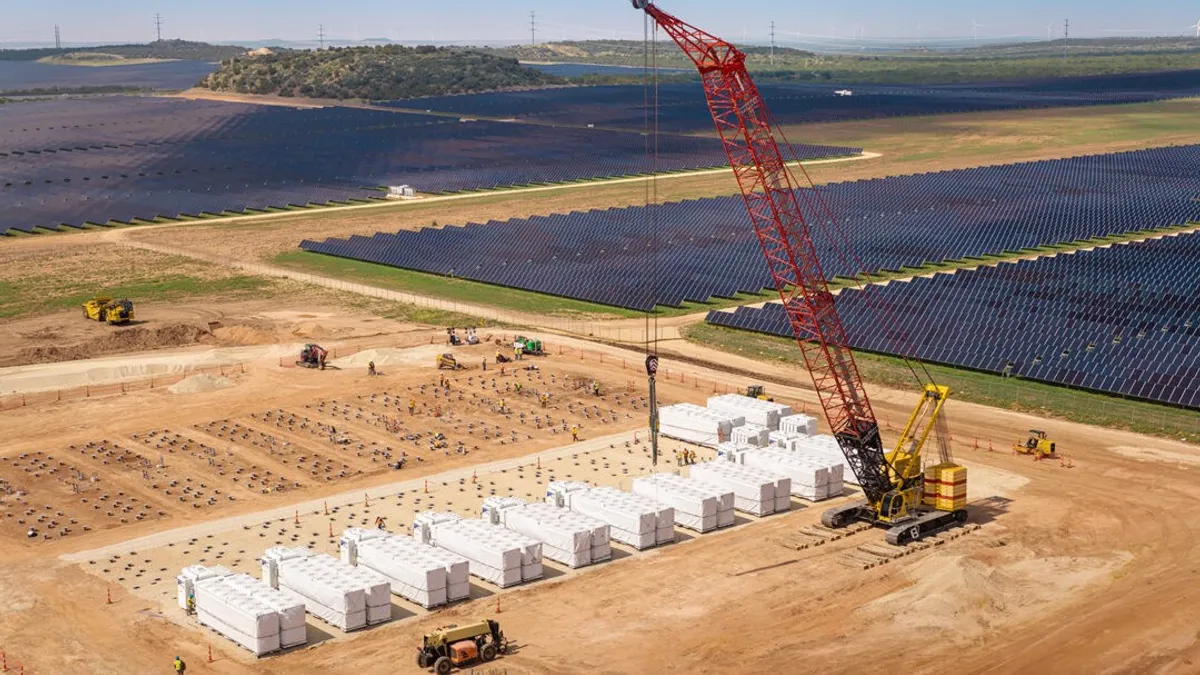
- Front-of-meter solar and storage could serve approximately 17.5 GW of summer peak load on the distribution substations owned by California’s three large investor-owned utilities, according to an August study commissioned by the Coalition for Community Solar Access and conducted by Kevala, a grid analytics firm.
- Those assets could offset about 32% of load between 4 p.m. and 9 p.m. from June through September, when California typically sees its highest net power demand for the year, Kevala said.
- Clean energy advocates said the analysis shows a path for Pacific Gas & Electric Company, San Diego Gas & Electric Company and Southern California Edison to improve reliability and preserve affordability for ratepayers without making significant upgrades to California’s transmission system.
Dive Insight:
Kevala found that distribution substations owned by PG&E, SCE and SDG&E could comfortably support 3,112, 5-MW solar-and-storage installations serving 15,560 MW of local load. Systems sized below 5 MW could serve an additional 1,976 MW of local load, it found.
SCE’s system saw the greatest numeric impact with 1,657 5-MW installations serving 9,188 MW of non-coincident summer peak load, or 37% of the expected summer peak in the California Energy Commission’s “mid-case” 2025 forecast for the 2032 season, according to the assessment.
The proportional impact was greatest on SDG&E’s comparatively small distribution system, where Kevala said 326 5-MW installations could meet 1,788 MW of non-coincident summer peak load — 39% of the CEC’s “mid-case” forecast for 2032.
For PG&E, the largest electric utility in the state, 1,129 5-MW installations could meet 6,560 MW of non-coincident summer peak load, or 26% of the CEC’s 2032 projection.
Paul Doherty, a PG&E spokesperson, said Kevala’s findings are consistent with the utility’s view that distributed energy resources will play an important role in California’s future energy mix.
“PG&E's recent planning and research efforts have similarly found significant opportunities to better leverage customer-owned energy resources and flexible electric demand to improve grid utilization, support reliability and help manage costs,” he said, pointing to recent initiatives like its SAVE virtual power plant and the just-announced SHARE VPP funded by Google.
Kevala cautioned, however, that its analysis was not intended as a development forecast, but rather as “an estimate of the technical potential of the amount of distribution-connected load that can be supplied by front-of-the-meter systems without back-feeding onto the transmission system.” Such a forecast would need to assess other constraints, such as land availability, it said.
Stephanie Doyle, California state affairs director for the Solar Energy Industries Association, said Kevala’s analysis was nevertheless a road map for the state’s investor-owned utilities to reduce stress on the “strained” transmission grid.
“This report shows that front-of-the-meter distributed solar and storage can deliver power where and when California needs it most,” Doyle said in a statement.
California’s three investor-owned utilities are embarking on ambitious capital spending plans to harden their grids against wildfire risk and integrate more clean energy at the transmission level as California advances toward a 2045 goal to zero out its greenhouse gas emissions.
PG&E and SCE alone expect to spend more than $110 billion over the next five years, the companies told investors this year.
That planned spending could become more expensive if uncertainty around wildfire risk results in credit downgrades for the utilities — costs that would then pass through to ratepayers, Pedro Pizarro, president and CEO of SCE parent company Edison International, said last month.
PG&E said earlier this month that it would defer $2 billion in spending planned for next year after the California legislature missed a key deadline to advance a wildfire liability cost-sharing bill.
PG&E and its peers can meet rising peak load from electrified transportation, advanced manufacturing, data centers and other sources of demand by boosting the availability of dispatchable distributed energy resources on summer evenings, Kevala found. These resources, such as community solar arrays paired with storage, can reduce the amount of incremental generation needed on the bulk grid, it said.
Kevala’s analysis assumed that front-of-meter batteries would be able to fully charge from a mix of colocated solar and from the grid during off-peak periods, and that host substations would be configured to redirect backflow to other feeders rather than to higher-voltage lines.
“These findings indicate that a substantial share of California’s energy demand during the most expensive hours of the year could be met directly by locally sited front-of-the-meter distributed resources,” Pete Skala, Kevala’s vice president of professional and advisory services, said in a statement.
Kevala’s work built on a separate study by Aurora Energy Research last year that found front-of-meter solar-plus-storage resources dispatching during the evening peak window would reduce reliance on electricity imports and in-state gas-fired peaker plants, James McGarry, an independent contractor who serves as CCSA’s California market lead, said in an email.
Aurora found 5.4 GW of community-scale solar and storage resources could reduce California’s power system costs by 0.6%, or about $6.5 billion, over 20 years.
CCSA would like to see the CEC and the California Public Utilities Commission work in tandem to study the load-modifying impacts of front-of-meter DERs, identify the attributes that maximize their grid value and revise state planning and procurement programs to recognize those benefits, McGarry said.
Both houses of the California legislature have passed a bill that would require the CPUC to develop a community solar-and-storage program that would compensate assets at avoided cost of generation. The bill awaits the signature of outgoing California Gov. Gavin Newsom, D.
“State policymakers have an opportunity to close the gap between the grid value that [front-of-meter] distributed energy resources can provide and how they are currently valued in state planning and procurement frameworks,” McGarry said.