Industrial customers provided much of the lift for Consumers Energy’s electric business as weather-normalized electricity sales in the segment rose 5.9% year over year, according to the company’s first-quarter 2026 earnings presentation.
The company expects new and existing large loads to support sustained annual sales growth of 2% to 3% into next decade, it said Tuesday.
Consumers Energy is a vertically integrated utility serving about 1.9 million electric customers and 1.8 million gas customers across lower Michigan. Its electric side has about 9.2 GW of generation and energy storage capacity.
CMS Energy, Consumers’s parent company, also owns NorthStar Clean Energy, an independent power developer and producer with more than 600 MW of operating wind, solar and biomass projects in six states, and thermal assets including a 770-MW gas- and waste-fired cogeneration plant in southeast Michigan.
Costs of complying with DOE emergency orders rises
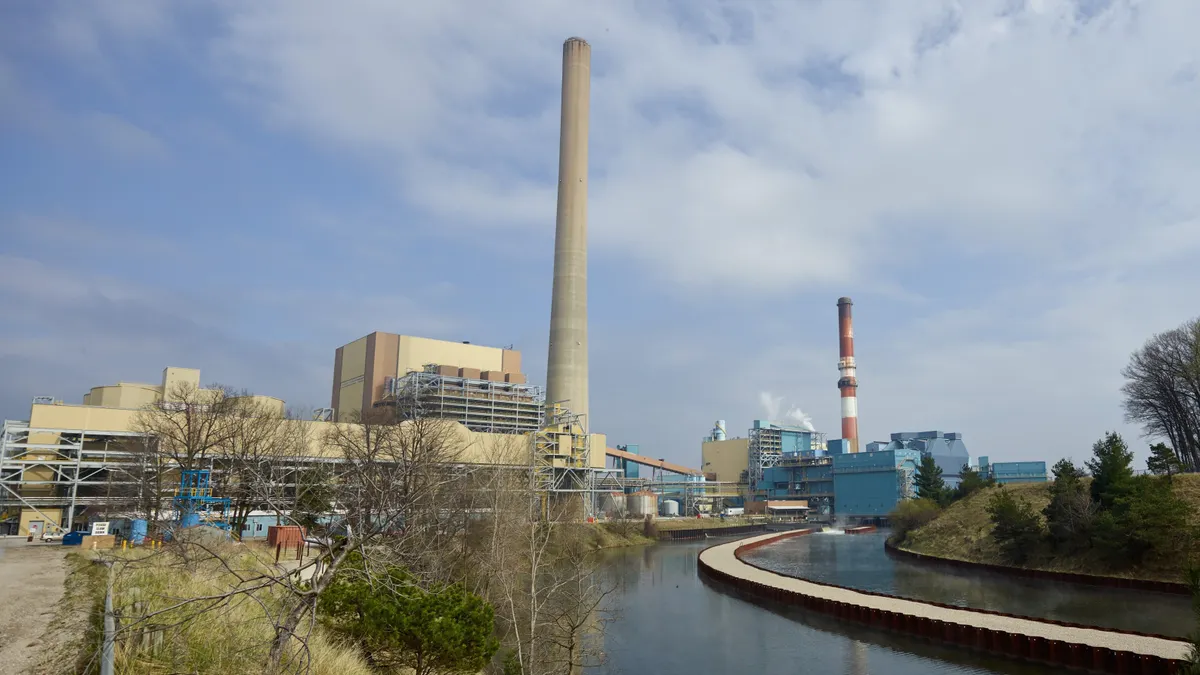
In a 10-Q filing with the Securities and Exchange Commission, CMS updated financial regulators on the impact of U.S. Department of Energy emergency orders directing it to continue running the J.H. Campbell generating station, a 1.6-GW coal-fired power plant the utility had planned to retire in May 2025.
In January, Consumers filed a request with the Federal Energy Regulatory Commission to recover the net financial impact of complying with a May 2025 emergency order to continue running the plant – which was $42 million after applying Midcontinent Independent System Operator revenues of $78 million. FERC approval of this filing, which encompasses recovery sought by the joint owners of J.H. Campbell, remains pending, CMS said.
For the second emergency order period through March 31, 2026, the net financial impact of compliance was $138 million after applying MISO revenues of $143 million.
CMS said it plans to seek recovery of these compliance costs at a later date, consistent with rate recovery sought for the May 2025 emergency order. “The ultimate financial impact remains subject to the outcome of the FERC proceeding and any future guidance or interpretation,” the company said.
Questions about ‘constructive’ regulatory outcomes
As it has in previous earnings presentations, Consumers Energy hailed a Michigan regulatory process that “yields constructive outcomes” for its electric business. The Michigan Public Service Commission approved 66% of the initial ask in its 2026 electric rate case, a higher ratio than the three prior rate cases.
“I continue to be pleased with our regulatory outcomes,” Consumers President and CEO Garrick Rochow said, touting the utility’s 9.9% approved return on equity.
“These outcomes reflect deliberate, customer-focused investments,” such as a comprehensive tree-trimming strategy, “that materially improve the reliability and resiliency of the electric grid,” he added.
Rochow emphasized affordability, saying Consumers is “sharply focused on continuing to bring down costs for customers.” Its electric and gas customers can expect annual rate increases around 3% for the rest of the decade, less than half the projected national average of 7.5%, the company said in a March investor presentation.
But at least one stock analyst on Tuesday’s call raised concerns about Consumers’ regulatory strategy following an announcement by DTE Energy that the Detroit-based utility would “pause future electric rate requests” for at least two years following a rate hike filed this week.
Rochow said he had not reviewed DTE’s proposal in detail — “just what I’ve seen reported in media” — but defended his company’s approach to what he described as a significant capital investment cycle.
“We are investing in a significant amount of capacity,” including a long-range plan for 13 GW of renewables and 1.5 GW of gas-fired generation to replace existing peaker plants, he said.
“These aren’t just Excel exercises — this is stuff that’s underway,” he said.
Continued large-load progress with emphasis on affordability
In 2025, Consumers Energy connected new industrial loads that will draw about 450 MW at full ramp-up and “signed” about 110 MW in the first quarter of 2026, according to its earnings presentation.
The biggest new contract this quarter came from a planned $1.2 billion fertilizer mine and processing plant in north-central lower Michigan. Michigan Potash & Salt Co. expects to open the facility in mid-2028, according to trade media reports.
Several smaller industrial expansions added to the Q1 contracting total, Rochow said.
The utility also expects new and expanded industrial loads plus large-scale data centers, including an AI training facility the utility is pursuing with Microsoft near Grand Rapids, to drive multiple years of sustained sales growth.
Rochow said a data center customer announced in the second quarter of 2025 “continues to close in” on final contracting and a second data center customer is progressing through contract negotiations. Those are among the most advanced prospects in a roughly 9-GW pipeline of “more qualified” large loads, he said.
Rochow downplayed an analyst question about public pushback on the Microsoft data center near Grand Rapids.
Overlapping local government units make for multi-step zoning and permitting approvals in Michigan, he said, but expressed confidence the project would progress to completion.
“Good things come to those who wait,” Rochow said. “They’re doing good due diligence. They’re elected officials; they’re doing the right thing.”
In its earnings presentation, company officials said large-load additions would have a positive impact on customer affordability. They said that each gigawatt of new load reduces the average customer bill’s five-year annual rate growth by 2%.
“This growth allows us to spread fixed costs over a larger customer base and improve affordability for all customers,” Rochow said.