Dive Brief:
- A bipartisan permitting reform bill introduced in the U.S. Senate on Wednesday would, in most cases, prevent the revocation or suspension of previously issued federal permits for energy projects, and strengthen the Federal Energy Regulatory Commission’s siting authority for transmission.
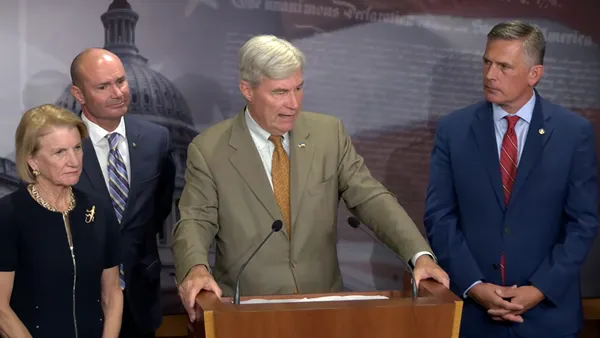
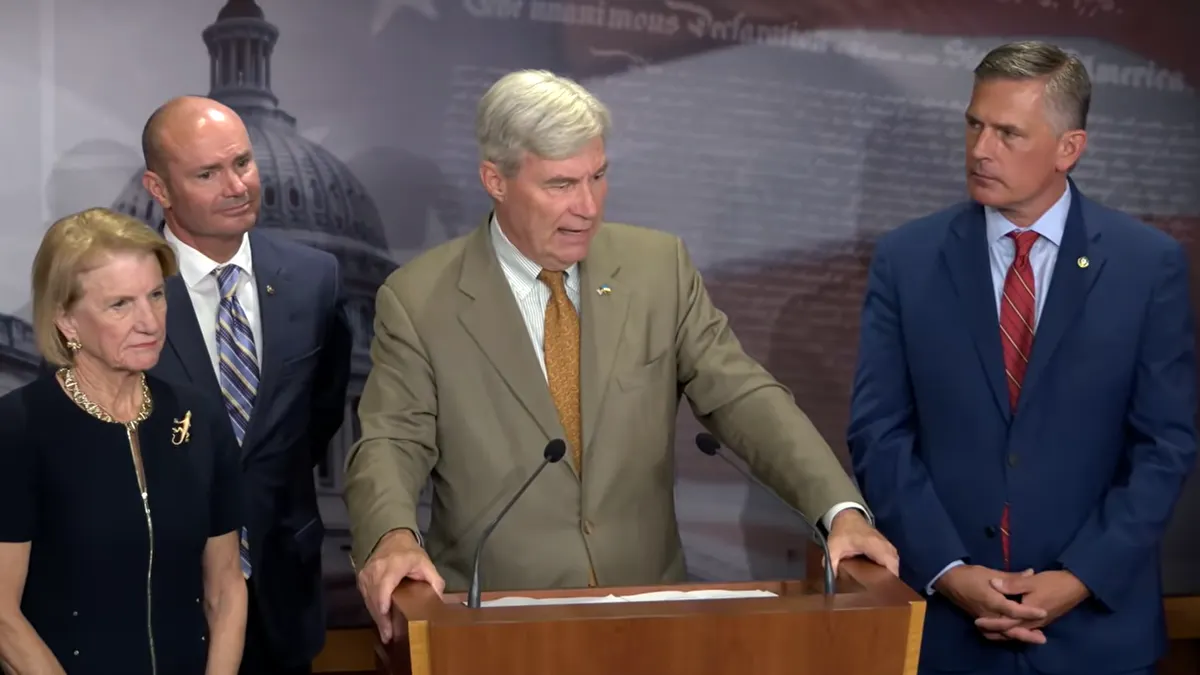
- “Right now we are hearing a lot of enthusiasm about the bill from industry, and we are optimistic this bill can pass the Senate sometime after the November elections,” Advanced Energy United spokesperson Adam Winer told Utility Dive in an email. At a Wednesday press conference, Sen. Sheldon Whitehouse, D-R.I., said that amendments to the bill will be considered when the Senate reconvenes in November.
- Permitting reform talks in Congress stalled in December after President Donald Trump issued stop work orders against five offshore wind projects, but a deal was reached in recent weeks after Trump told Democratic lawmakers that wind and solar energy projects would be given better treatment in the bill, according to reporting from Reuters. The bill creates a right for projects to sue over a pattern of “disparate” federal treatment based on project type.
Dive Insight:
Along with Whitehouse, the Bipartisan American Affordability and Jobs Act is sponsored by Sen. Martin Heinrich, D-N.M., Sen. Mike Lee, R-Utah, and Sen. Shelley Moore Capito, R-W.Va. It builds on the provisions included in the Energy Permitting Reform Act of 2024 and the Standardizing Permitting and Expediting Economic Development Act of 2025, both of which stalled out in Congress.
The new legislation aims to ensure that “all Federal agencies shall treat all applications for Federal authorizations or permits fairly and efficiently,” and provides for applicants to sue the government if permits are improperly denied or unreasonably delayed due to disparate treatment based on the type of project.
Whitehouse said the question of “returning to regular order for wind and solar projects in the Trump administration” is “still outstanding” and unresolved. “But we have had what I would consider to be a very reasonable opening proposal from the Trump administration,” he said. “We need more clarity on that.”
The Rhode Island senator said he anticipates that in parallel with the amendment work, there will be negotiations to resolve disputes around the administration’s obstruction of renewable energy permits. Whitehouse said that the legislators’ previous negotiations with the administration were “not outside the bounds of ordinary legislative disagreement,” and the initial proposal that members of the administration made was a signal they want to “land this in good faith.”
Whitehouse and Heinrich had in December issued a joint statement saying that permitting reform efforts were “dead in the water” due to “illegal attacks on fully permitted renewable energy projects” after Trump moved to halt work on five offshore wind projects.
Courts eventually ruled against the administration on all five projects, clearing the way for work to resume. In April, U.S. District Judge Denise Casper of the District of Massachusetts granted a preliminary injunction filed by several clean energy organizations which sought relief relief from federal decisions to pause permitting or establish additional levels of review for solar and wind projects.
Increasing federal power over transmission
In addition to provisions aimed at ensuring resource-neutral permitting, the legislation strengthens FERC by eliminating National Interest Electric Transmission Corridors and expanding the commission’s siting authority to “issue one or more permits for the construction or modification of electric transmission facilities,” project-by-project, based on circumstances such as the proposed construction being consistent with the public interest.
“If Congress wanted to expand and de-congest the nation's transmission grid, these permitting bill policies are the changes that can get that done,” said Rob Gramlich, Grid Strategies’ founder and president, in a Wednesday LinkedIn post about the legislation. “The transmission title as well as the impact of the other sections on transmission development are very well-crafted.”
The legislation eliminates the federal right of first refusal for incumbent utilities, stripping their automatic right to build new regional lines, and requires FERC to issue a rule requiring “each transmission planning region to file a consolidated interconnection and regional transmission planning process,” similar to the process that FERC approved for the Southwest Power Pool in March.
“This is what stakeholders have been working on — permitting and transmission reform — for the last several Congresses,” said Devin Hartman, president of the Lighthouse Energy Institute, a think tank, in an interview with Utility Dive.
Hartman noted that the bill will likely undergo changes during the legislative process.
“There's a ton to work with with these bones that would be having major effects on driving speed to power and living up to the billing on energy affordability,” he said. “You could see the trajectory of the energy sector take a significant shift potentially, depending on how some of the final language works out here.”
The bill states that transmission costs should be fully assigned to the owners and operators of computational loads, or data centers, “so as to minimize or avoid the cost burden on other customers.” Specifically for loads equal to or exceeding 20 MW, the legislation mandates exit charges and bars the load’s incremental costs from being recovered from any other customer.
Hartman noted that the bill reduces the authority states have under the Clean Water Act’s section 401 to block gas pipeline applications, which he said could have implications for gas-constrained regions like the Northeast.
Ethan Howland contributed to this story.